AI Agent Platform: What These Tools Actually Provide

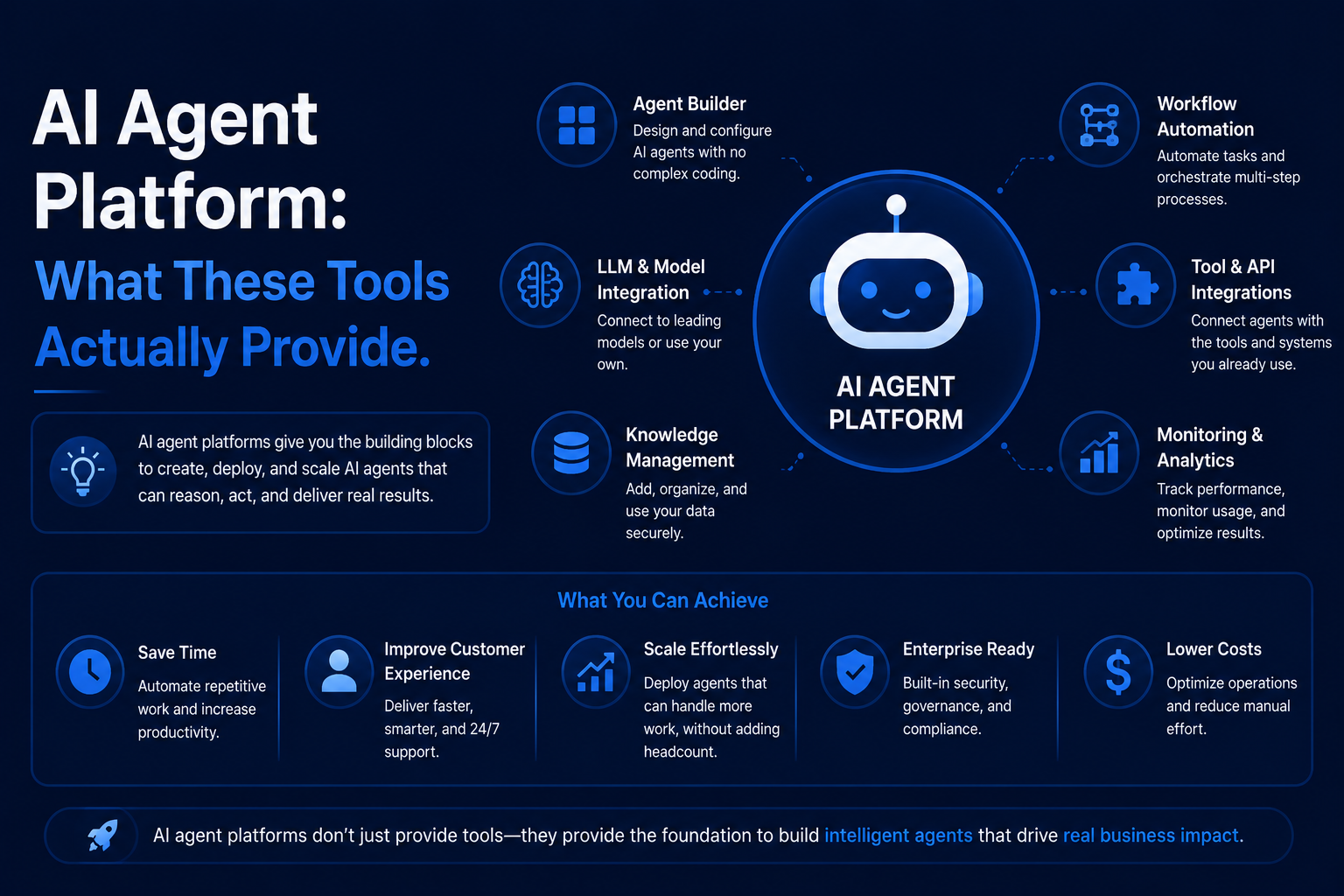
AI agent platforms provide developers and companies with a platform for designing, deploying, and managing AI agents without having to develop each individual piece from the ground up. With the rising popularity of using agents, this market has rapidly developed and being able to know what an AI platform really offers makes selecting one easier.
What an AI Agent Platform Typically Includes
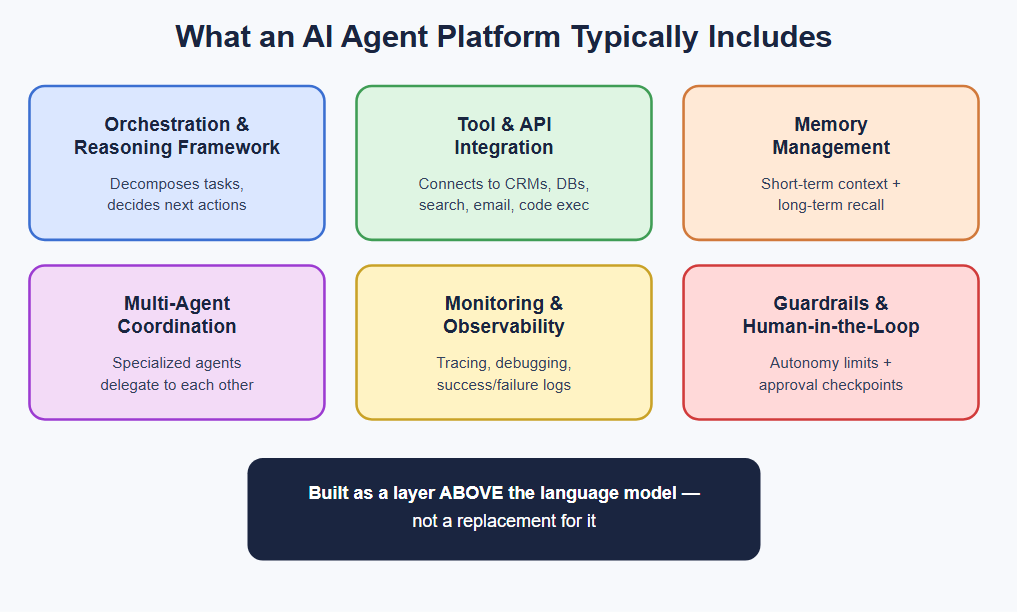
Orchestration and Reasoning Framework
This logic layer allows the agent to decompose a task into smaller components, make decisions about its next actions based on the outcomes of those actions, and deal with multistep workflows, usually built as a layer above a language model and not as a replacement for it.
Tool and API Integration
Pre-existing integrations to various external services, databases, CRMs, searching, executing code, sending email, allowing an agent to actually perform actions rather than just generating descriptions of what it should do.
Memory Management
Management of short-term context associated with a particular task, as well as long-term memory (where available), which allows an agent to use its past conversations as a foundation and not have to start from scratch each time.
Multi-Agent Coordination
Some platforms provide a way to construct multi-agent systems out of individual specialized agents who can delegate tasks to one another.
Monitoring and Observability
Tracing system that traces what exactly an agent did while performing a certain task, the actions it performed, the APIs it called, where it failed and where it succeeded, essential for debugging and establishing trust in agent’s behavior prior to any widespread use.
Guardrails and Human-in-the-Loop Controls
Configuration for setting the limits of autonomous operation of an agent and the actions requiring human permission, together with safety constraints to avoid any unwanted actions.
Categories of AI Agent Platforms
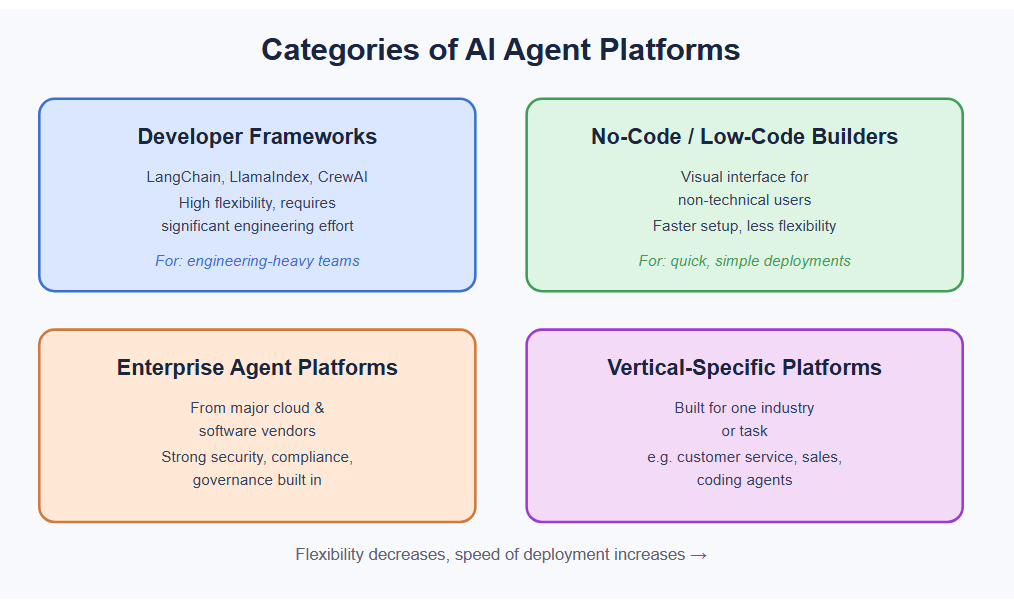
Developer Frameworks
Open-source or lower-level frameworks (such as LangChain, LlamaIndex, or CrewAI), which provide engineers with building blocks for creating customized agents and allowing high levels of flexibility, usually with considerable effort put into the construction of production agents.
No-Code/Low-Code Agent Builders
Tools for people who are not particularly technical, for creating and deploying agents using the visual interface, sacrificing some flexibility for faster creation and lower technical overhead.
Enterprise Agent Platforms
Comprehensive platforms (from leading cloud computing providers and enterprise software vendors) targeting bigger enterprises with the need for robust security and compliance and integration with their existing infrastructure, often offering better governance and monitoring tools compared to developer frameworks.
Vertical-Specific Platforms
Platforms targeted specifically towards an industry, particular task, or function, such as customer service agents, sales agents, coding agents, and so on.
Choosing an AI Agent Platform
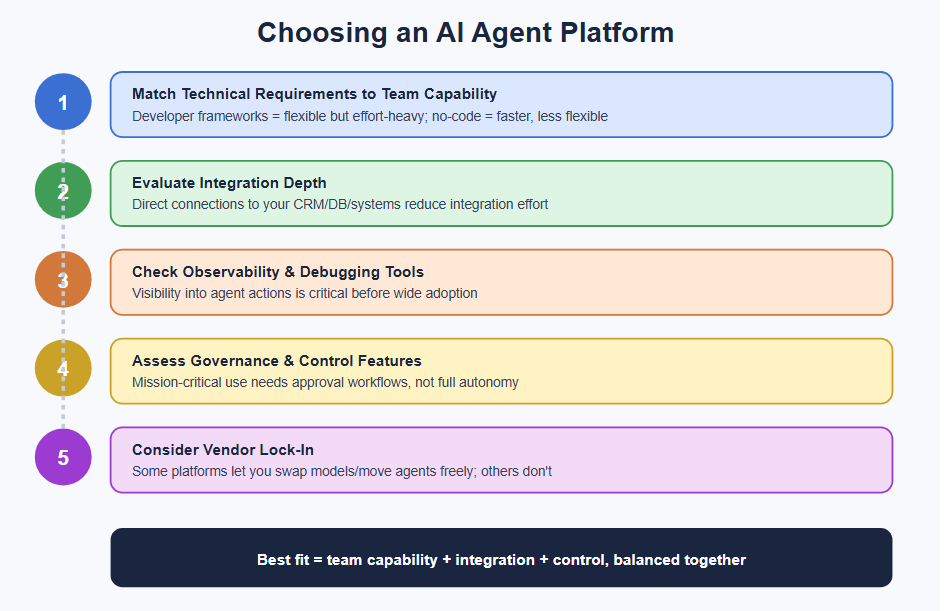
1. Match Technical Requirements to Your Team’s Capability
Developer frameworks provide greater flexibility but take actual engineering effort; while no-code tools sacrifice some features for faster development with reduced technical complexity..
2. Evaluate Integration Depth With Your Existing Systems
A solution that is able to connect directly to your particular CRM, database, or business systems reduces considerable integration effort.
3. Check Observability and Debugging Tools
Taking into consideration the variety of failures that agents can have, having a high degree of visibility into what an agent did during the process is very important before its adoption and utilization.
4. Assess Governance and Control Features
If the case is about mission-critical use cases, make sure that the system allows proper workflow for approvals rather than full autonomy.
5. Consider Vendor Lock-In
Some of the platforms allow users to easily replace models or move agents to another location while other platforms lock users to particular ecosystems.
Common Mistakes When Choosing an AI Agent Platform
- Selecting a very flexible developer framework when the team is not capable of building and maintaining the production agent
- Underestimating the significance of monitoring and observability until the agent breaks down in production with no way to understand why
- Over-reaching in scope of initial deployments, trying to create a fully autonomous, unrestricted agent without having reliability on more limited tasks
- Failing to consider integration needs up front, causing unexpected and expensive customization later on
Bottom Line
AI Agent Platform enables the required orchestration, tools integration, memory, and monitoring capabilities that help develop and deploy the agents without having to start from scratch. The choice of an appropriate platform will depend on several factors including the technical capabilities of your team, the requirements for integration and the balance between control and flexibility.