Custom AI Agents: When Off-the-Shelf Isn’t Enough

The custom AI agent is developed especially for the business process in use by the company, instead of purchasing the pre-developed generic agent. This is when developing the custom AI agent makes more sense and how it is really done.
Custom vs. Off-the-Shelf Agents
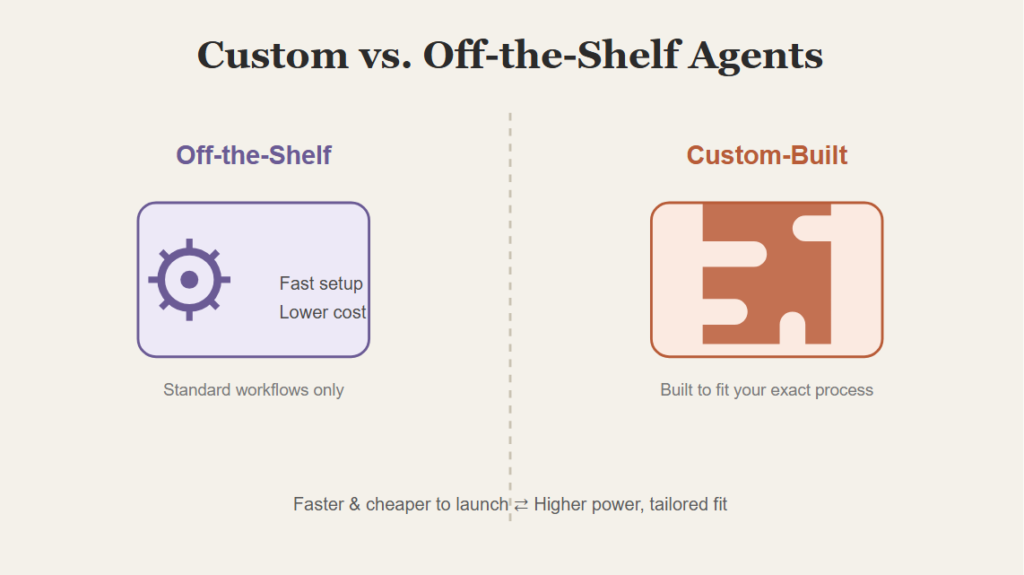
Commercial off-the-shelf AI agent tools are created to be fairly effective for a wide range of companies within their respective categories as well as a standard customer service agent or a standard sales agent. While it is quicker and cheaper to implement, it usually means you have to adapt your process in order to suit the tool’s expectations.
On the other hand, customized AI agents would be specifically tailored to your company’s processes, giving it more power, but taking a lot more time and money to develop initially.
When Custom Development Makes Sense
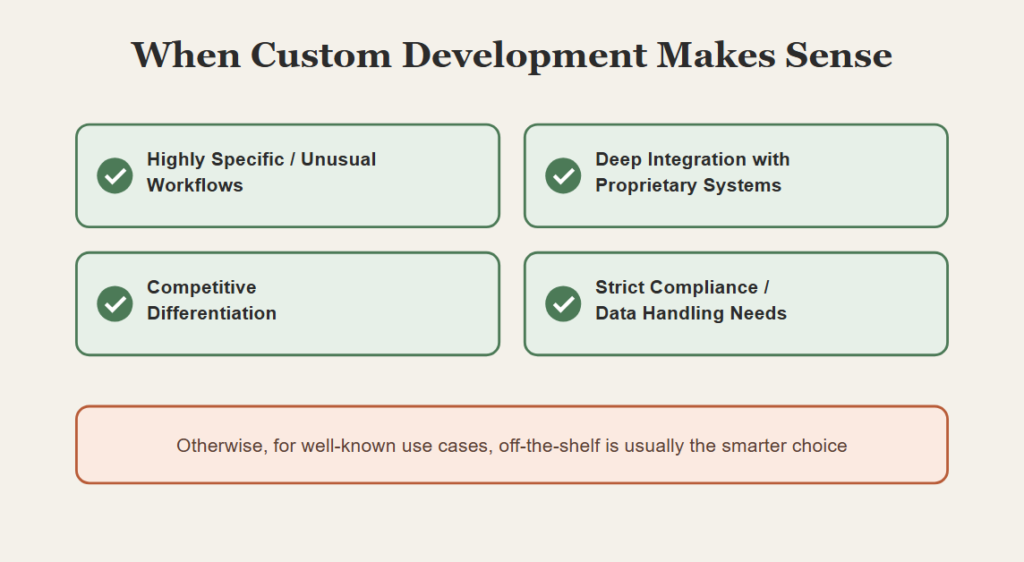
Highly Specific or Unusual Workflows
If your process cannot be easily modeled by the way agent products have been designed for use, using a generic tool will almost certainly yield a poorer solution than developing a customized solution for your specific process.
Deep Integration with Proprietary Systems
Companies that have large amounts of custom software, older legacy systems, or nonstandard data structures will probably discover that a generic off-the-shelf solution will not work well enough even with customization.
Competitive Differentiation
Companies that rely on an agent being part of the product or a competitive advantage themselves can develop an agent that would not otherwise be possible with a generic tool available to all competitors.
Strict Compliance or Data Handling Requirements
In some highly regulated sectors, there is a requirement for agent actions, information handling, and auditing that exceeds the basic functionalities available in an all-inclusive product.
When Off-the-Shelf Makes More Sense Instead
For widely known use cases where generic support and sales approaches, along with standard scheduling, are sufficient, custom development would be redundant because generic products are likely to have iterated on solutions to those issues long ago, with their numerous clients.
What Building a Custom AI Agent Actually Involves
Scoping and Feasibility
Defining precisely what actions the agent will perform, what decisions it will take on its own and what decisions need human intervention, and an honest evaluation of how reliable this process is to be automated at present.
Architecture Design
Choosing the type of reasoning used by the agent, the memory requirements, and what resources and tools are required by it to accomplish the job, designing a substantially different approach when dealing with a narrow agent rather than a multistep or multi-agent application.
Integration Development
Designing the connection of the agent with your business processes, applications, databases, and other tools is normally the most time-consuming stage in creating a custom agent.
Testing and Evaluation
The extensive testing under realistic conditions before implementation since customized agents have not been tested extensively as mature software applications have.
Deployment and Monitoring Infrastructure
Development of the systems required to monitor the performance of the agent as well as fix any errors that may occur because the custom agent will require active maintenance.
Build vs. Buy vs. Hybrid Approaches
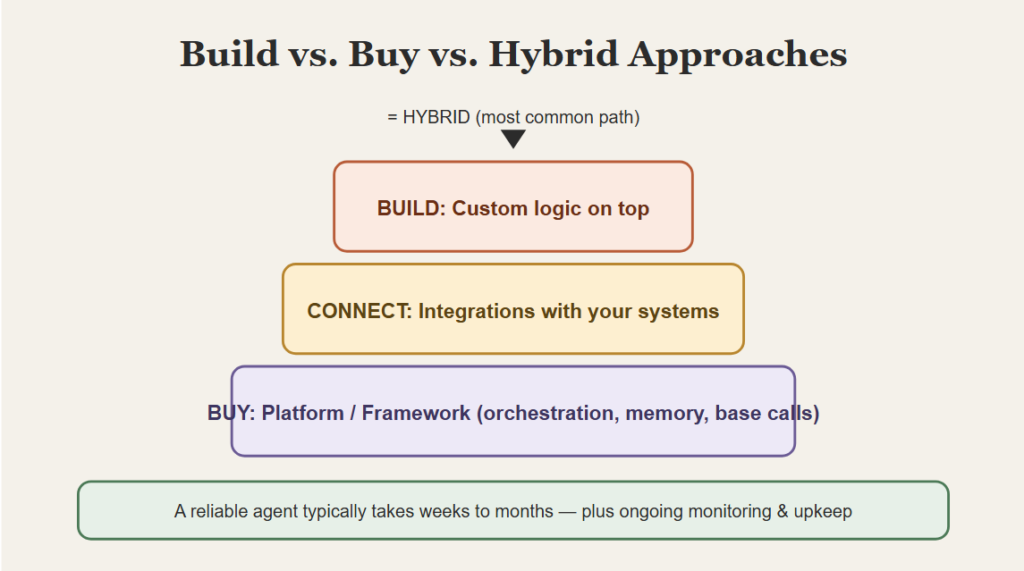
Most organizations end up taking a combination route, where they use the out-of-the-box platform for the agent or use a framework as the base layer (dealing with things like orchestration, memory management, and basic calls), and then develop their own custom solution on top of that platform or framework.
Realistic Cost and Timeline Expectations
There is a huge variability when it comes to how long custom AI agents take to develop, depending on their complexity; however, a truly reliable custom agent for performing a useful task takes weeks or even months rather than days, especially when considering integration and evaluation. The need for ongoing monitoring and maintenance should also be accounted for, because the behavior of the agent will change as its underlying models evolve.
Bottom Line
When customization truly makes sense in terms of your processes, system, and competitive advantage, then a custom AI agent is the best way to go. However, when dealing with situations where customization is not necessary because the situation is fairly typical and well-known, you may be able to save money and time by going with an off-the-shelf solution.