AI Agents for Sales: Where They Actually Add Value in the Pipeline

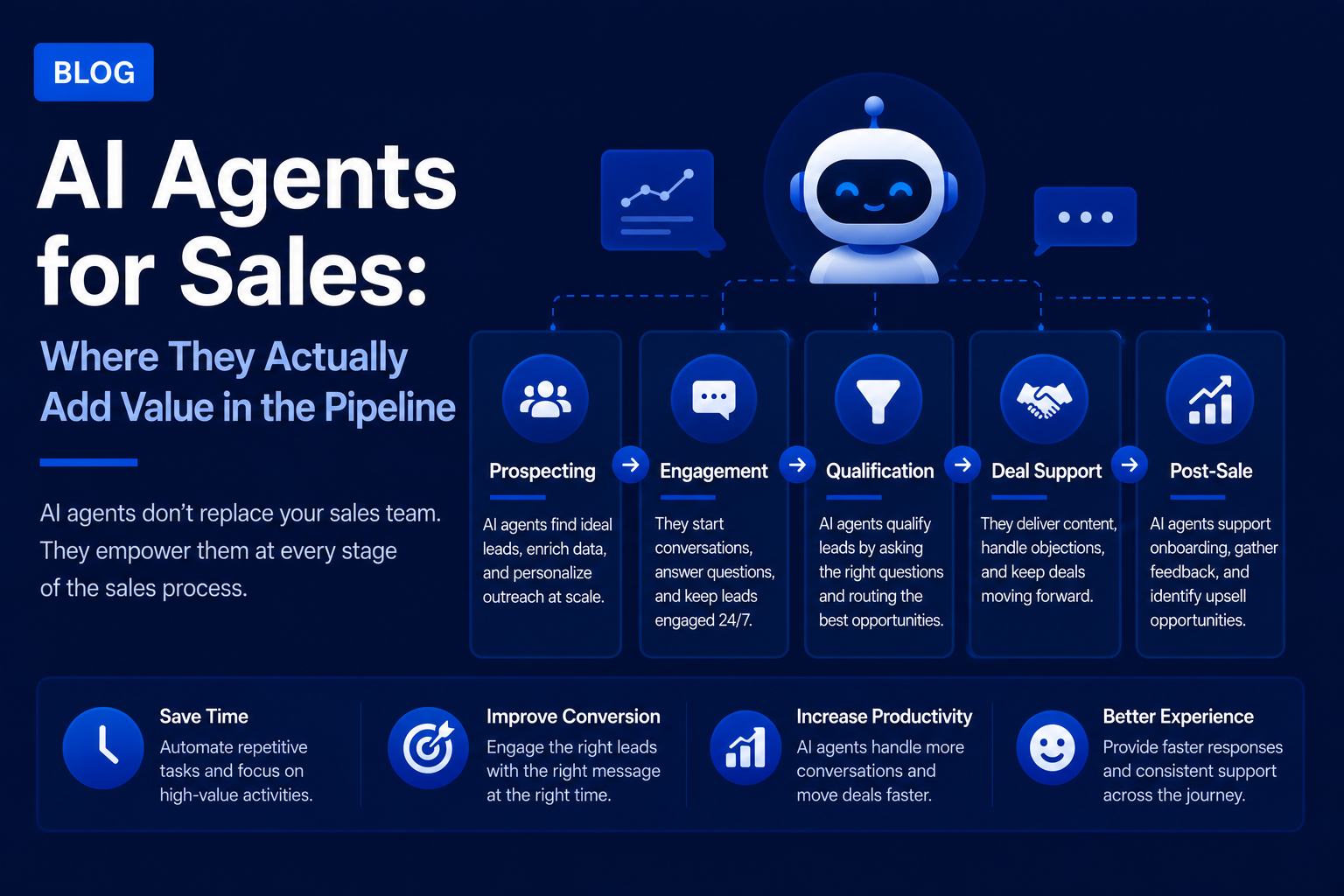
Selling is made up of a combination of repetitive and volume-related tasks, as well as relationship-oriented tasks that require judgment. While AI bots are helping with the former, but not yet the latter, knowing how to draw the line between the two will be critical.
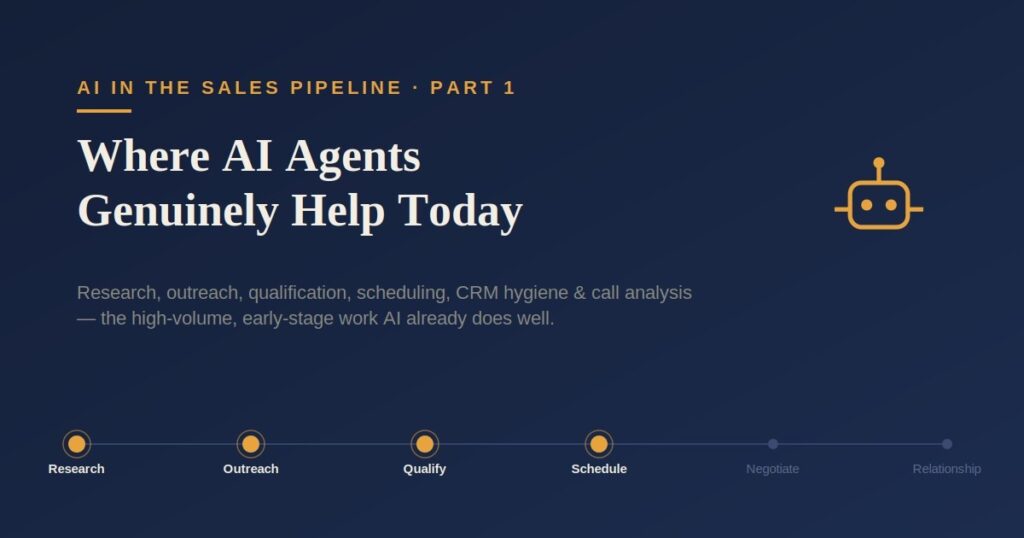
Where AI Agents Genuinely Help in Sales Today
Prospect Research and List Building
These agents will be able to do research on the target account, company, latest news, financing, hiring, technology stack, much quicker than manual research, revealing valuable signals that show potential buyer intent or are right for outreach.
Personalized Outreach at Scale
Instead of deploying completely generic outreach messages, an agent may customize initial outreach messages by mentioning actual facts about the prospect’s organization and thus significantly improve their outreach messages without compromising volume.
Lead Qualification
These agents will be able to connect with the inbound leads, ask questions to clarify and evaluate whether they meet the required criteria for being transferred to a human agent.
Meeting Scheduling and Follow-Up
Taking care of all the overhead work involved in scheduling, reminding, and following up on next steps, allowing the reps to focus on their core activities, sales.
CRM Data Entry and Hygiene
Recording of notes from calls automatically, changing the status of deals depending on the results of conversations, as well as marking out-of-date and inaccurate data will significantly reduce administrative load.
Sales Call Analysis
Reviewing audio recordings to highlight key takeaways, objections made, and areas where the sales manager can offer coaching, without the need for the sales manager to listen to every single call.
Where AI Agents Still Fall Short in Sales
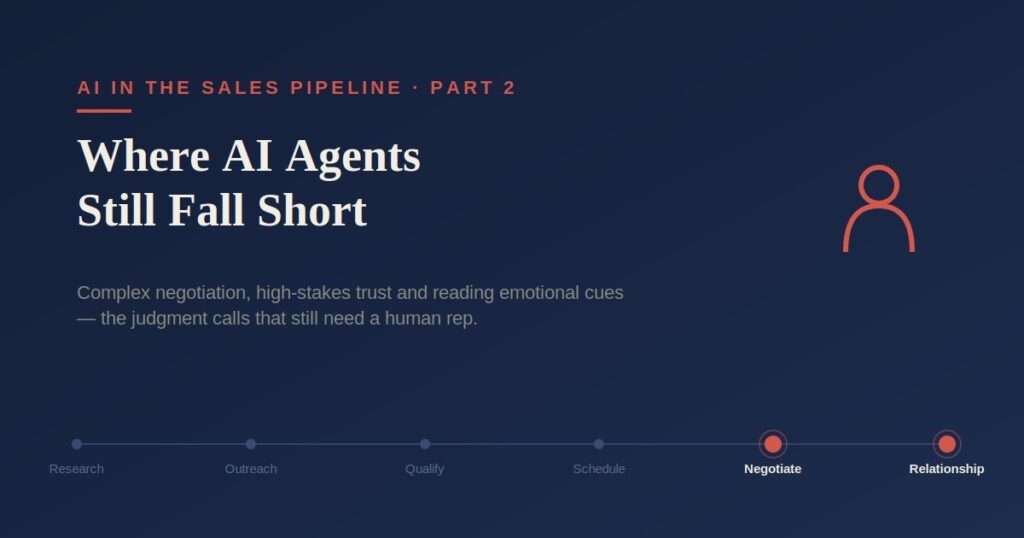
Complex Negotiation
Handling the intricacies of negotiating prices, customized agreements, or deals with multiple stakeholders is a skill that today’s representatives lack.
Building Genuine Trust with High-Value Prospects
In bigger and more strategic deals, prospects always look forward to creating relationships with real people, and highly automated communication processes can create distrust instead of gaining trust especially when they realize that the communication is not personal at all.
Reading Nuanced Social and Emotional Cues
Recognizing a delay, subtle resistance, or changes in priority during an actual conversation still requires human sales skills rather than those of the agent.
How AI Agents Fit into a Modern Sales Process
In all of the most effective deployments, AI agents manage the early and high-volume parts of the process, like research, prospecting, and qualifying, whereas humans play the role in the latter stages, where judgment is important.
It is analogous to how sales organizations already split responsibilities between sales development representatives (SDRs) who do the early-stage, high-volume activities and account executives (AEs) who conduct the more consultative and later stages, except that AI now handles the former part.
Practical Examples of AI Agents in a Sales Stack
Outbound Research and Outreach Agent
Outbound agent that does account research, writes personalized initial touch email, and manages the follow-ups until the prospect opens up to communicate.
Website Lead Qualification Agent
Qualification agent on web site chat that interacts with visitors, qualifies through relevant questions and schedules a meeting on the rep’s calendar.
CRM Automation Agent
An automatic summarization agent for recording details of each sales call, thus doing away with manual entry of information.
Sales Coaching Agent
A coaching agent for reviewing recordings of each sales call and highlighting the parts that need a managerial review, instead of reviewing each and every sales call.
Measuring AI Agent Impact on Sales Performance
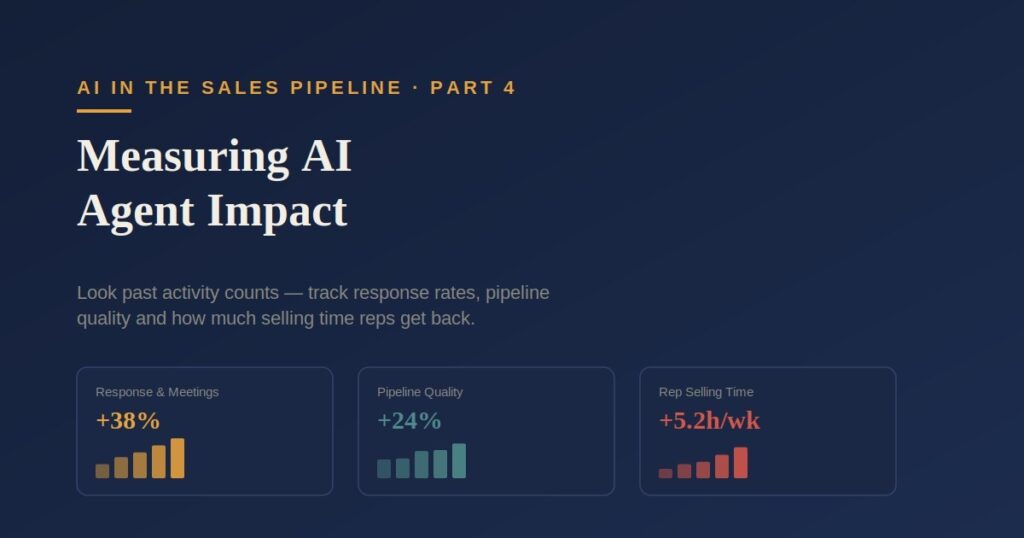
In addition to measuring mere activity (email sent, phone call made), measure what really matters:
Response and Meeting Performance
- Rate of response from assisted agent contacts relative to historic benchmarks
- Rate of appointments booked using AI-assisted campaigns
Pipeline Quality
- Rate of converting leads into opportunities from AI-qualified leads
Sales Productivity
- Time of rep available for selling activities compared to admin tasks
Common Mistakes When Deploying AI Agents in Sales
Over-Automating Outreach
Over automation of outreach, causing the message to appear generic even with the help of technological “personalization,” thereby bringing about the disengagement that came about through generic outreach.
Automating Relationship-Critical Conversations
Use of agents for later stage, relationship-building communications where human intuition beats automation.
Focusing Only on Activity Metrics
Failing to monitor quality conversions downstream, and optimizing for sheer volume of transactions which the agent can create.
Bottom Line
AI agents used in sales are highly valuable in the case of higher volume, early stage sales pipeline processes like research, outreach, qualifying and administrative functions; while human agents are required for negotiating and relationship selling.
The best sales teams are those who have AI agents to enable human agents to focus on only those processes which need human intervention.