Best AI Agent Platforms in 2026: How to Choose Among a Crowded Field

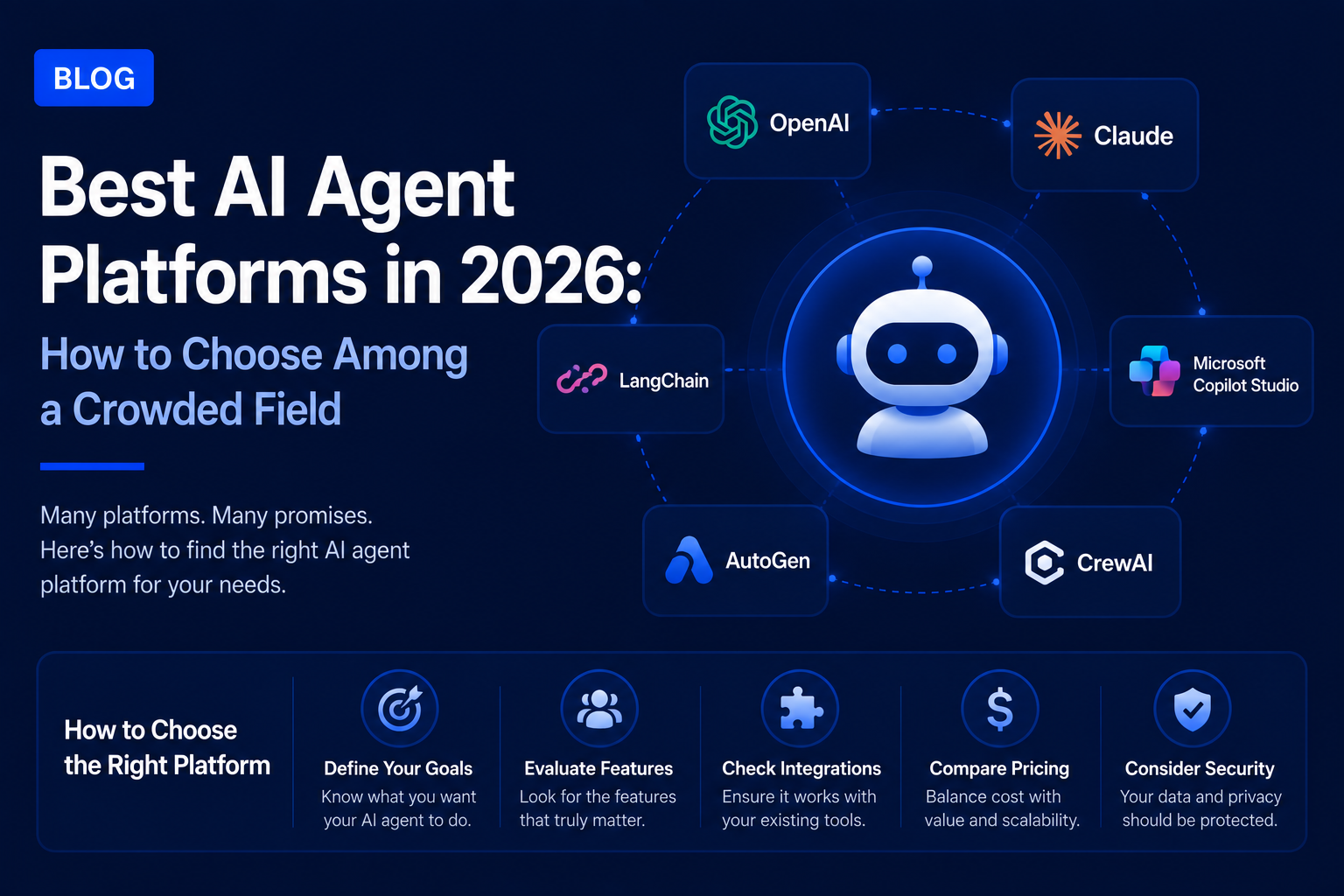
It is a truly fragmented ecosystem for AI agents, by 2026; there is not a dominant player and each of the platforms is based on different assumptions where it makes sense for software to be autonomous. This is an overview of the various types of platforms and a way to look at picking among them.
Why There’s No Single “Best” Platform
Different Categories Serve Different Needs
This has led to the segmentation of the market into tribes that are best suited to particular uses and user profiles:
- Orchestration tools tailored for developers
- Platforms that are designed around a specific ecosystem and relate to a particular cloud or productivity suite
- No-code business platforms intended for non-technical users
- Agents that are specialized for a single purpose
- Infrastructure with emphasis on governance in enterprises
Any sort of ranking that attempts to make a comparison between these different segments is bound to be misleading.
Developer-Focused Orchestration Frameworks
Flexible Platforms for Engineering Teams
Technologies such as LangChain and LangGraph allow technical staff complete freedom and control over the agent’s behavior, which includes clear state transitions and conditional branching for multiple steps.
Key Advantages
- Flexibility and customizability are at their peak
- Control is highly granular
- They work well for agents that involve several steps
Considerations
These are ideal for those with actual engineering capabilities and need to exercise granular control.
Ecosystem-Centric Platforms
Deep Integration with Existing Business Software
Major cloud and productivity providers deliver agent platforms that are natively integrated into their own software suites, Microsoft Copilot Studio for those that use Microsoft 365, Teams, and Azure, and Google’s Vertex AI Agent Builder for teams using Google Cloud with robust retrieval and memory management capabilities.
Benefits
- Integration with existing tools
- Enterprise features included
- Robust organizational workflow support
Such platforms have the advantage of being deeply integrated with the tools that the organization probably uses every day.
No-Code and Business-User Platforms
Building AI Agents Without Programming
Designed for non-technical teams that require production automation without substantial engineering input, such platforms focus on easy set-up, extensive libraries of ready-to-use integrations and templates, as well as visual, no-code creation of agents.
Typical Features
- Visual workflow builders
- Out-of-the-box integrations
- Built-in templates
- Rapid deployment
Growth of this segment has been rapid as companies try to deploy agents without having engineering teams on board for each use case.
Open-Source and Self-Hosted Options
Greater Control and Flexibility
A platform such as n8n offers a combination of an intuitive interface along with the freedom to switch into code if necessary, and also supports self-hosting.
Why Organizations Choose Them
- Capability for self-hosting
- More control over infrastructure
- Customizability for workflow
- Good data governance
Self-hosting is a key differentiator for companies dealing with confidential information that require complete control over their data, rather than having complete dependence on the vendor’s cloud infrastructure.
Specialized Vertical Platforms
Purpose-Built Solutions
Instead of creating agents for a general purpose, some platforms concentrate solely on one particular area, such as designing conversations for customer service, coding, or document processing, providing more advanced capabilities in this particular field than a general purpose platform.
Coding-Specific Agents
AI Platforms Built for Software Development
Coding continues to be among the most quantifiable and commercially advanced applications for agents, with coding agents assessed on their ability to safely manipulate code and work within actual development and build systems.
This represents a fundamentally different standard of assessment than for conversational or workflow agents.
Enterprise Governance and Infrastructure Platforms
Managing AI at Enterprise Scale
With big, regulatory firms, some platforms target specifically the governance and infrastructures layer and include access controls, cost controls, and audit logging for whatever underlying models and agents the firm is using.
Enterprise Priorities
- Access controls
- Cost management
- Audit logging
- Compliance assistance
Such platforms deal with problems which are usually neglected by other types of platforms.
Key Factors to Evaluate Regardless of Category
Integration Depth
Make sure that your platform can really read/write to your key systems and isn’t just listed among dozens and dozens of supported integrations.
Technical Fit
Developer frameworks provide ultimate flexibility but take significant engineering effort; no-code platforms sacrifice some complexity in return for ease of use.
Governance and Audit Capability
In particular, when it comes to regulatory environments or high-risk scenarios, where it is equally important to prove what an agent has access to and how it works.
Reliability Under Real Conditions
Consider not only the performance of agents in a demonstration but also their ability to cope with unanticipated input and maintain consistency in long-running workflows.
Why So Many Pilots Stall
Common Reasons AI Projects Fail to Reach Production
According to industry research, there is an extremely high rate of failure of generative AI pilot programs to go into production, since firms opt for platforms that do not fit their existing technical capabilities or try to do too much too soon without proving reliability on smaller cases.
Bottom Line
Finding the optimal AI agent platform in 2026 would require starting from the ground truth of your own use case and available technical proficiency, rather than a generalized list of the top ten platforms.
Developer platforms, platforms based on the broader ecosystem, no code business solutions, as well as vertical or governance platforms would all fit into different circumstances, as appropriate for your particular situation.