Types of Agents in AI: A Practical Breakdown

Introduction
“AI agent” is a catch-all phrase that applies to several types of agents which differ greatly in their capabilities, architecture, and intended applications.
Knowledge of these classifications allows for a much more accurate evaluation of the potential of a particular “AI agent.”
What Makes Something an “Agent” Rather Than Just a Chatbot
Autonomy and agency is the important difference.
The simple chatbot acts in a dialogue with messages.
The agent performs actions independently, contacting third-party software, performing multi-step operations, and adjusting strategy depending on the outcome, and this all may happen with no human interaction at all or with minimal human involvement.
The reason why not all AI agents fit this description is one of the reasons for the importance of the topic.
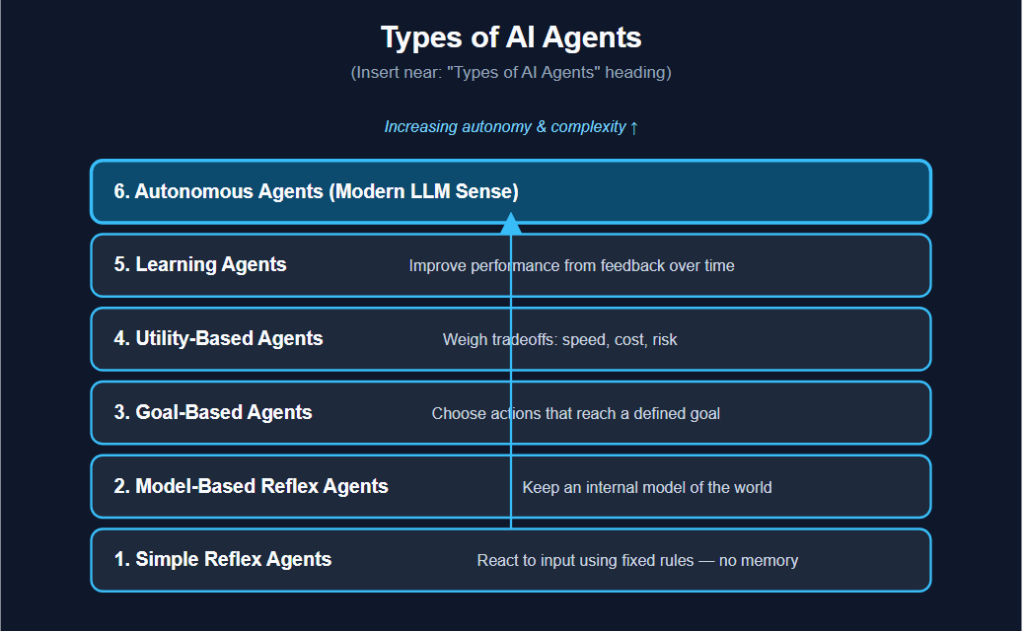
Types of AI Agents
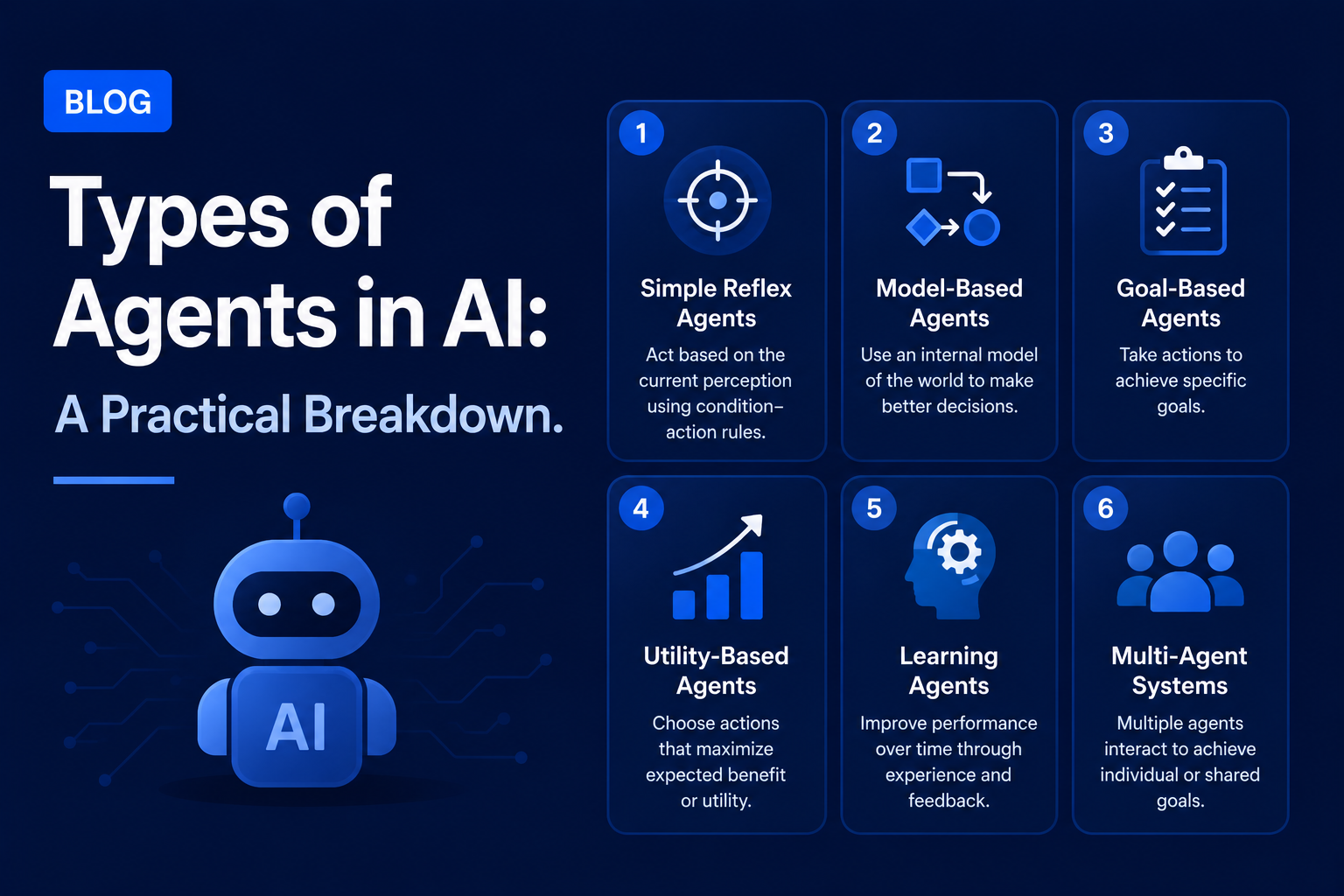
Simple Reflex Agents
First type: these are agents that respond to stimuli at hand according to pre-set rules without remembering past experience or planning for future actions.
This can be likened to an elementary form of a robot that responds to keywords and gives automatic answers as per its pre-set rules and is only effective in handling situations within its programmed rules.
Model-Based Reflex Agents
These have an internal model of their environment, enabling them to deal with situations that are not totally visible within the current input by considering what they have seen before.
It is an improvement on reflex agents as they are able to take into account more than the current input.
Goal-Based Agents
The agents compare different potential actions based on some predefined goal that is most likely to help the agent reach its goal.
Key Characteristic
- Incorporates the concept of planning into agents because it does not only respond to inputs; it plans for future actions.
Utility-Based Agents
While goal-based agents help the agent to find a way to perform a certain task, utility-based agents enable an agent to choose from several potential actions in order to complete the goal.
Common Tradeoffs Considered
- Speed
- Cost
- Risk
Learning Agents
They gradually learn to perform better due to the input received from the environment around them, unlike agents that use pure logic.
Modern-day AI agents that utilize language models have at least some kind of ability to learn in one way or another.
Autonomous Agents (in the Modern LLM Sense)
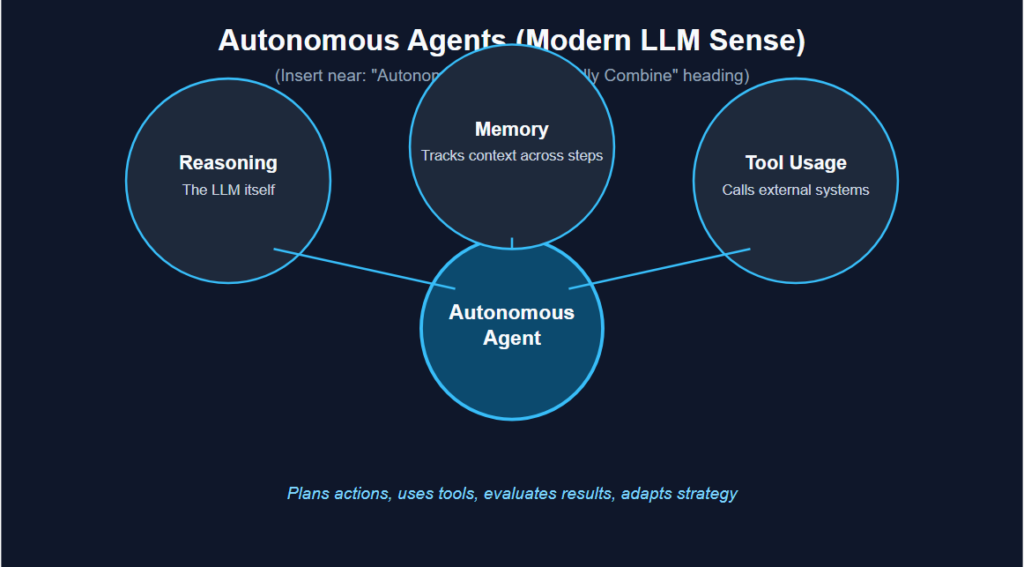
Today’s definition of “AI agent” refers to the category that is characterized by an independent ability to plan a series of actions, use external tools or API, assess outcomes, and change its strategy on the basis of a large language model.
Autonomous Agents Typically Combine
- Reasoning (the LLM itself)
- Memory (keeping track of context throughout all the steps)
- Tool usage (requesting help from external systems in taking real action)
Multi-Agent Systems
Whereas one agent performs the whole task at once, a multi-agent system involves several different agents, each dedicated to performing its own task. This resembles the approach taken by humans in dividing up work, and is becoming increasingly common practice in more complicated workflows.
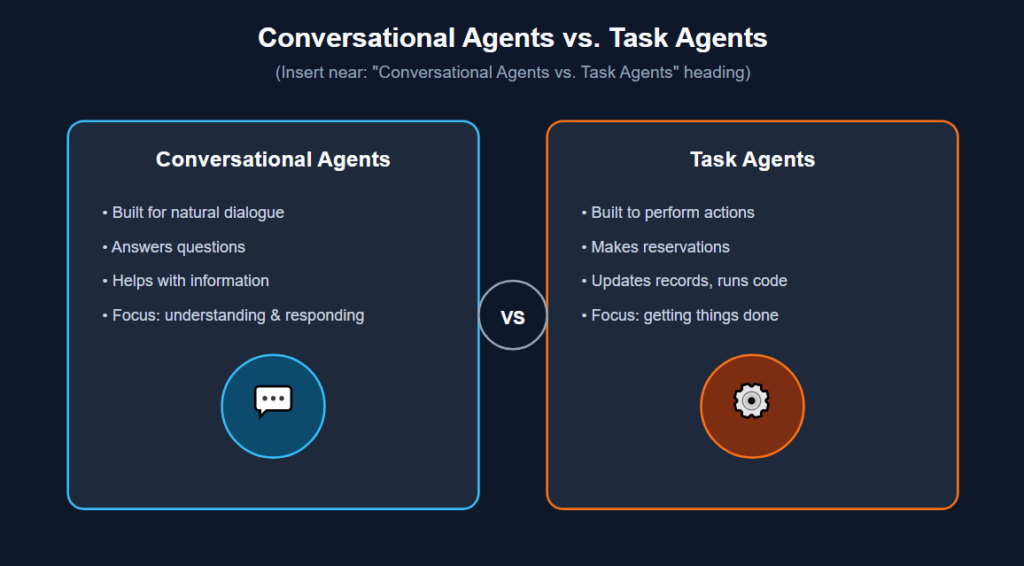
Conversational Agents vs. Task Agents
In LLM-driven agents in particular, there is merit in separating conversational agents from task agents.
Conversational Agents
Built mainly for natural conversation, responding to queries and helping with information.
Task Agents
Built to actually perform tasks, making a reservation, updating a record, running some code, without much interest in natural conversation.
Why This Distinction Matters Practically
The distinction of the type of AI agent that a product is becomes apparent when one tries to evaluate the product.
- A simple bot of the reflex kind would have problems handling unexpected circumstances.
- An actual autonomous agent with access to tools could do real-world work, but needs greater control because of its ability to perform actions with consequences.
- Multi-agents could deal with more complicated workflows, but have additional coordination issues.
Common Misconceptions
Marketing talk uses “agent” liberally when describing products that are really just basic chatbots with more capabilities, and “autonomous” in systems that still need a lot of human input at each stage.
It might be wise to ask point-blank what exactly an individual product can do for itself, as opposed to what its “agent” designation means.
Bottom Line
Agents of artificial intelligence come in many varieties, from basic reactive rule-based systems to more complex autonomous tool-using systems and team-based multi-agent systems.
Understanding what kind you’re talking about, and how much the system can actually do on its own as compared to what still needs human input, is crucial to understanding what to expect from an AI agent product.