Data Protection: What It Actually Covers and Why It’s Easy to Get Wrong

Introduction
Data protection refers to the methodologies and techniques employed to secure critical data from potential risks of loss, distortion, or unauthorized use, rather than any one specific measure that provides automatic security.
It may appear to be a relatively straightforward concept, but the amount of overlap in various other fields makes it an aspect of business that is often overlooked.
Why Data Protection Is More Complex Than It Appears
However, data protection is not a uniform process but a combination of the following:
- Backup and restoration of data
- Data Access Control and Encryption
- Compliance Regulations
While some companies consider data backup alone to be enough data protection, such an approach has substantial vulnerabilities related to access control and compliance regulations.
Since one company can process different kinds of data in its operations, the process of protection must be set up separately for each type of data, since customer files, financial information, and internal documents can have different risks and compliance requirements.
Major Areas of Data Protection
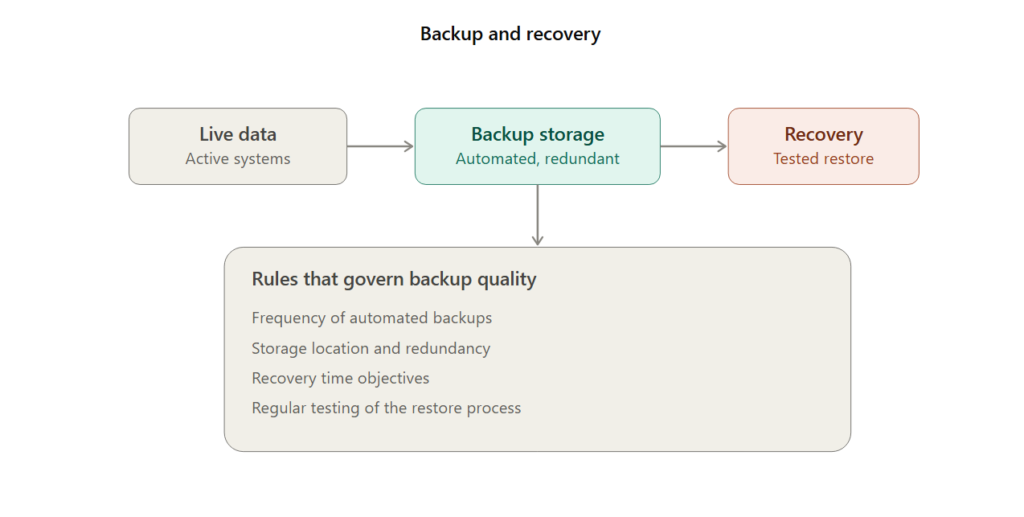
Backup and Recovery
Rules Governing
- Frequency of backup automation
- Place of storage and redundancy
- Time objectives for recovery in case of data loss
Inadequate frequency or testing of backups is perhaps the most common and expensive loophole because it may lead to:
- Data loss during an actual occurrence
- Long downtime during recovery
- Identification of backup failure at times when they are most needed
Access Control and Encryption
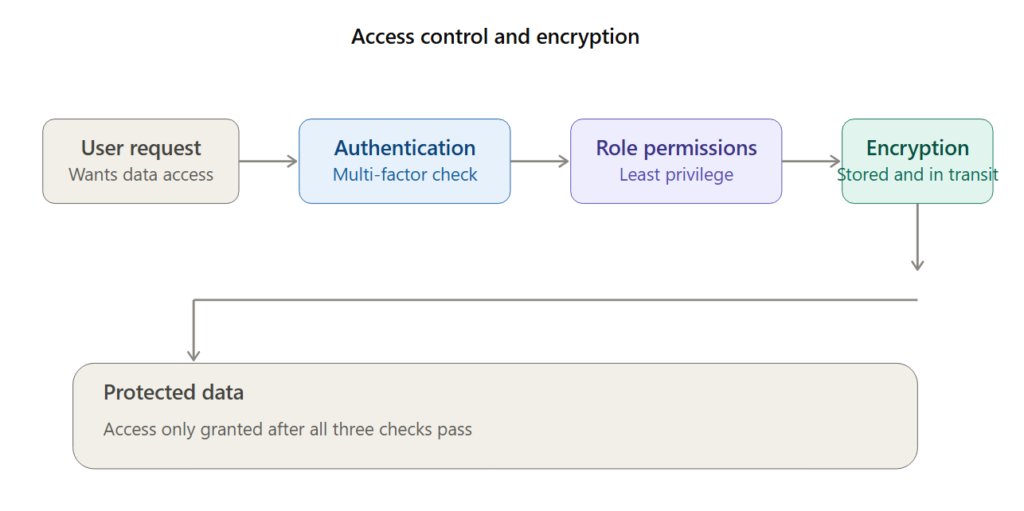
Data protection approaches generally encompass access control measures in which organizations must follow the principle of least privilege within their respective systems.
Access Control Often Includes
- Role-based permission controls on data access and modification
- Multi-factor authentication in critical systems
- Encryption for stored and transmitted data
Threat Detection and Monitoring
Response is not only about putting in place preventive measures but also about the growing adoption of tools to monitor any attempts at unauthorized access or suspicious activity.
Those Monitoring Tools Usually Vary in Many Respects Including
- Detection speed
- Incident response procedures integration
- System-wide coverage
Regulatory Compliance
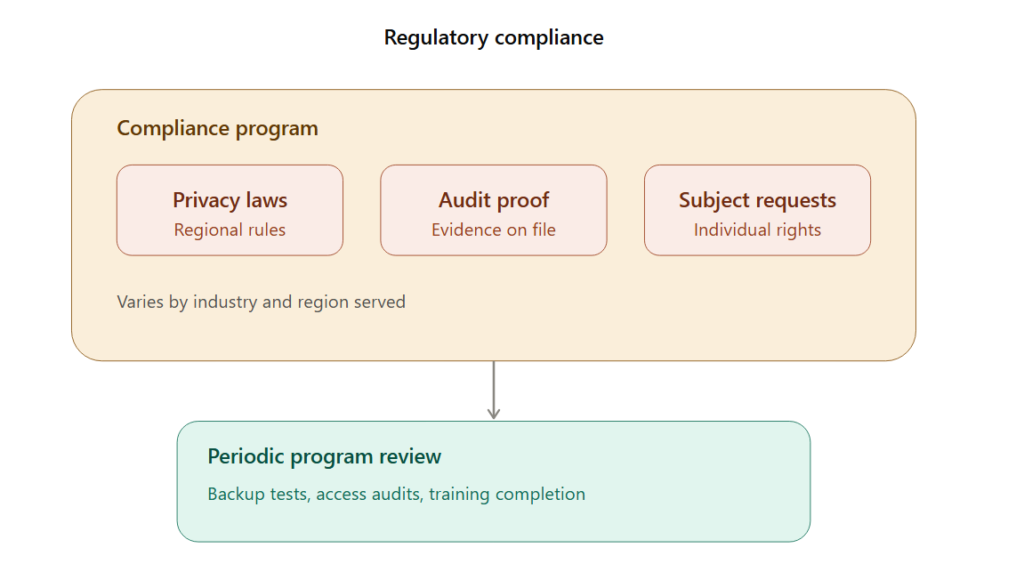
Protection of data generally entails:
- Compliance with privacy laws in that region.
- Proof of such compliance during auditing processes.
- Process of handling requests by data subjects.
The particularities vary depending on the industry and regions served by the business.
Employee Training and Policy Enforcement
There are some data protection schemes that mandate an organization to keep some practices such as:
- Security awareness training
- Policies for data handling and sharing
- Consequences for violation of the policies
This is because one of the major reasons behind data breaches is human error.
Why Data Protection Failures Happen Even at Well-Resourced Companies
It rarely fails to be properly protected because the firm is simply oblivious to the danger.
On the contrary, there can be failures due to:
- Backup procedures are set up only once and never tested on whether they work or not.
- Permissions to access various areas being granted continuously and never reviewed.
- Not having enough training for employees to spot social engineering attacks.
How Organizations Build Effective Data Protection Programs
Assessing Risk Across Data Types
More extensive enterprises might prioritize the classification of data by sensitivity, particularly when the obligations for different types of data vary.
Data Protection Practices Supporting Resilience
There are several methods that organizations can use to ensure data protection, such as:
- Testing backup recovery processes, as well as confirming that backups have been made
- Automating access reviews to reduce excess permissions
- Monitoring everywhere, including the cloud environment
Ongoing Program Reviews
Periodic review in organizations includes:
- Test outcomes for backup and recovery
- Results of access control audits
- Completion of training of employees
Such periodic reviews help organizations in ensuring that their efforts at data protection remain relevant.
Common Data Protection Mistakes
Treating Backups as the Only Safeguard
This assumption that backup alone is sufficient as data protection measures without dealing with access and monitoring control.
Never Testing Recovery Processes
Ensuring that backups run successfully without checking whether the data is restorable at all.
Ignoring Access Creep
Building up permissions among employees without doing any cleanups now and then.
Poor Incident Response Planning
Lack of preparation for:
- Who should respond to the incident
- Plans to communicate with affected clients or regulatory authorities
- Post-incident review to ensure it will not happen again
The lack of incident response planning can make recovery from an incident take longer and cause more harm.
Bottom Line
Data security is a very wide-ranging concept that includes many aspects, like backups and recoveries, access controls, threat detections, compliance regulations, and training employees.
Taking into account all the possible vulnerabilities that may lurk under the guise of safety offered by the mere fact of data being backed up, it would be much more beneficial for companies to develop a multi-tier strategy including protection, detection, and recovery processes.