eSign: What It Actually Covers and Why It’s Easy to Get Wrong

Introduction
eSign pertains to the method and technology employed in signing documents electronically, and not to simply entering one’s name on a text box.
Though it may sound simple, there are many aspects involved in ensuring a legitimate electronic signature that often lead businesses to misunderstand the subject.
Why eSign Is More Complex Than It Appears
eSign is not a monolithic process but rather a complex one consisting of:
- The method used for signing
- Legal validity based on jurisdiction and type of document
- The audit trail and information required to verify the signature’s legitimacy
It is assumed by several companies that a digital mark on a document is always a legally valid signature, and such reasoning ignores the special conditions that make the eSignature valid.
As far as the use of eSign in a business across various types of documents is concerned, each type should be analyzed separately since there are special requirements for some documents like wills or certain real estate transactions.
Major Areas of eSign Functionality
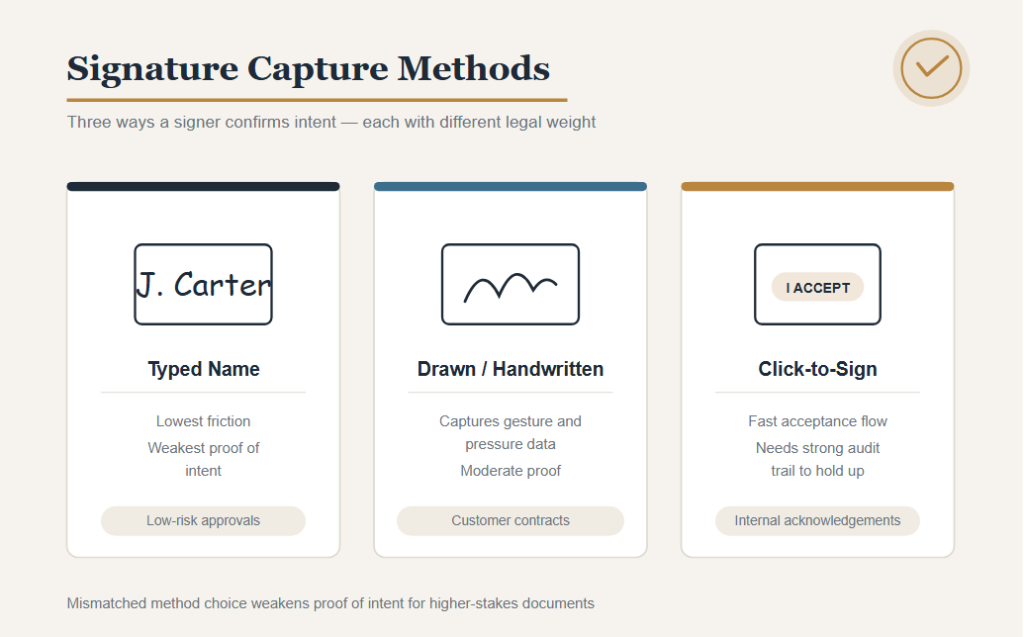
Signature Capture Methods
Rules Governing
- Typed name signatures
- Digitally recorded handwritten or drawn signatures
- Click to sign acceptance methods
Selecting the incorrect signature capturing method for the document is one of the most common problems since it can lead to:
- Less persuasive proof of intention for high-risk documents
- Legitimate signatures which won’t withstand any challenge
- Mismatched perceptions of the formality of the document
Legal Validity and Compliance
Electronic signature software works within the parameters of defined laws, meaning it must be compliant in order to meet requirements such as the ESIGN Act in the US and eIDAS in Europe.
Legal Validity Often Depends On
- Evidence that the party intended to sign
- Linking the signature to the particular document
- Explicit consent to perform the transaction online
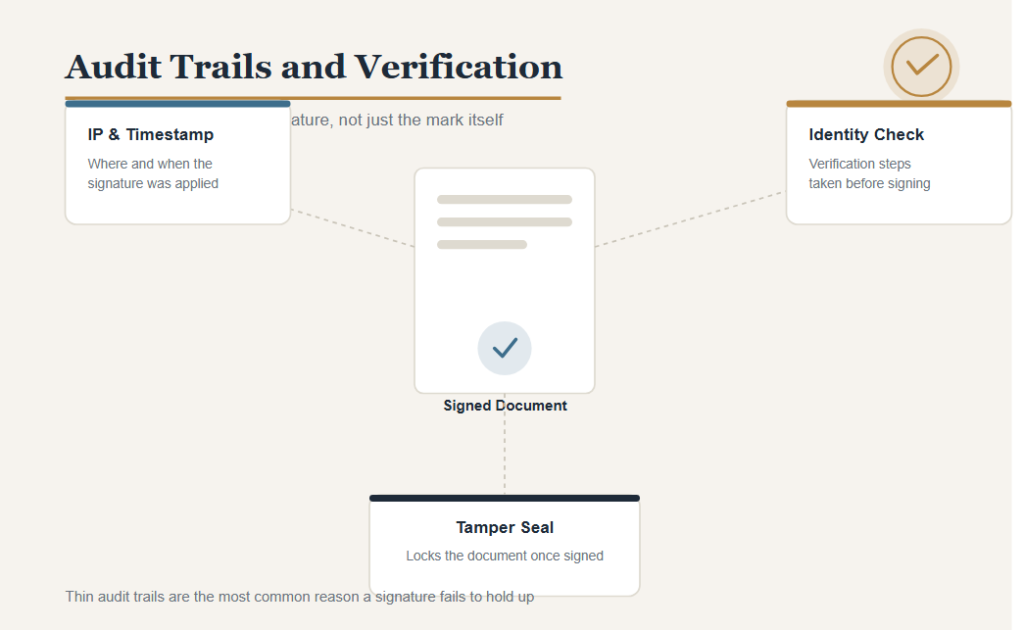
Audit Trails and Verification
The handling process includes not just the signature but also increasingly the metadata surrounding the fact of signing – namely, who signed, when, and under what conditions.
Those Audit Trails Usually Vary in Many Respects Including
- IP address and time stamp tracking
- Identification steps prior to the signing
- Sealing the signed document to show no tampering
Document Types and Use Case Fit
Typical features that eSignature software offers include:
- Simple internal approvals and acknowledgements
- Customer contracts and agreements
- Legal documents where higher security is required
Higher security will depend on the significance of the document to be signed from both legal and monetary perspectives.
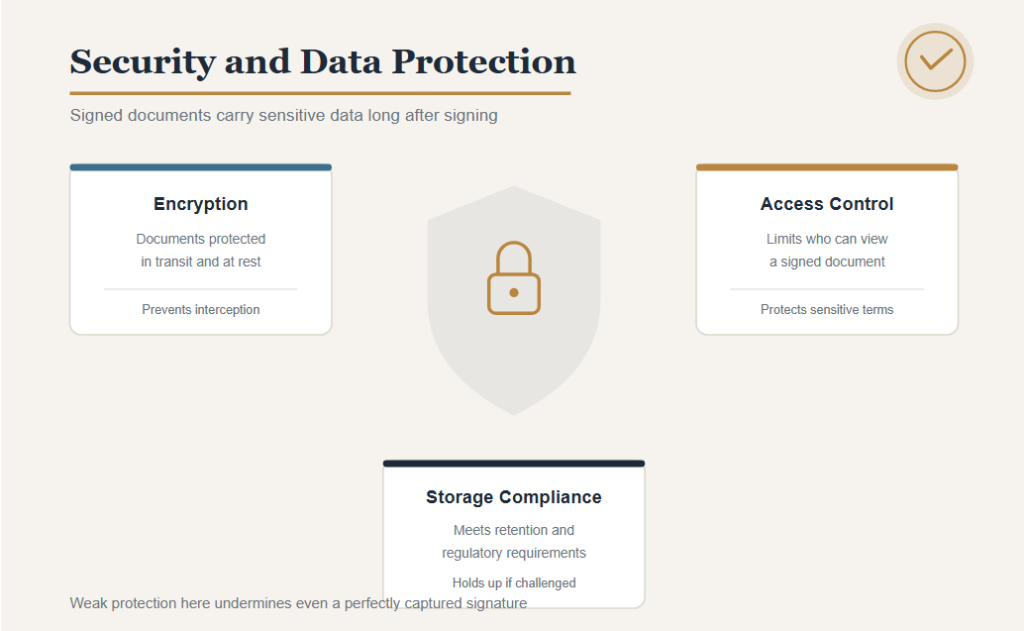
Security and Data Protection
Certain security measures must be taken into consideration in several e-signing platforms; namely:
- Secure encryption of transmitted and stored documents;
- Access control for viewing signed documents that may have sensitive information;
- Compliance with the regulations on storing signatures.
These security measures are necessary due to the nature of signed documents, which usually consist of some private/personal or financial information.
Why eSign Adoption Runs Into Problems Even at Well-Intentioned Companies
The reason why eSign implementation rarely fails is due to the company underestimating the potential of the technology.
However, this issue can arise when:
- A universal eSign solution is applied to documents that need more formal procedures.
- The audit trail information is not stored for a sufficient amount of time to provide justification if questioned.
- The signers are not instructed on how to use eSign properly.
How Businesses Choose and Implement eSign Effectively
Matching the Tool to Document Stakes
In large organizations, it is possible that varying levels of eSign verification will be used for various types of documents, particularly where there are some important legal or financial implications.
eSign Practices Supporting Legal Enforceability
There are several eSign technologies that allow companies to:
- Document intent and consent of the signers
- Create an audit trail for each signed document
- Archive signed documents and associated data based on a retention policy
Ongoing Process Reviews
Companies undertake regular reviews of:
- Whether present e-signature policies are in compliance with changing laws
- Comprehensiveness of audit trails of newly-signed documents
- Ease of use of the signers
Regular reviews help organizations ensure that their e-signature procedures are legally and functionally sound.
Common eSign Mistakes
Using a Basic Tool for High-Stakes Documents
Utilizing a basic signing system on documents which would need enhanced identity verification.
Failing to Retain Audit Trail Data
Failing to maintain adequate metadata for proving the validity of a signature if challenged.
Ignoring Jurisdiction-Specific Requirements
Presuming that all electronic signatures have the same validity requirements in each country or state.
Poor Signer Experience Design
Lack of focus on:
- Clear understanding of what the signer is committing to
- Accessibility of the signing process on multiple devices
- Delivery of confirmation and record after completion of the signing process
Poor signer experience can result in an abandoned signing process or disputes over what was agreed to.
Bottom Line
It is very versatile and includes factors like methods of collecting signatures, legal binding, audit trail, suitability for different types of documents, and data protection.
Given how much the legality of an electronic signature depends not only on the act of collecting the mark on the document, but also on other things, it would be more beneficial for organizations to adapt their electronic signing processes based on the significance of the document type.