Swiss Federal Data Protection Act vs GDPR for AI: What the Comparison Actually Covers and Why It’s Easy to Get Wrong

Introduction
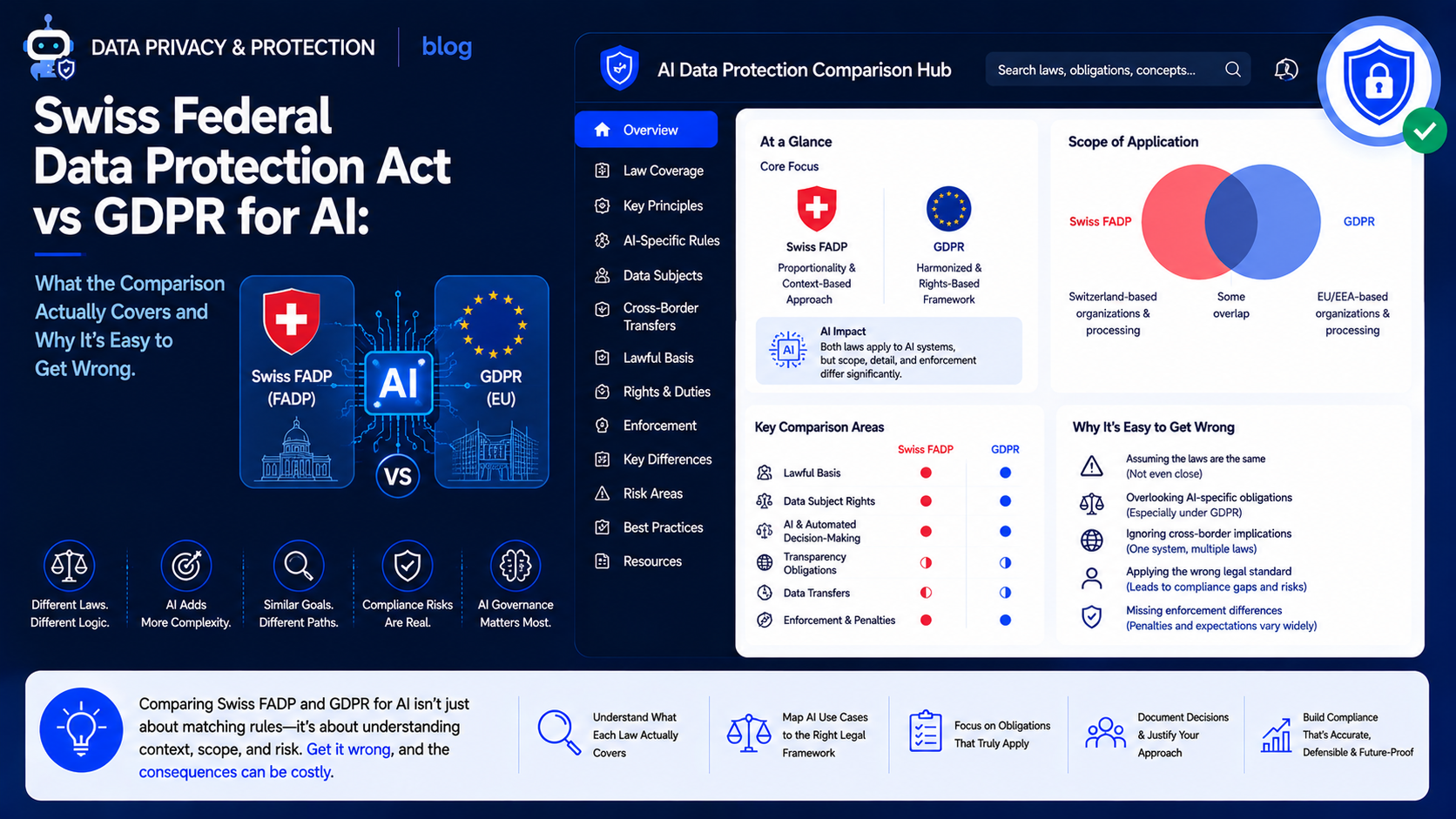
The comparison of the FADP and GDPR in relation to AI requires an examination of the two legal frameworks that deal with personal data used in artificial intelligence applications, rather than the idea that one is simply a reproduction of the other.
It may appear relatively straightforward at first glance; yet, the variety of nuances between the two frameworks is considerable enough to make this issue a common mistake for companies working in both countries.
Why Comparing FADP and GDPR for AI Is More Complex Than It Appears
However, the legal environment around AI and personal data is not one set of regulations but a combination of:
- Shared basic principles of data protection present in both laws
- Differences in scope and applicability
- Different penalties and ways of enforcing these laws
Many companies think that compliance with GDPR will ensure compliance with FADP, but it does not take into account the differences in scope and obligations.
This is especially true in the case of companies that do business in both the European Union and Switzerland, since AI processing personal data will have different duties under each regulation.
Major Areas of Comparison Between FADP and GDPR
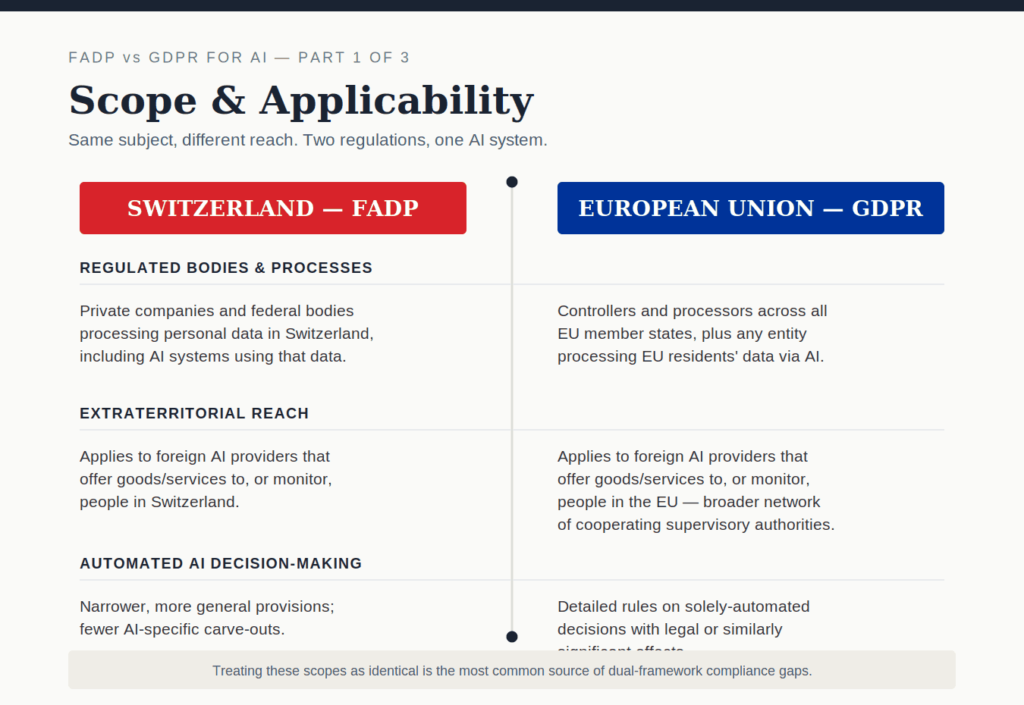
Scope and Applicability
Rules Governing
- The bodies and processes that fall under each regulation
- Extraterritorial applicability to foreign companies from each relevant jurisdiction
- Applicability to automated decision-making in AI technology
Thinking of both regulations as having the same scope is the most common mistake due to the fact that:
- There might be compliance gaps if the special provisions of FADP are not covered separately
- Confusion in relation to whose laws take precedence during international data transfers
- Failing to pay attention to obligations specific to Switzerland while focusing on GDPR compliance
Legal Basis for AI Processing
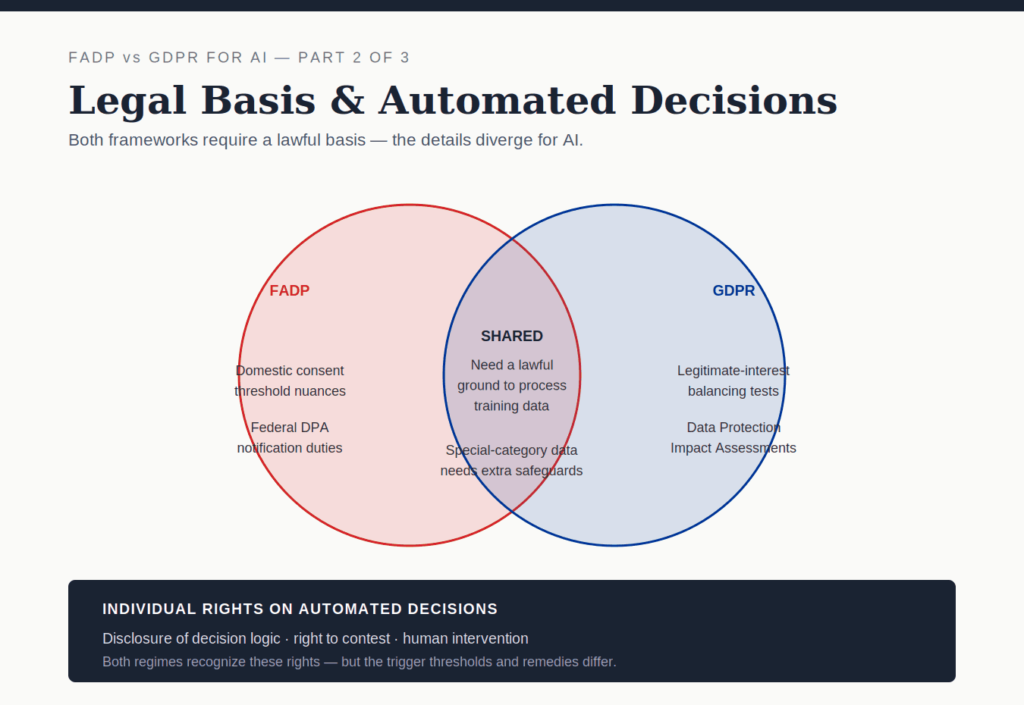
Both frameworks demand adherence by the organization to legal grounds for processing, although the requirements and grounds vary from one framework to another.
Legal Basis Considerations Often Include
- Requirements for consent and standards applicable under each legislation
- Legitimate interests assessments for AI processing
- Processing of special category data, as is common with AI processing because of the wide scope of training data
Automated Decision-Making Provisions
This involves not just general rules for data processing but specific provisions regarding automated decision-making, a key component of AI applications.
Those Provisions Usually Vary in Many Respects Including
- Individual rights in relation to automated decision-making
- Disclosure obligations related to how the AI system makes decisions
- Human intervention requirements for critical decisions made automatically
Enforcement and Penalty Structures
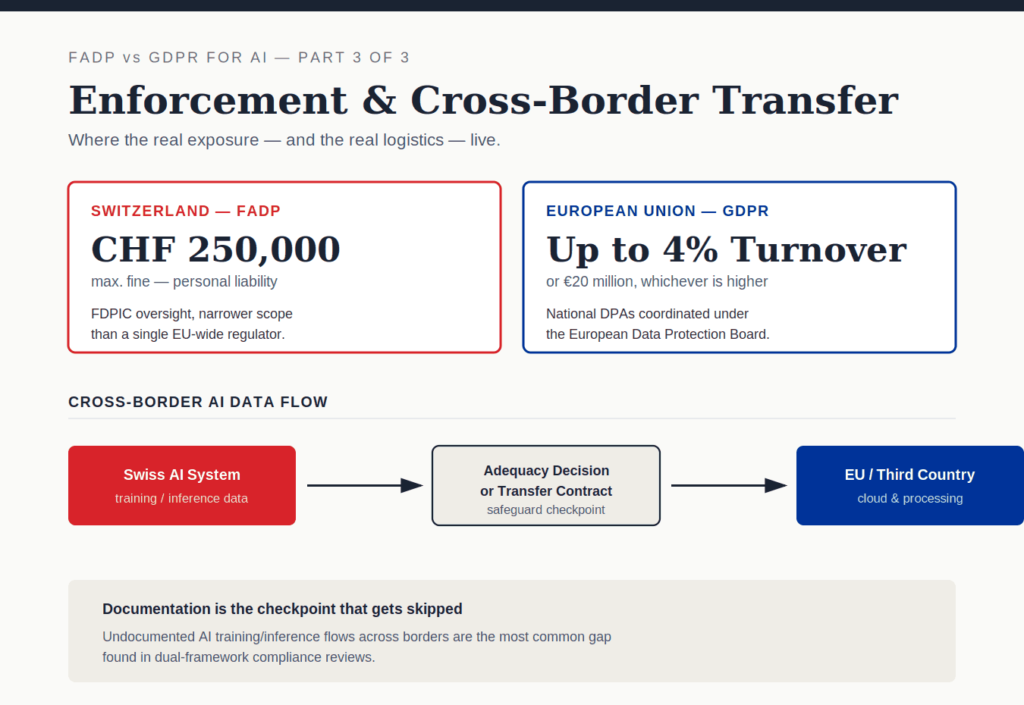
The difference between the two approaches lies in:
- The maximum penalties for non-compliance
- The structure of regulatory authority and its methods of implementation
- The requirements for breach notifications
The real risk of exposure is very different depending on who regulates the specific AI process.
Data Transfer Considerations
Some cross-border uses of AI need certain safeguards to be in place, which include:
- Adequacy decisions in relation to data transfers from Switzerland to the EU
- Contracts for data transfers from Switzerland to other countries
- Documentation of compliance with data transfer procedures
These safeguards must be in place since AI typically involves data processing in different jurisdictions and cloud computing facilities.
Why Compliance Gaps Happen Even at Companies Familiar With GDPR
Full compliance with both legal instruments rarely occurs when a company fails to address the issue of data protection altogether.
Indeed, such discrepancies may be caused by:
- Knowledge of GDPR makes people believe that FADP compliance is automatic.
- Specific requirements for AI in each regulation are not discussed as much as those concerning data processing in general.
- Cross-border flows of data linked to AI training or AI inference are not analyzed properly.
How Organizations Approach Compliance Across Both Frameworks
Mapping AI Data Flows Against Both Laws
For larger organizations, there may be detailed tracking on how personal data flows through AI systems, especially where training data or inference is done in more than one jurisdiction.
Compliance Practices Supporting Dual Framework Readiness
- Some compliance methods allow an organization to:
- Undertake separate legal review of requirements under the FADP other than relying on GDPR being enough
- Create transparency documentation for decisions made using AI
- Keep track of regulation developments since AI interpretations keep evolving
Ongoing Regulatory Monitoring
Periodic reviews performed by organizations include:
- Updates of guidance specific to AI under both frameworks
- Valid cross-border data transfer methods
- AI systems with automated decision-making processes
Periodic reviews help organizations ensure that their compliance is up to date as both frameworks continuously evolve with regard to AI-specific guidance.
Common Mistakes When Comparing FADP and GDPR for AI
Assuming GDPR Compliance Automatically Covers FADP
Switzerland-specific requirements, which vary from the EU framework.
Underestimating AI-Specific Provisions
General compliance with data processing rules, but ignoring those related specifically to automated decisions, which would be important in the context of AI.
Ignoring Cross-Border Transfer Complexity
Lack of mapping for data flows from AI training and inference across different jurisdictions.
Poor Documentation of AI Decision Logic
Insufficient documentation on:
- The process through which AI makes automated decisions
- Human intervention in the process of making critical decisions
- Information about transparency that is given to the affected individual
If poor documentation is done, it will make compliance difficult to prove in a regulatory assessment.
Bottom Line
Comparison between the FADP and the GDPR regarding AI is highly diversified and includes aspects such as different scopes, legal bases, automation, mechanisms for enforcement, and cross-border data transfer.
As easy as it is to fall into the misconception that GDPR compliance means compliance with the FADP, it would be more beneficial for entities that operate in both regions to undertake different legal assessments.