AI Automation Software: What It Actually Covers and Why It’s Easy to Get Wrong

Introduction
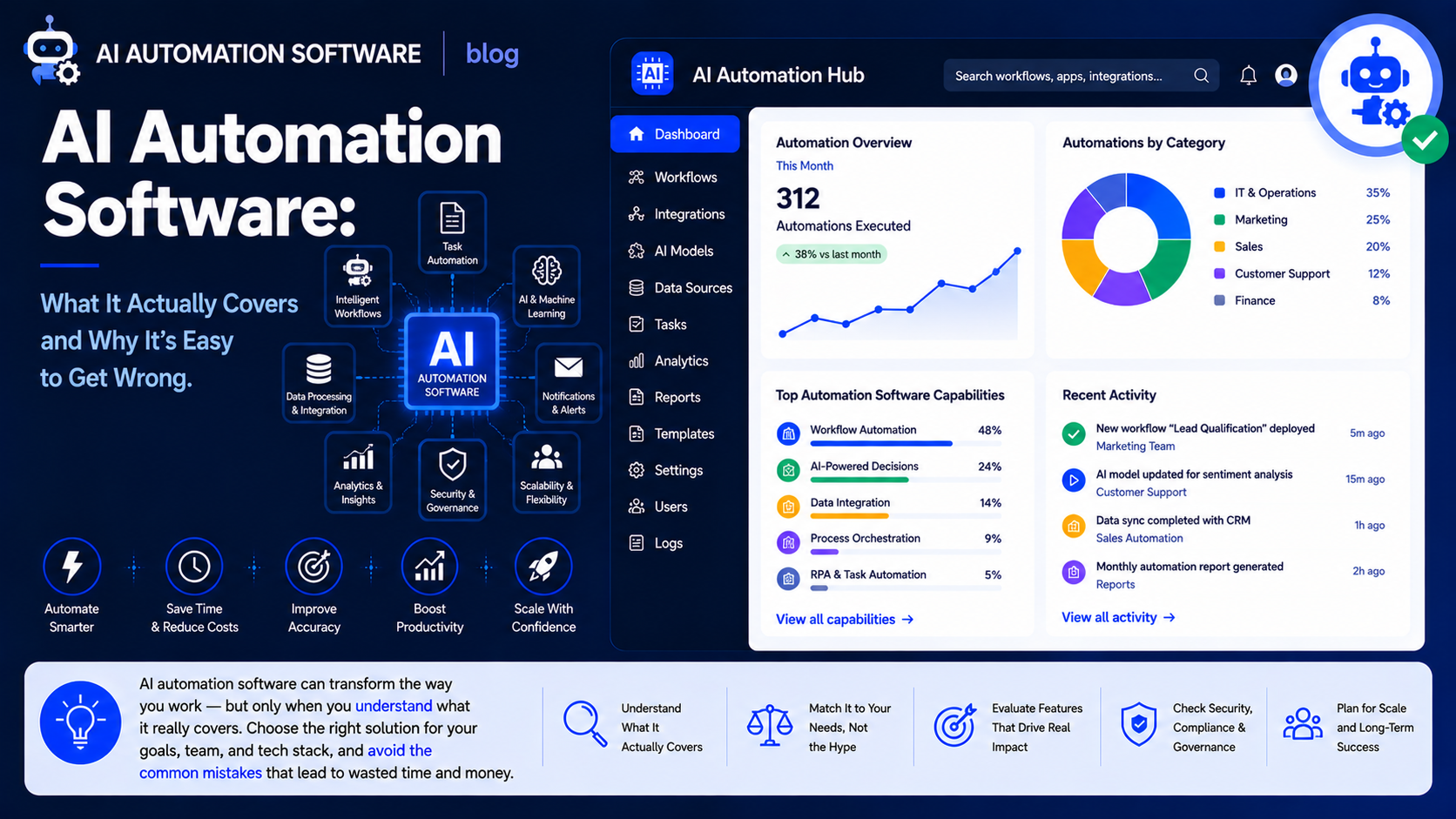
Automation software with AI is defined as any software application which combines artificial intelligence and automation of tasks to eliminate manual effort, not as one static category of software with uniform characteristics.
This sounds relatively simple, but due to the large number of software categories that can be referred to as such, it is often incorrectly evaluated when buying by business owners.
Why AI Automation Software Is More Complex Than It Appears
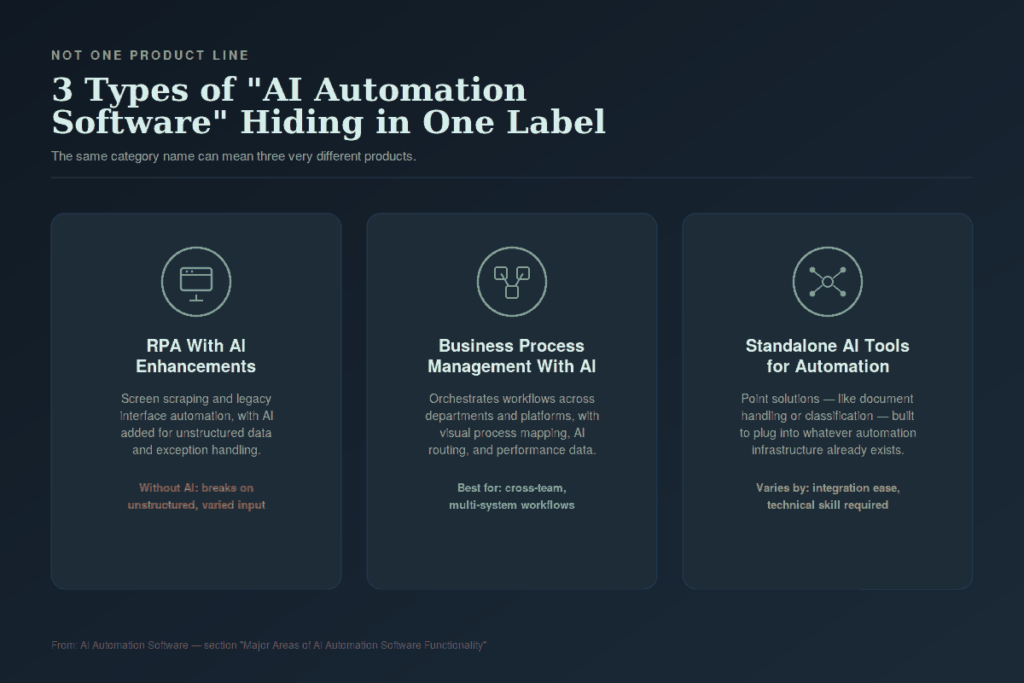
The AI automation software is not one particular product line but rather a combination of the following:
- RPA with added AI features
- Software for business process management incorporating AI-based decisions
- Independent AI software that can be integrated into other existing automation software products
In several companies, buying of software is done just based on categorization of the products, and this method of evaluation doesn’t consider any difference between these software products in terms of AI use.
When a company is faced with a choice of different software products, each one of them should be evaluated separately by its functional capacity, since two “AI automation software” products can differ greatly.
Major Areas of AI Automation Software Functionality
RPA With AI Enhancements
Rules Governing
- Screen scraping and interface automation in legacy systems
- AI integration to deal with unstructured data in RPA processes
- Exception handling while automated process runs into unexpected input data
Static RPA, not enhanced with AI, is one of the most popular entry points due to the following possible outcomes:
- Successful automation of structured processes
- Failing of processes that contain unstructured or varying input data
- Lack of exception handling capabilities
Business Process Management With AI
Process Orchestration is one type of AI automation software that provides orchestration for processes and requires companies to work with set workflows across various platforms and departments.
BPM Software Features Often Include
- Visual process mapping and documentation
- AI routing in processes
- Process performance analytics
Standalone AI Tools for Automation
Handling includes both end-to-end solutions as well as AI tools that are available separately to be used within existing automation infrastructures.
Those Standalone Tools Usually Vary in Many Respects Including
- Their ease of integration into existing automation solutions
- The need for any technical know-how to deploy
- The particular task that they can carry out, such as document handling or classification
Deployment and Infrastructure Considerations
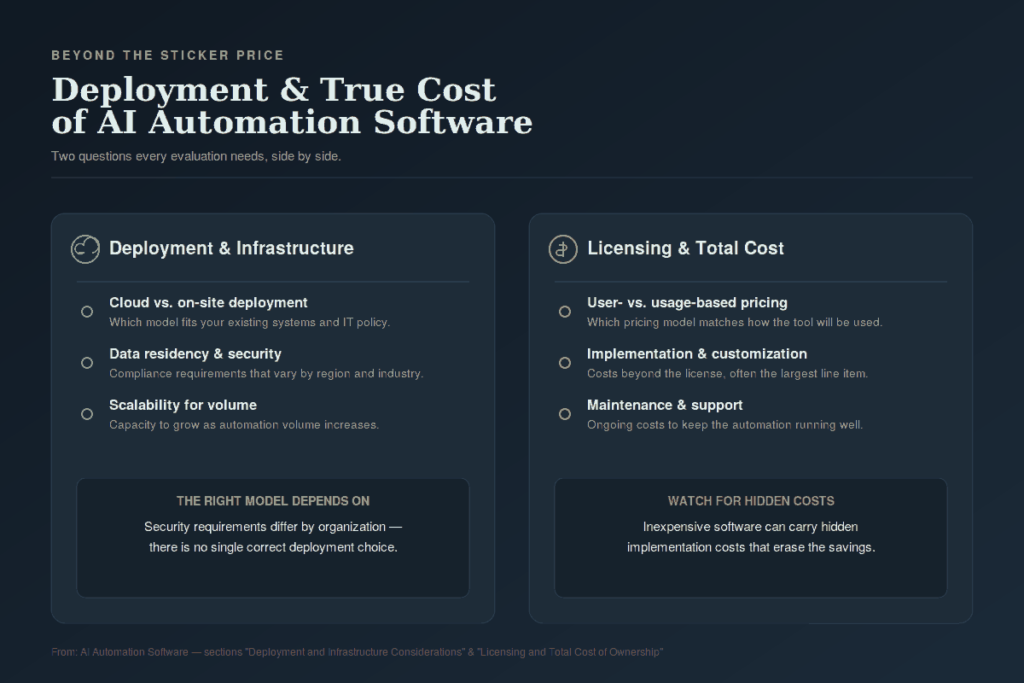
The AI automation software needs:
- Cloud deployment rather than on-site deployment
- Compliance with the data residence and security requirements
- Scalability for increasing automation volumes
The appropriate deployment model will vary based on the security requirements of the organization.
Licensing and Total Cost of Ownership
There are some considerations that need to be made for some of the AI software purchases, and they include:
- User-based or usage-based pricing
- Costs other than the licensing cost incurred during implementation and customization
- Maintenance and support costs
This is because there may be hidden costs of implementation in inexpensive software.
Why AI Automation Software Purchases Go Wrong Even With Careful Research
Incorrect selection of AI automation software is rarely encountered in practice since a business does not conduct the proper evaluation.
However, mismatches can occur due to the following reasons:
- Categories hide the reality of differences in capabilities.
- Implementation difficulties are under-assessed during the sales process.
- A product is selected according to features instead of compatibility with existing processes/systems.
How Businesses Choose the Right AI Automation Software
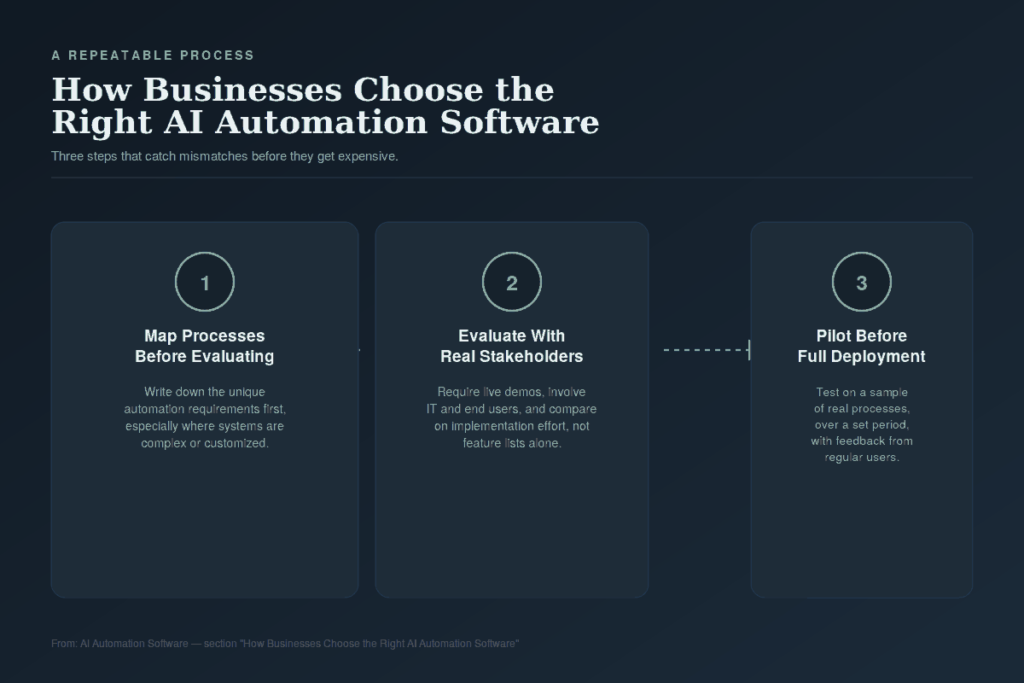
Mapping Processes Before Evaluating Software
Larger firms may decide to write down their unique requirements for automation initially, particularly when the systems being used are complicated or customized.
Software Evaluation Approaches Supporting Better Fit
Some evaluation approaches include companies which:
- Require real-time demos instead of just product demonstrations
- Include IT personnel and users during the evaluation process
- Make comparisons based on the implementation process rather than functionality
Piloting Before Full Deployment
The organization conducts pilots in relation to:
- A sampling of the processes which will be automated.
- A specific period of time to assess success.
- Inputs from the people who will use the software on a regular basis.
The process allows for an assessment of how well the software will function before implementation.
Common AI Automation Software Mistakes
Choosing Based on Category Labels Alone
If all software branded as “AI automation” has equal capabilities without verifying its actual performance.
Underestimating Implementation Complexity
If the effort required for configuring software according to existing processes is not taken into consideration.
Ignoring Total Cost of Ownership
When attention is paid only to the cost of software licenses without any regard to implementation and maintenance expenses.
Poor Stakeholder Involvement
Lack of input from:
- IT staff dealing with integration and security issues
- End users who will deal with the automated systems on a regular basis
- Management interested in business results
Problems with stakeholder engagement may result in well-engineered but underused software.
Bottom Line
There is plenty of variation among AI automation software, with many things to consider, such as improvements in RPA, BPM, stand-alone AI, deployment methods, and total cost of ownership.
In light of the extent to which labeling of categories may hide significant differences in ability, it would be better for organizations to chart out their own processes and pilot the software.