What Are the Best AI Workflow Automation Tools: What the Question Actually Depends On and Why It’s Easy to Get Wrong

Introduction
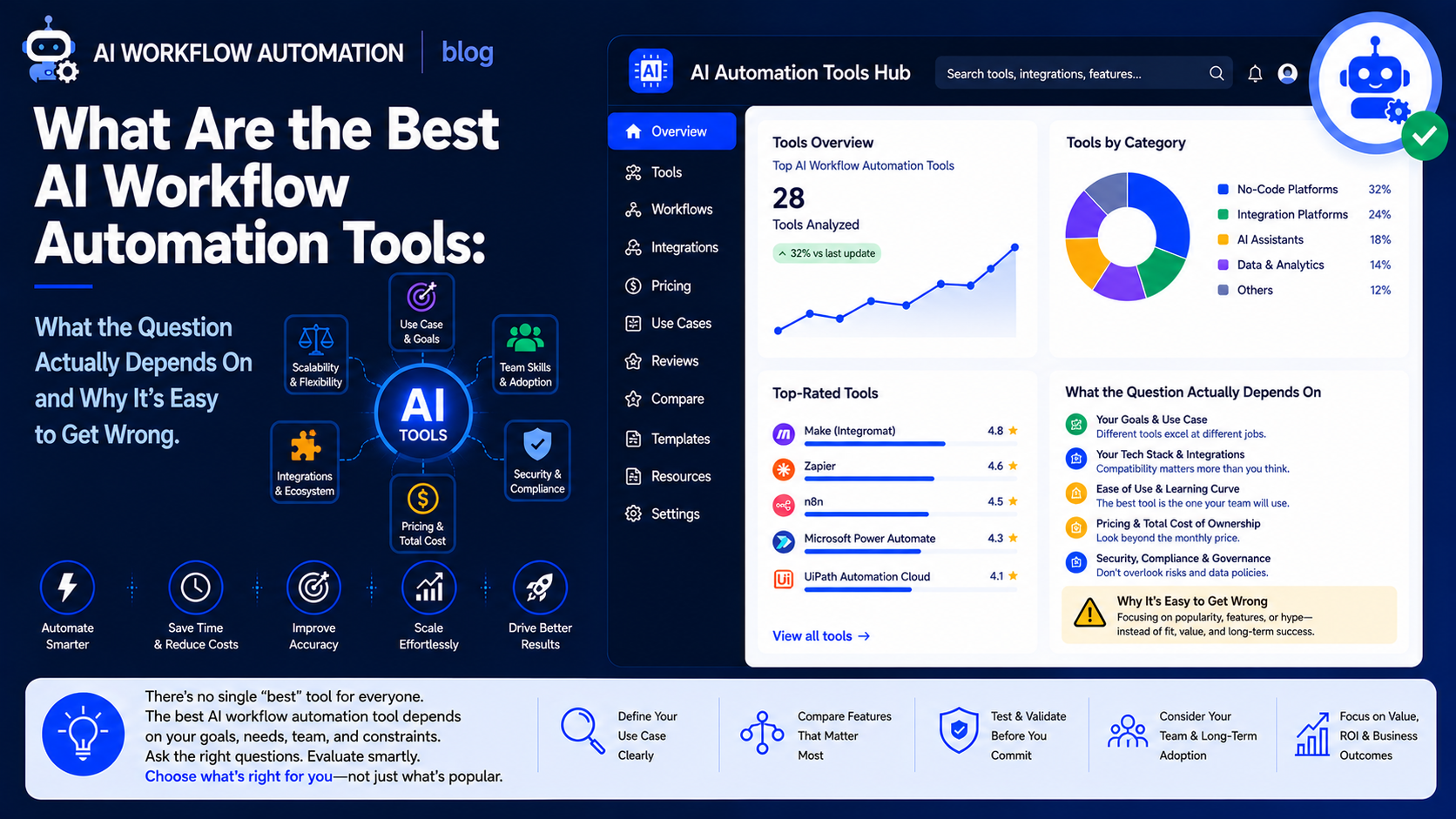
What is the right AI workflow automation tool for an organization? There isn’t one universal tool that is always correct for any business but there are a range of factors that need to be considered in order to determine the right choice.
It may sound quite obvious, yet there are plenty of variables that need to be taken into account when making comparisons.
Why This Question Is More Complex Than It Appears
When comparing AI workflow automation solutions, the comparison process is not one monolithic effort but rather consists of several components, which include:
- Organizing tools according to their capabilities in terms of the type of workflow
- Balancing simplicity and customization
- Evaluating the cost in relation to the actual benefit
Some users seek a definitive list of best solutions without taking into account the fact that there is no one-size-fits-all solution and what works for some will not work for others.
In the case of a business comparing AI solutions, the criteria should be established first prior to evaluating solutions since the best tool for simple marketing automation won’t be suitable at all for complicated multi-system workflows.
Major Factors in Comparing AI Workflow Automation Tools
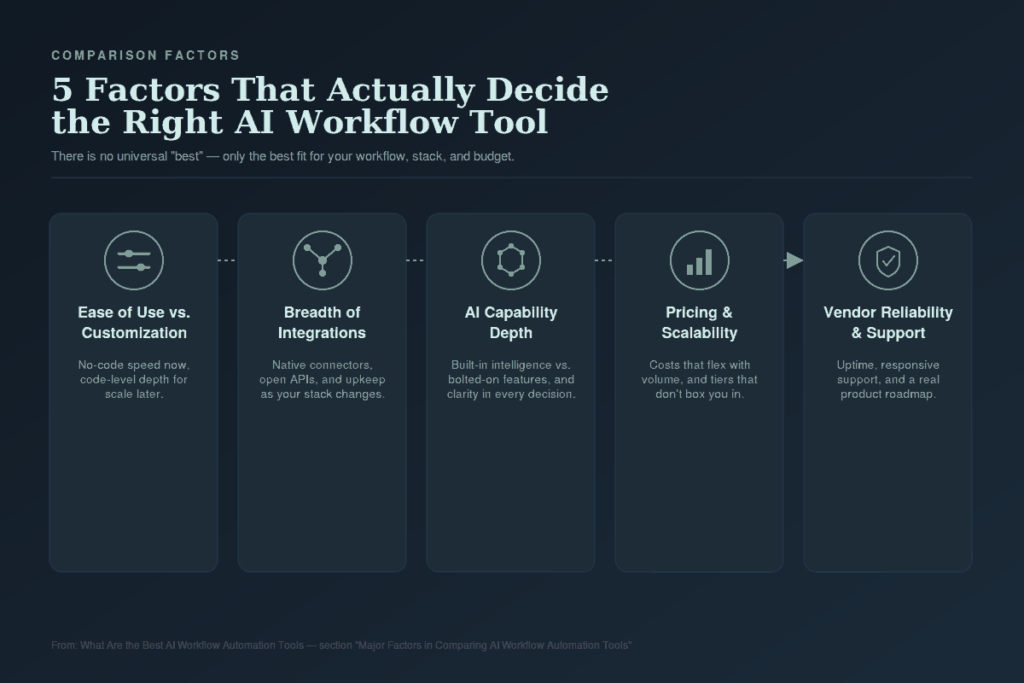
Ease of Use Versus Customization Depth
Rules Governing:
- User interfaces created without coding for non-technical people
- Code-enabled platforms that allow for advanced customization
- The balance between speed and future scalability
Focus on simplicity and user friendliness only is one of the most prevalent strategies since it could lead to:
- Quicker implementation in case of straightforward uses
- Difficulty when more complicated workflows emerge
- Eventually having to move to a better-suited platform
Breadth of Integrations
It is usually the case that the best applications for any particular company have great integration capabilities, as these should be compatible with what the current software stack is already using.
Integration Considerations Often Include
- Native connectivity to popular business applications
- API connectivity for custom or niche systems
- Maintaining current integrations
AI Capability Depth
Handling involves more than mere trigger-response automation; it includes the rising significance of actual AI capabilities such as natural language processing and prediction.
Those AI Capabilities Usually Vary in Many Respects Including:
- AI capabilities that are integral to the platform versus bolt-ons later on
- Accuracy and reliability of AI-powered decision-making in workflow processes
- Transparency as to how AI makes its decision-making process
Pricing and Scalability
Tools that are most effective for growing organizations depend on various factors, such as:
- Scalability of costs with use volume and complexity of workflow
- Accessibility of features in expensive tiers
- Ability to change the plan based on changing requirements.
Choice of the right tool depends greatly on your scale and growth prospects.
Vendor Reliability and Support
The following assessments demand that companies take into account certain considerations, such as:
- Reliability of the platform
- Quality and promptness of customer service
- Frequency of updates and future plans for the products
These considerations must be taken into account because faulty tools or poor customer service can ruin a good automation process.
Why Generic “Best Tools” Lists Often Mislead Buyers
Finding an appropriate tool through the list of generic tools is usually not difficult because the lists do not give an accurate portrayal of the tools.
Actually, discrepancies may occur due to the following reasons:
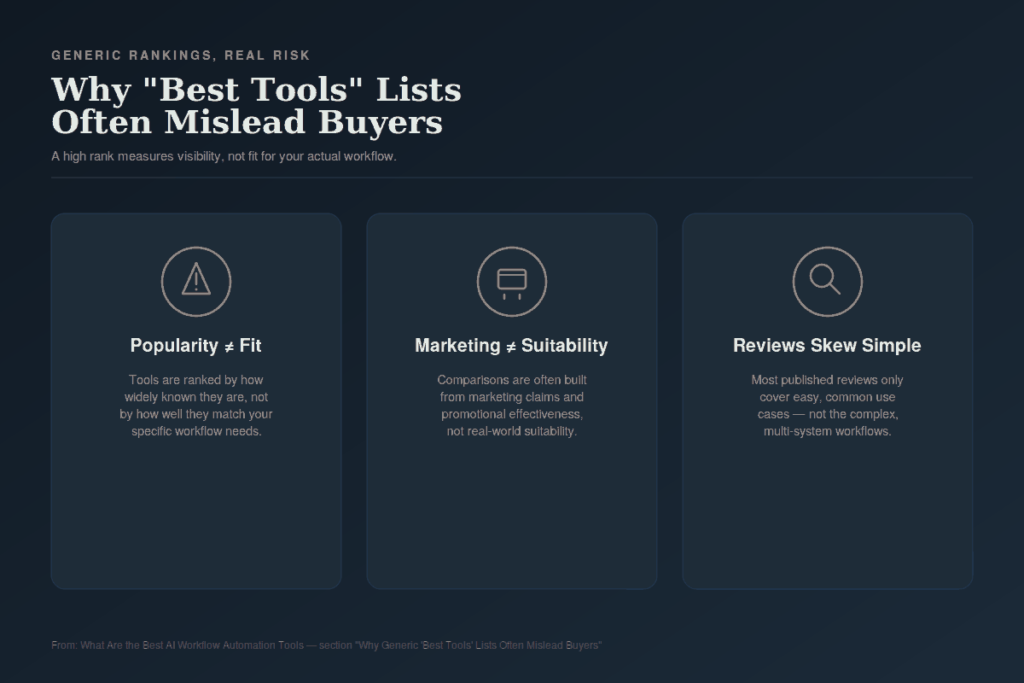
- Tools are ranked according to their popularity but not their appropriateness in different scenarios.
- Comparing tools is mostly done on the basis of marketing effectiveness, not appropriateness.
- Reviews often take into account easy-to-use cases only.
How Businesses Identify Genuinely Suitable Tools
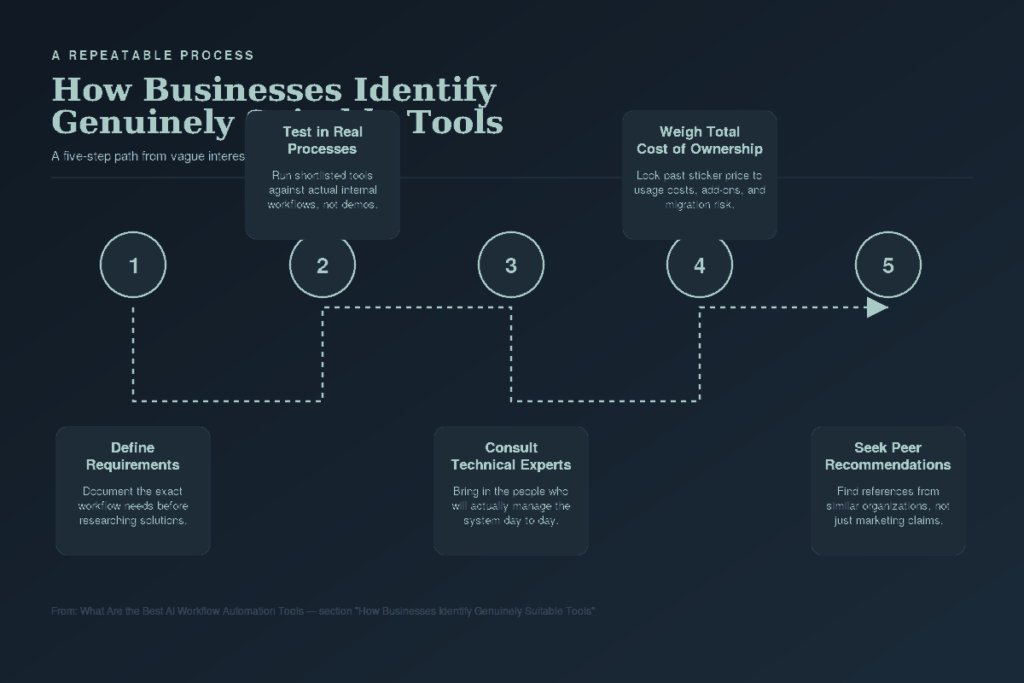
Defining Specific Requirements First
Larger organizations often decide to document the exact requirements of the workflow before looking for possible solutions, especially when the process is complicated or unique to the specific industry.
Comparison Approaches Supporting Better Decisions
Some of the approaches used by businesses when evaluating include:
- Testing the shortlisted software in actual internal processes
- Engaging technical experts who will manage the selected system
- Looking at total cost of ownership as opposed to just price
Seeking Recommendations From Similar Businesses
Research conducted by organizations involves:
- Case studies/references from organizations that are similar in size and industry
- Community discussion forums on practical issues of implementing solutions
- Testing rather than just depending on marketing statements
By searching for relevant suggestions, organizations can ensure that the tools they are planning to use have been tested in similar situations.
Common Mistakes When Researching the Best Tools
Trusting Generic Rankings Without Context
Selection of a tool based on a general “best of” list without checking its suitability for internal needs.
Overweighting Popularity
Believing that the most popular tool is always the best choice without considering the complexity of the use case.
Skipping Hands-On Testing
Dependence on marketing information alone without validating the tool with an internal test.
Poor Long-Term Cost Consideration
Insufficient assessment of:
- Increasing costs based on increase in usage
- Costs for additional services or greater usage levels
- Migration costs for long term if scaling is not good
Improper cost assessment may result in extra costs far exceeding expectations.
Bottom Line
The problem of which are the best tools for automating AI workflows is quite broad and includes factors such as usability, connectivity, depth of AI capabilities, scalability of pricing, etc.
Having regard to how subjective the concept of “best” is, it would be more beneficial for businesses to set their own criteria and conduct tests than just follow any ratings.