AI Workflow Automation Governance: What It Actually Covers and Why It’s Easy to Get Wrong

Introduction
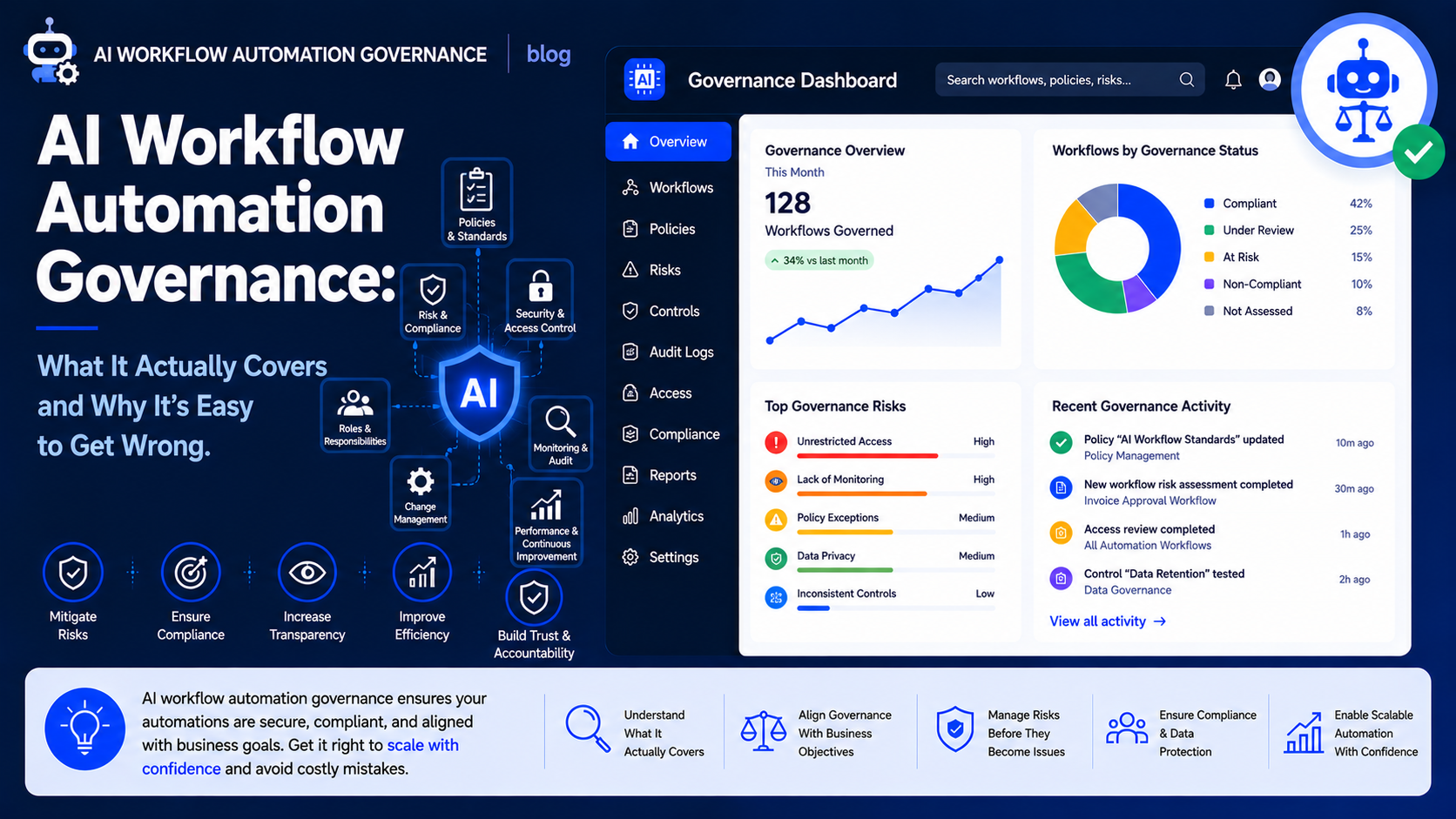
The governance of workflow automation in AI is about the policies and controls in place to guarantee that the systems work in a safe, ethical manner while being compliant, not just implementing automation without any checks at all.
This may sound relatively straightforward; yet, due to the large number of risks associated with automated decision making, it is a field that businesses tend to neglect until something happens.
Why AI Workflow Automation Governance Is More Complex Than It Appears
Governance, however, is not one single policy; rather, it is a framework composed of the following elements:
- Data protection and security measures
- Bias detection and fairness testing
- Automated decisions accountability framework
A number of organizations implement governance only as an afterthought after automation is operational, and such an approach leaves room for undetected risks until they cause some serious consequences.
As far as the governance implementation in the organization using automation in different processes goes, governance has to be implemented separately for each process, as the risks associated with automating a low-risk internal decision-making process are very different from those associated with automating customer decisions.
Major Areas of AI Workflow Automation Governance
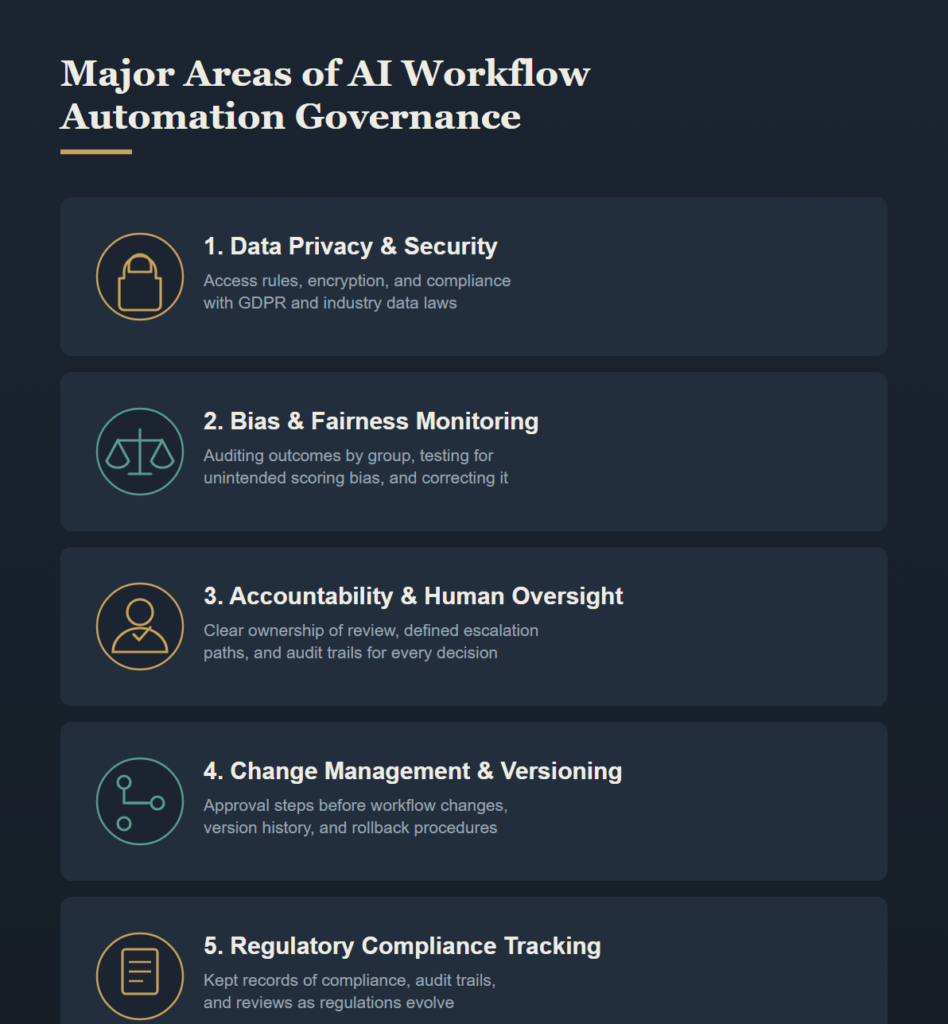
Data Privacy and Security Controls
Rules Governing:
- The type of data that an automated workflow is allowed to process and access
- Encryption and access to sensitive data
- Regulation compliance such as GDPR or other industry-specific laws regarding data
Lack of data control measures is one of the most common and expensive governance problems since it could lead to:
- Processing of data by automated workflow outside its scope
- Penalties due to violation of laws
- Customer distrust after a data breach
Bias and Fairness Monitoring
Ongoing monitoring will generally be necessary in the case of AI workflow governance since organizations need to follow the principles of fairness in their decision-making, especially where people are directly involved.
Fairness Monitoring Often Includes
- These include auditing of automated decision-making results by group
- Checking whether there is any unintended bias in AI-based scoring/classification
- Processes for correcting the bias, once detected
Accountability and Human Oversight
Resolution involves not just automated decision-making, but also a growing emphasis on human accountability whenever something goes wrong.
Accountability Structures Usually Vary in Many Respects Including:
- This includes who would be responsible for reviewing automated decisions
- What should happen in case of an unexpected outcome from automation
- Trails for audit purposes
Change Management and Version Control
AI workflow governance may entail:
- Approval process documentation prior to implementing any changes to the workflows
- Versioning to understand the evolution of the logic used for automation
- Roll-back process in case the changes cause issues
The maturity level of such controls varies based on the regulatory nature of the sector and how critical the automated decision-making is.
Regulatory Compliance Tracking
Some governance frameworks mandate that certain documents must be kept by firms, including:
- Documents showing compliance with AI regulations
- Documentation of audit trails of automated decision-making in regulated industries
- Compliance reviews due to the evolving nature of regulations
This documentation needs to be kept as a result of the dynamic nature of AI regulation.
Why Governance Gaps Happen Even at Well-Intentioned Organizations
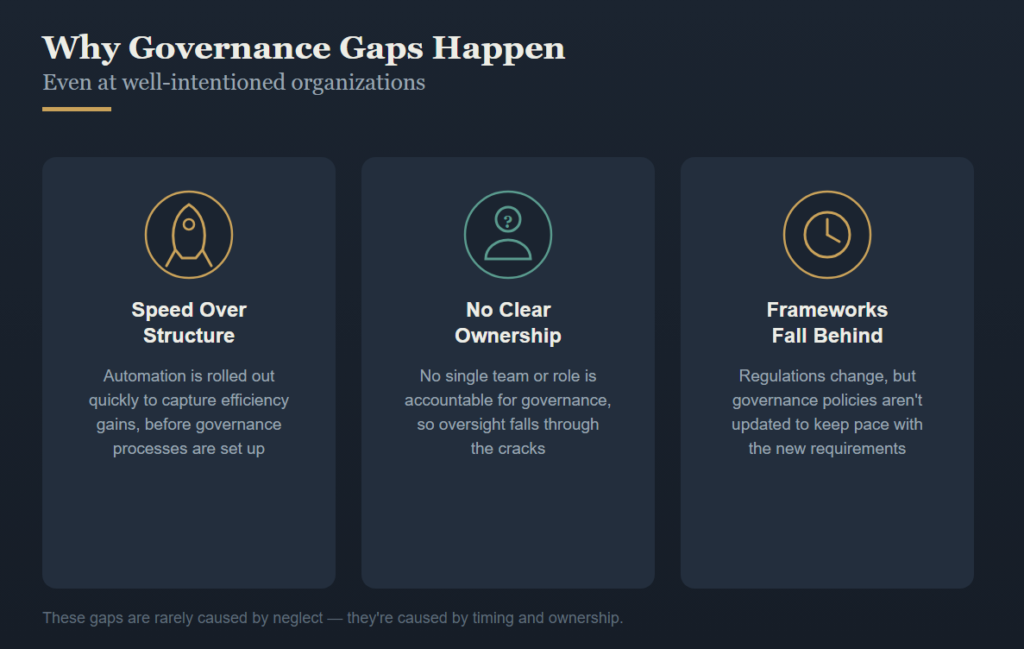
The reason why there isn’t proper AI governance isn’t that it is neglected by the management.
Actually, the absence of such governance could occur due to:
- Rapid implementation of automation to benefit from its efficiency prior to setting up the governance processes.
- There is no governance accountability for any particular team or position.
- Regulatory changes do not lead to updating governance frameworks.
How Organizations Build Effective AI Governance
Establishing Governance Before Scaling Automation
Some large organizations can create a governance framework prior to implementing widespread AI automation, particularly in circumstances where decisions have an impact on customers and/or employees.
Governance Practices Supporting Responsible Automation
There are several ways to implement governance that allow organizations to:
- Assign ownership for decision monitoring
- Perform audits for bias and fairness
- Maintain appropriate documentation
Ongoing Governance Reviews
There are periodic reviews of:
- Governance policies’ alignment with regulations
- Audits on bias and/or unintended consequences
- Employee awareness of governance responsibilities
Such periodic reviews allow organizations to ensure that the governance framework changes along with regulations and automation.
Common AI Workflow Automation Governance Mistakes
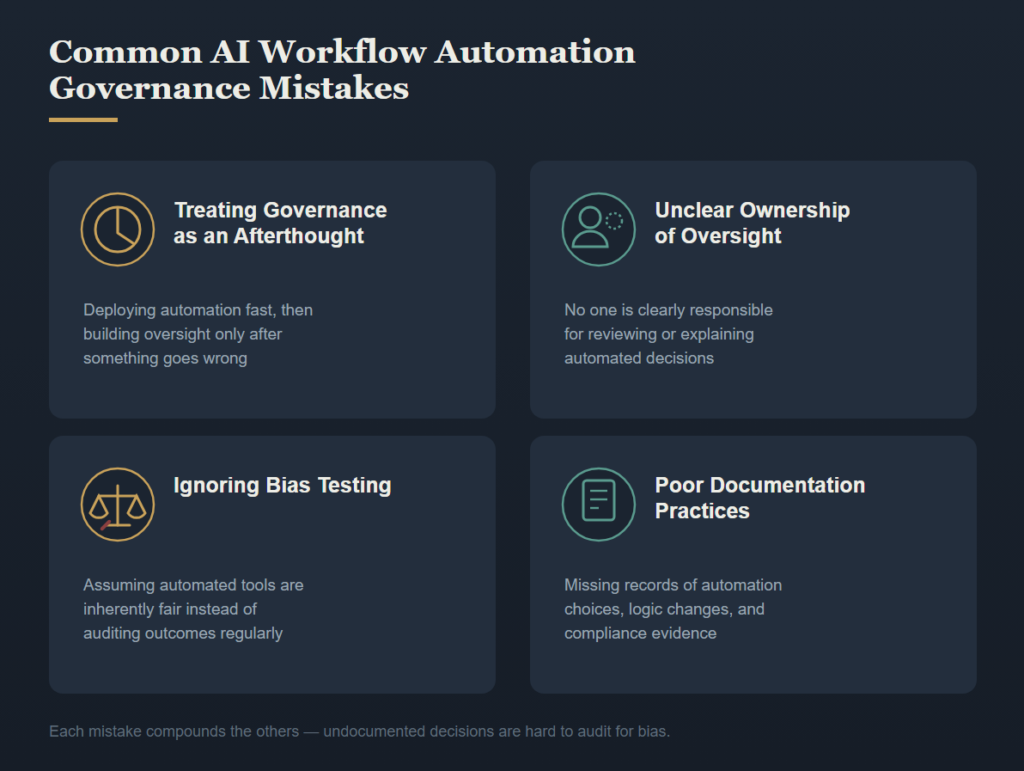
Treating Governance as an Afterthought
Fast deployment of automation and creation of governance mechanisms after something goes wrong.
Unclear Ownership of Oversight
Failure to ensure clear responsibility regarding the review and analysis of automated decisions.
Ignoring Bias Testing
Expectation that automated tools will be inherently just without auditing outcomes regularly.
Poor Documentation Practices
Documentation issues include:
- Reasons for choosing particular automation choices
- Any changes to the automation logic throughout its lifespan
- The compliance documentation that would be required for regulatory audits.
Documentation issues can lead to considerable risks for both regulators and reputation.
Bottom Line
The governance of AI workflow automation is very varied and involves many different issues, which include data privacy, bias detection, accountability, change management, and compliance.
Given that the risks of automation can remain undetected unless there is sufficient oversight, it is better for companies to have their governance systems in place prior to scaling automation efforts.