Landscaping CRM: What It Actually Covers and Why It’s Easy to Get Wrong

Introduction
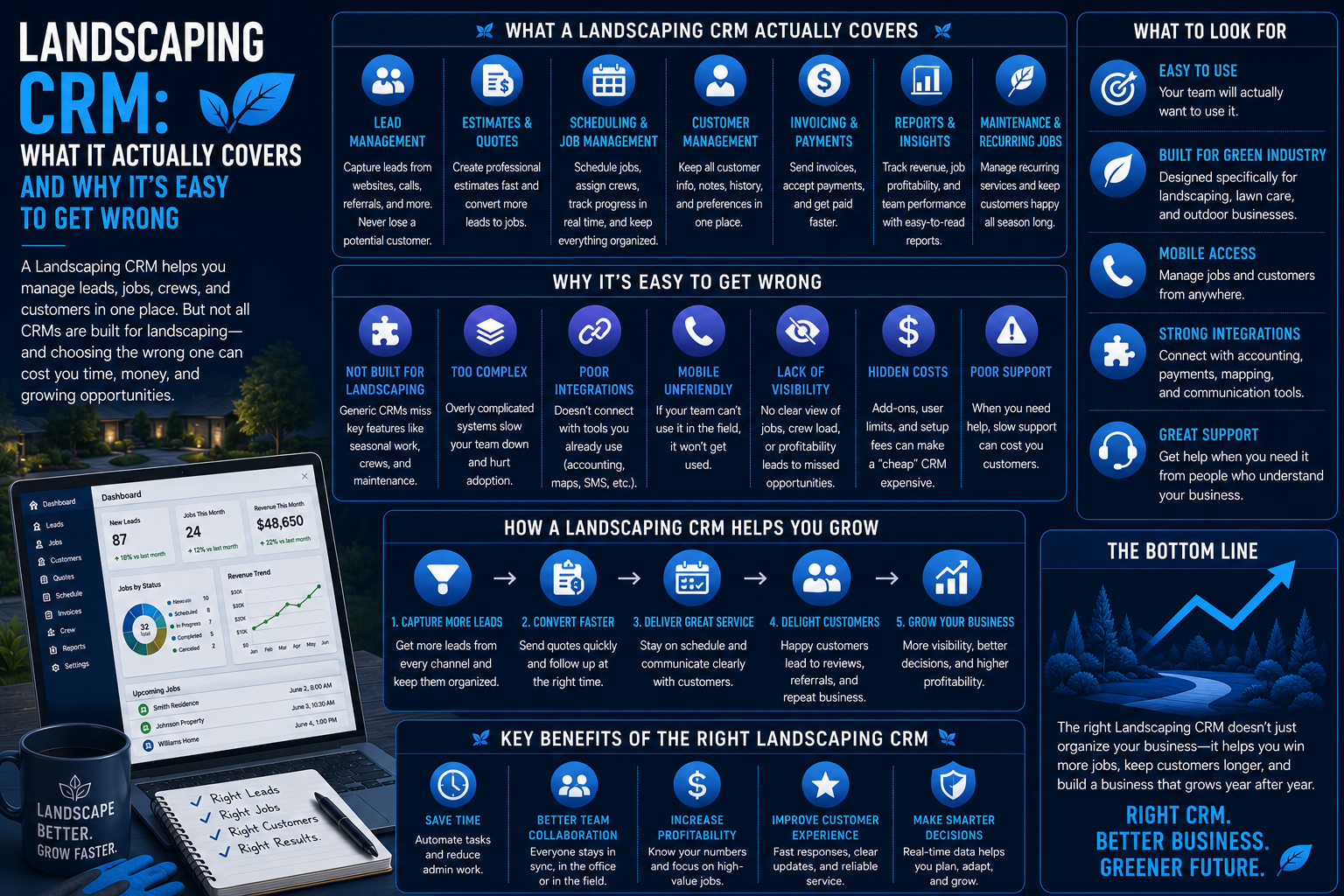
Landscaping CRM refers to a software solution that deals with managing customers as well as scheduling, estimating, and tracking jobs associated with the landscaping and lawn care industry, not sales-based CRM customized for field service businesses.
It may appear quite straightforward at first sight; nevertheless, due to the large number of elements involved in the process, it becomes one of those aspects of business that is often overlooked.
Why Landscaping CRMs Are More Complex Than They Appear
The customer relationship structures of the landscape industry are not a singular structure but a composite structure comprising of the following:
- One-off project customers
- Regular maintenance agreement customers
- Weather-based scheduling
A few CRM programs have not incorporated scheduling and route optimization into their processes, which necessitates that landscaping businesses use separate systems for their work.
When it comes to businesses dealing with regular maintenance agreements, the schedule has to be set up uniquely for each individual client, depending on their frequency of maintenance service requirement, as this affects their retention rate.
Major Areas of Landscaping CRM Functionality
Estimating and Quoting
Rules Governing
- Quotes generated from sizes of properties and services required
- Transferring approved quotes into schedule appointments
- Generating Quote to Close metrics
Estimating done manually and independently is among the common and expensive deficiencies because it could lead to:
- Delayed quote submission causing loss of business to competitors
- Price variation in similar projects
- Lack of visibility on quote conversions

Scheduling and Route Optimization
CRM solutions for landscaping services usually provide scheduling facilities, meaning that crews have to follow efficient daily schedules which involve reducing the time needed to move from one site to another.
Scheduling Features Often Include
- Job scheduling for regular maintenance contracts
- Drag-and-drop calendar
- Optimization of routes according to crew location
Customer Communication and Reminders
The term handling includes not just manual calling but also the growing trend of using automated reminders regarding appointments or services.
Those Communication Tools Usually Vary in Many Respects Including
- Time to send automated reminder before visiting
- Medium through which it is sent (text/e-mail/both)
- Request for review after completion of job
Invoicing and Payment Tracking
Financial features provided by landscaping CRMs may include:
- Invoicing generated automatically when the job is done
- Payment collected online
- Recurring contract billing tracked
These financial features differ in depth according to the presence or absence of native invoicing in the CRM.
Crew and Job Tracking
Some CRM systems in landscaping involve maintaining visibility of certain details such as:
- The status of the job and confirmation of completion
- Pictures proving that the job was completed
- The crew’s hours for each job and productivity
This should be done continually for controlling labor costs and resolving customer complaints.
Why Landscaping Software Failures Happen Even at Growing Companies
It is rare that failure to leverage CRM systems occurs due to a business’ complete disregard of the necessity.
Indeed, such shortcomings can arise from the following reasons:
- Business uses a spreadsheet right from its infancy without migrating to specific software as it expands.
- Seasonal employees are not always trained properly in relation to scheduling and updates.
- Route optimization capabilities remain unused owing to the habitual behavior of crews.
How Landscaping Businesses Choose the Right CRM
Evaluating Field-Specific Features
Large landscaping firms may choose a platform specifically designed for field services if their business is heavily dominated by recurring contracts.
CRM Features Supporting Field Operations
There are various CRM software platforms for landscaping firms with features such that they can:
- Schedule recurring jobs based on the details of the contract
- Send automatic reminders for reducing no-show and cancellation instances
- Calculate profitability of the jobs by estimating the time taken
Seasonal Process Reviews
Periodic review is done by organizations on:
- Scheduling efficiency for peak seasons
- Retention of customers under recurring agreements
- Adoption of mobile systems for job tracking by crews
Periodic reviews allow organizations to ensure that the organization’s CRM system matches changes in the seasons.
Common Landscaping CRM Mistakes
Sticking With Spreadsheets Too Long
Continuing to handle scheduling and client information manually when a separate CRM system would greatly reduce time spent doing so.
Ignoring Route Optimization
Not using the integrated routing features, causing additional driving time and fewer jobs per day.
Inconsistent Job Documentation
Enabling the crew to skip photo updates and status reporting, thus making it difficult to solve any customer grievances.
Poor Contract Tracking
Lack of visibility on:
- Which recurring contracts are due for renewal
- Service delivery frequency promise to each customer
- Past service record to support grievances
Ineffective management of the contracts may result in missing renewals and unnecessary customer loss.
Bottom Line
The use of CRM for landscaping companies is very varied and takes into account many issues including estimating, scheduling, customer communications, invoicing, and job tracking by crews.
Taking into consideration the amount of revenue that depends on proper scheduling, it would be better for landscaping companies to use a specific field service CRM rather than a sales CRM.