Digital Marketing Tools: The Main Categories and What They’re Used For

Introduction
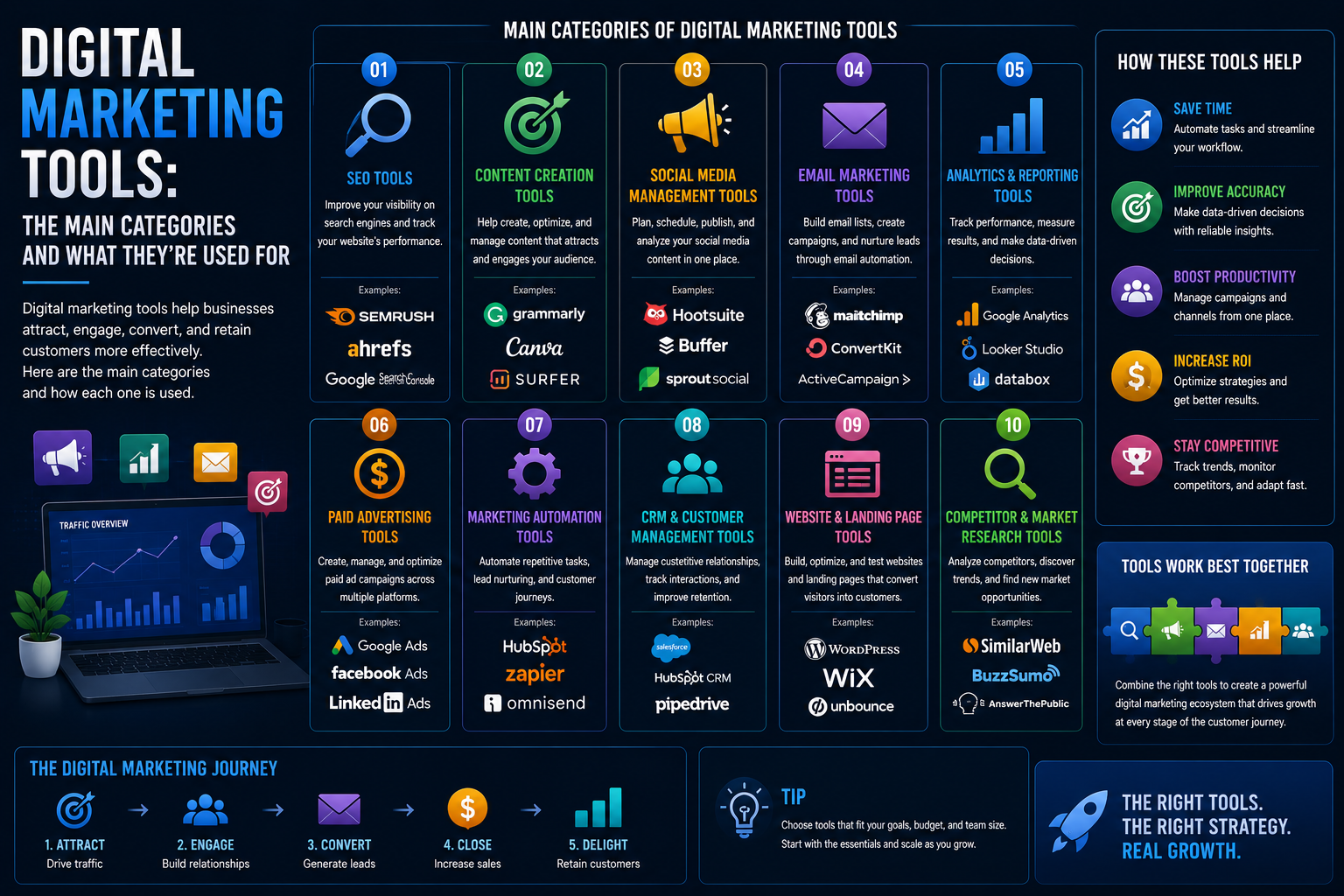
The digital marketing tools refer to computer software systems that are used for planning, implementation, monitoring, and optimization of online marketing efforts through SEO, paid advertising, social media, email, and analytics.
In this paper, an exhaustive review will be provided on the different types of digital marketing tools, their examples, and decision criteria that are commonly applied by marketers to choose the appropriate tools.
Why Digital Marketing Relies Heavily on Software
While the traditional form of marketing utilized more manual methods as well as delayed feedback mechanisms, digital marketing is based on mediums that provide high amounts of data that can be tracked in real-time. As a result, this has led to the development of a wide range of software designed to facilitate marketing efforts by marketers.
Main Categories of Digital Marketing Tools
SEO Tools
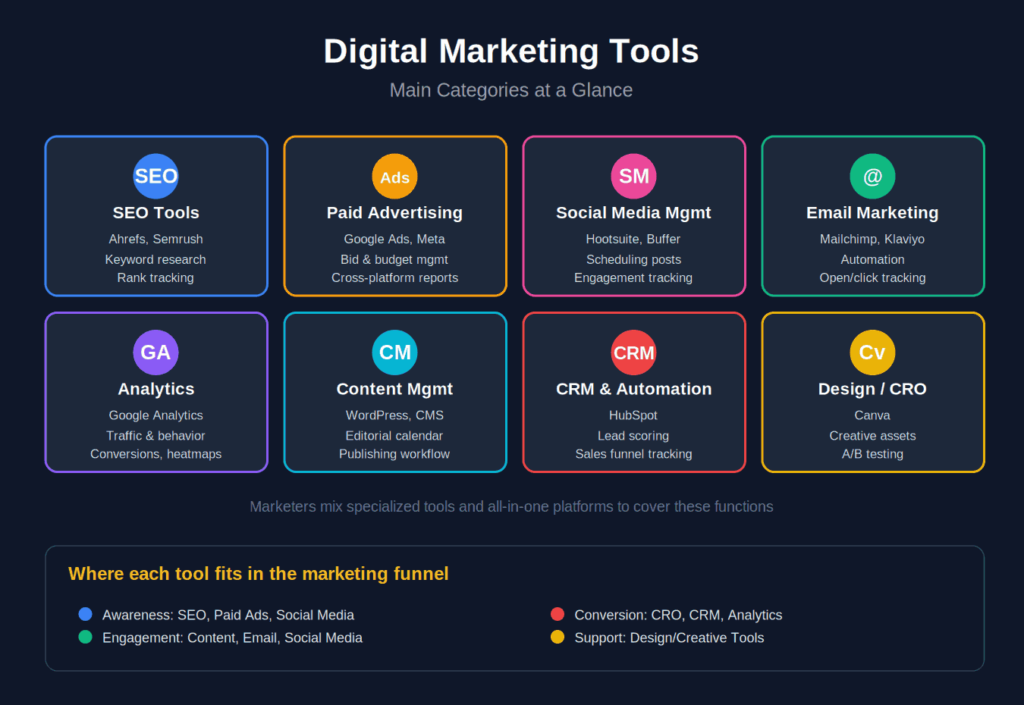
Has been used for keyword research, competitor analysis, website technical audits, and search ranking monitoring. Such tools as Ahrefs and Semrush usually include all of these services in one software package.
SEO Tools Are Used For
- Keyword research
- Competitor analysis
- Technical website audits
- Search ranking tracking
Paid Advertising Platforms and Management Tools
Advertising platforms like Google Ads and Meta Ads Manager help in creating, managing, and optimizing the ads directly. In addition, there are other external tools that help in managing the bids, budgeting, and reports in multiple ad networks.
Paid Advertising Tools Help With
- Campaign creation
- Campaign management
- Budget management
- Bid optimization
- Cross-platform reporting
Social Media Management Tools
These can be used to plan posts, manage different social media accounts using a single dashboard, measure engagement, and analyze the performance on various platforms. Some examples are Hootsuite and Buffer.
Social Media Management Features
- Features of Social Media Management
- Scheduling Posts
- Managing Multiple Accounts
- Measuring Engagement
- Performance Tracking
Email Marketing Platforms
It is used for designing, delivering, and automating email campaigns, managing subscriber lists, and measuring performance indicators like open and click-through rates. Examples of such tools include Mailchimp and Klaviyo.
Email Marketing Platform Features
- Email design
- Campaign automation
- Subscriber management
- Open rate tracking
- Click-through rate analysis
Analytics Platforms
Can be employed for monitoring traffic, actions performed by users, and conversions. The most popular software of this type is Google Analytics. It is usually used in conjunction with other types of analytics or heatmap software.
Analytics Functions
- Website traffic analysis
- Analysis of user behavior
- Analysis of conversions
- Heat map analysis
Content Marketing and Content Management Tools
Used for creating an editorial calendar, organizing content creation workflow, and publishing the content, often including CMS like WordPress along with other planning and collaboration software.
Content Management Activities
- Planning the editorial
- Workflow management
- Publishing the content
- Collaboration among teams
Customer Relationship Management (CRM) and Marketing Automation Platforms
These tools are used to handle leads and clients throughout the sales process; they integrate email marketing, lead scoring, and workflows in one tool. Tools like Hubspot fit into this broader category.
CRM and Automation Capabilities
- Lead management
- Customer management
- Lead scoring
- Workflow automation
- Sales funnel tracking
Design and Creative Tools
Utilized for creating the graphic materials required in the process of digital marketing through the use of software like Canva, which is common among marketers who lack design expertise.
Design Tool Uses
- Social media images
- Advertising images
- Marketing visuals
- Brand images
Conversion Rate Optimization and Testing Tools
These can be used to conduct A/B tests to better understand user behavior on the website and allow marketing professionals to make changes to increase conversions.
CRO Tool Functions
- A/B testing
- User behavior tracking
- Website optimization
- Conversion optimization
How Marketers Typically Choose Digital Marketing Tools
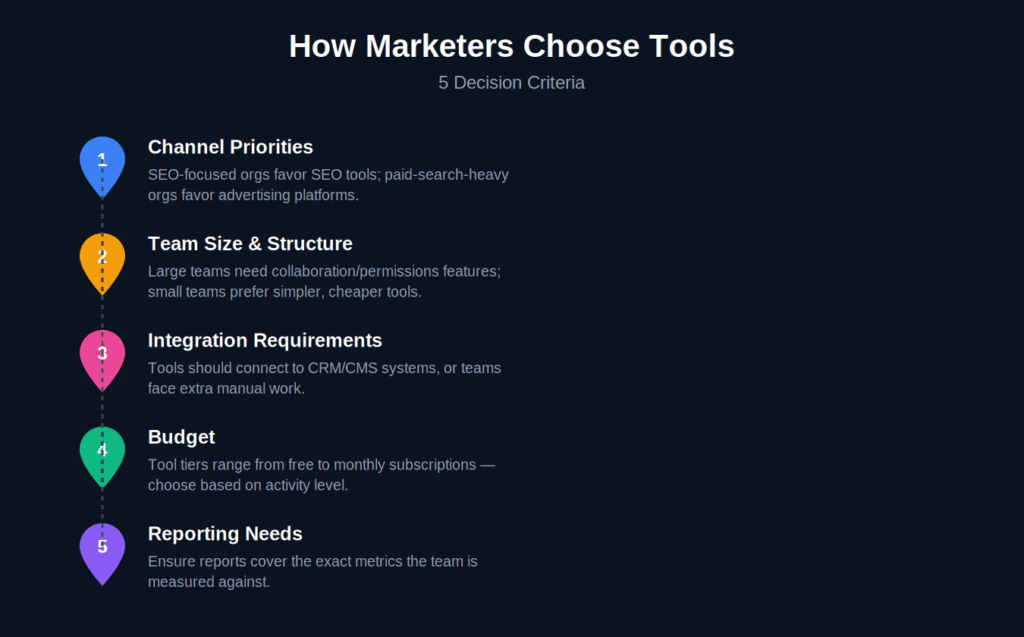
1. Channel Priorities
Since an organization that concentrates much on organic search would be emphasizing SEO tools while the organization that uses more paid search will emphasize advertising platform tools.
2. Team Size and Structure
While big teams will require better tools for teamwork and permissions, smaller teams or individual marketers would prefer simpler tools and cheaper ones compared to team
3. Integration Requirements
In case the tool is supposed to interface with other systems such as CRM or content management system because failure to integrate may lead to extra manual labor.
4. Budget
Because there are various levels of digital marketing tools depending on features offered, some even free, but there are others that require monthly payments, therefore, the correct level is dependent on the amount of activities.
5. Reporting Needs
Whether the tool is capable of providing reports that are sufficiently detailed for the particular metrics that the team needs to be measured against.
All-in-One Platforms Versus Specialized Tools
There are many digital marketing tools designed to perform one particular function extremely well; however, there are also digital marketing platforms that try to encompass multiple functions under one roof.
A combination of the two is quite common when companies adopt a platform that covers some functions, but use other tools for those which need more specialization.
Common Pitfalls When Adopting Digital Marketing Tools
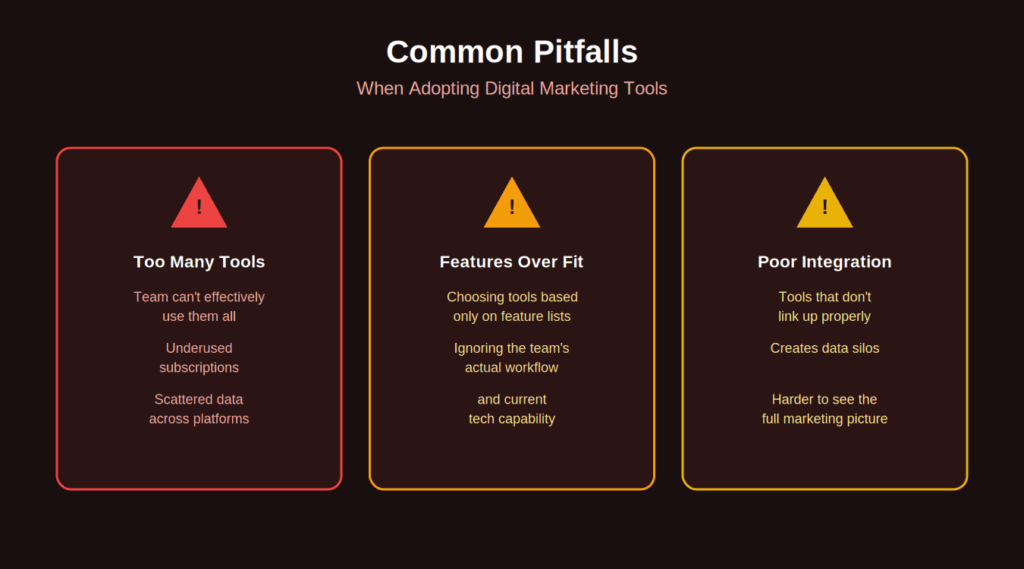
Adopting Too Many Tools
Having too many tools that a team cannot effectively use, resulting in underutilization of subscription and scattered data on different platforms.
Choosing Tools Based Only on Features
Selecting tools by comparing their features irrespective of their suitability for the team’s current workflow and technological capabilities.
Poor Tool Integration
An inability to effectively link up the various tools, leading to silos of information that make it more difficult to have an overall understanding of how the marketing efforts are performing.
Bottom Line
There are many different types of digital marketing tools to choose from, including SEO, paid advertising sites, email tools, analytics programs, and automation systems, all for separate marketing purposes.
The best way to select which ones to use is to match them to a company’s own channel needs, team size, and budget, as opposed to using them all or having one single program for everything.