AI Detector Tool: How to Choose the Right One

Introduction
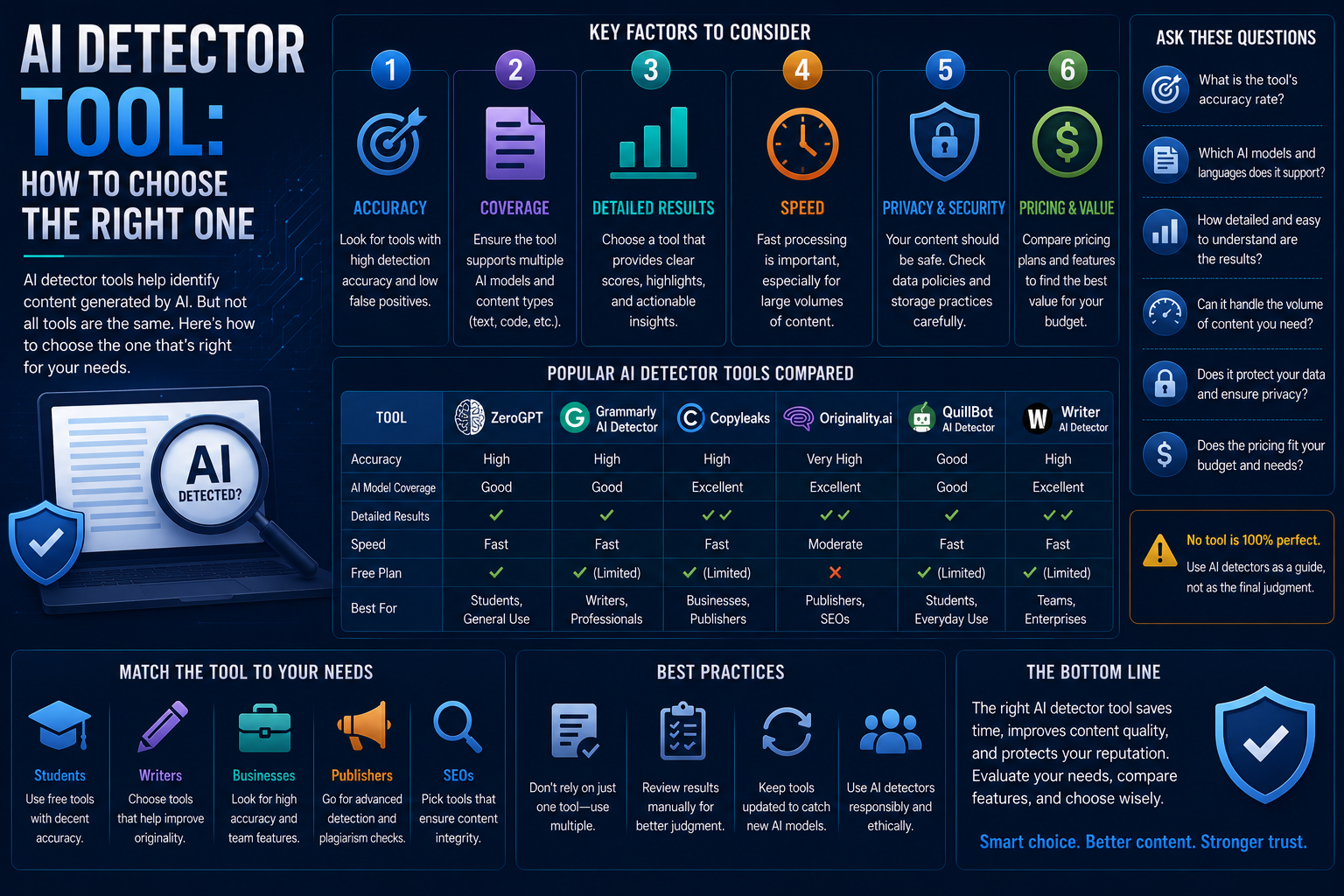
Any software product designed to assess the likelihood of content generation using artificial intelligence is referred to as an AI detector tool. As more such tools become available today, from browser-based versions which do not require installation to professional ones which provide access to an API, selection of the appropriate one will greatly depend on who needs it and why.
In this paper, we will examine a number of issues related to AI detector tools, such as their types and criteria for selection.
Why Tool Choice Matters in This Category
While there are other types of software where all of the different programs are essentially the same, different AI detectors will have varying degrees of effectiveness, features, and purposes.
A program that was developed for someone who needs to check one essay as a student will not be effective in detecting plagiarism in hundreds of different articles that need to be checked weekly by a publisher.
Selecting an AI detector solely on the basis of price or brand name is often a mistake.
Main Categories of AI Detector Tools
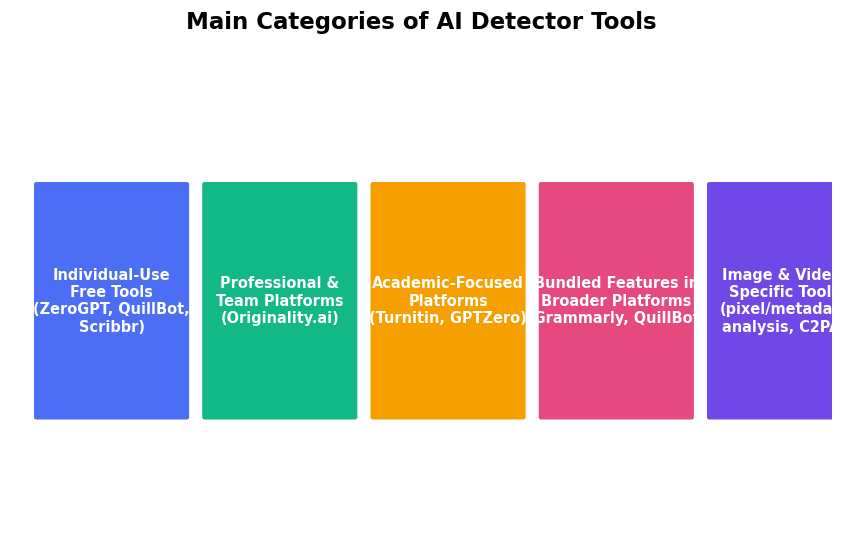
Individual-Use, Free Tools
Detection tools like ZeroGPT, the QuillBot detector, and the Scribbr checker are designed to be used instantly and sporadically by an individual, generally within set-word limits.
Professional and Team Platforms
Originality.ai tools and others similar to it are designed for use by content creation and publishing teams, providing:
- Batch scanning capabilities
- Team accounts
- Integration with editorial processes
Academic-Focused Platforms
Turnitin and GPTZero and similar tools are made for education establishments and have integration with LMS (learning management systems).
Bundled Features Within Broader Platforms
Tools like Grammarly and QuillBot provide AI detection as a secondary service to their writing tool offering, not as their main offering.
Image and Video-Specific Tools
There is another, more nascent set of offerings that are created solely for visual content analysis, which use:
- Artifact analysis at the pixel level
- Metadata analysis
- Provenance standards like C2PA
Key Criteria for Choosing an AI Detector Tool
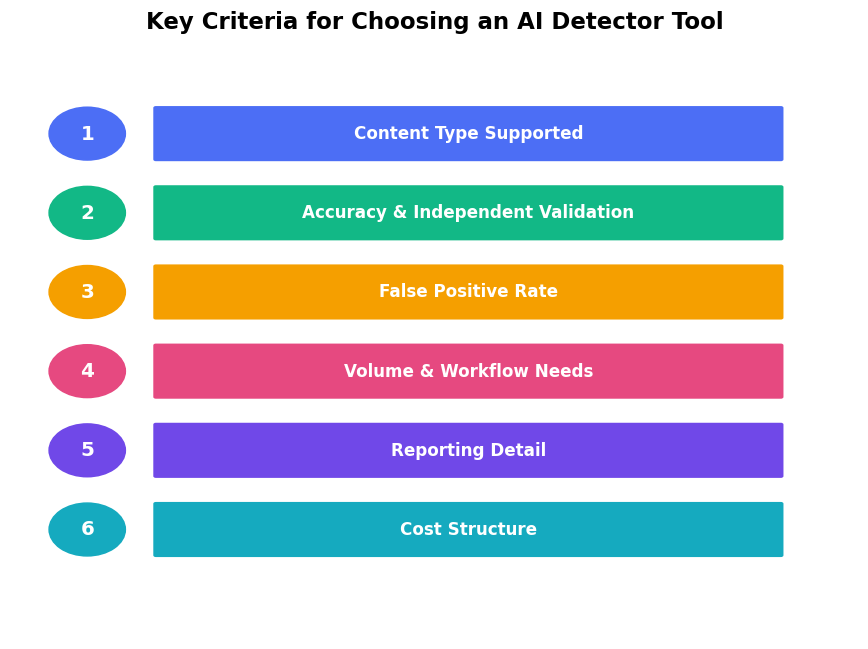
1. Content Type Supported
Ensure that the tool is created to check the particular type of content.
Detection of text, images, and videos uses different methods altogether, and therefore, using the wrong tool will yield negative results.
2. Accuracy and Independent Validation
Try to find a device whose performance has been tested independently from the company’s promotional materials because self-reported levels of accuracy differ greatly among them and are hard to confirm.
3. False Positive Rate
In high-stakes environments like those involving matters of academic integrity or conflicts between clients and freelancers, the software with a lower rate of false positives will typically be more useful than the one solely focused on catching all instances of artificial intelligence.
4. Volume and Workflow Needs
Individuals who check documents now and then need something entirely different from what is required by individuals in teams who check large amounts of documents frequently.
The following become essential for organizations:
- Batch processing
- API integration
- Content management systems
None of the above matters much to occasional individual users.
5. Reporting Detail
Tools that break down their alerts at the sentence level, rather than simply giving one score without any further explanation, are more helpful when making a judgment about whether or not the content should be accepted or rejected.
6. Cost Structure
For sporadic use and personal purposes, free versions suffice, but paid versions tend to be worth it when the number of times one uses the tool increases.
Matching Tools to Common Use Cases
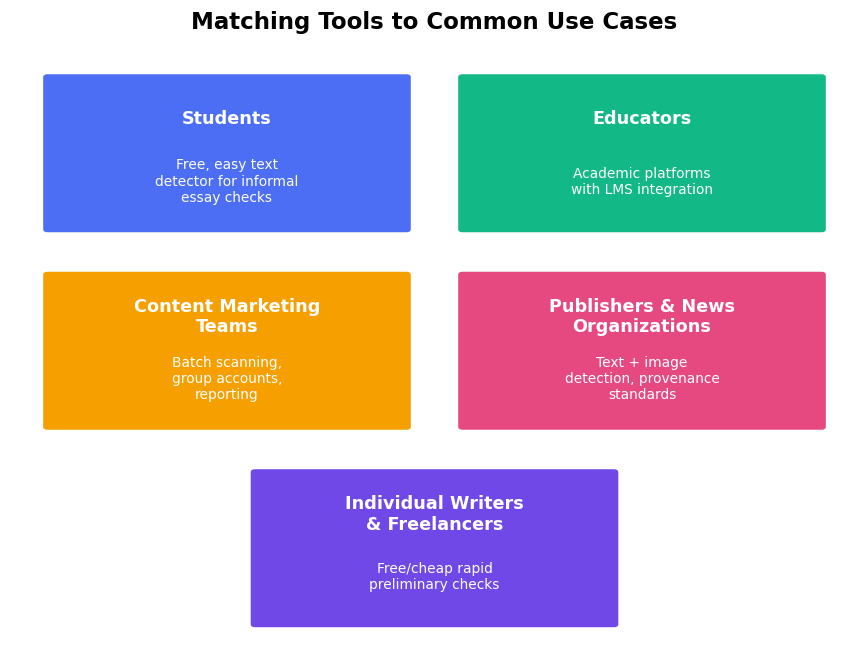
For Students
The free, easy-to-use text detector is enough for the informal check-up of an essay but students should know that there will be differences between the text detector employed at their institutions compared to free ones on the market.
For Educators
Those that are aimed at academia and integrate LMS as well as have functionality oriented toward evaluation of submitted student papers would likely suit better compared to general consumer-oriented products.
For Content Marketing Teams
Those that have:
- Batch functionality
- Group accounts
- Reporting focused on reviewing freelancer/agency submitted content
would provide more practical benefit, since checking one paper at a time is not really scalable.
For Publishers and News Organizations
Text and image detection both can be relevant, especially in terms of authenticating photographs uploaded along with text.
These companies can benefit from solutions which either cover multiple content types or work with provenance standards.
For Individual Writers and Freelancers
Any free or cheap detector that can serve as a rapid preliminary check before submission is normally sufficient, without having the batch or team functionality geared towards corporations.
What No AI Detector Tool Can Currently Guarantee
No matter which service is selected, it is absolutely standard for all detectors in the category to provide both false positives and false negatives, especially concerning:
- AI text that is paraphrased or edited heavily
- Text written in non-native English language
- The output of advanced models specifically developed to generate human-sounding text
No available detector can be considered as delivering an absolute final conclusion.
All providers of detectors now consider the results to be merely an estimation of probabilities.
Bottom Line
It is important that when choosing an appropriate tool for detecting AI, consideration is given to how that tool was designed to be used, whether it will be for personal or team use, written or image-based work, casual or high-stakes projects, instead of just selecting the more widely known tool.
In any case, when using the tool chosen, it should always be considered just one of the inputs in making decisions, especially when the stakes are high.