AI Text Detector: How Written Content Gets Flagged as AI-Generated

Introduction
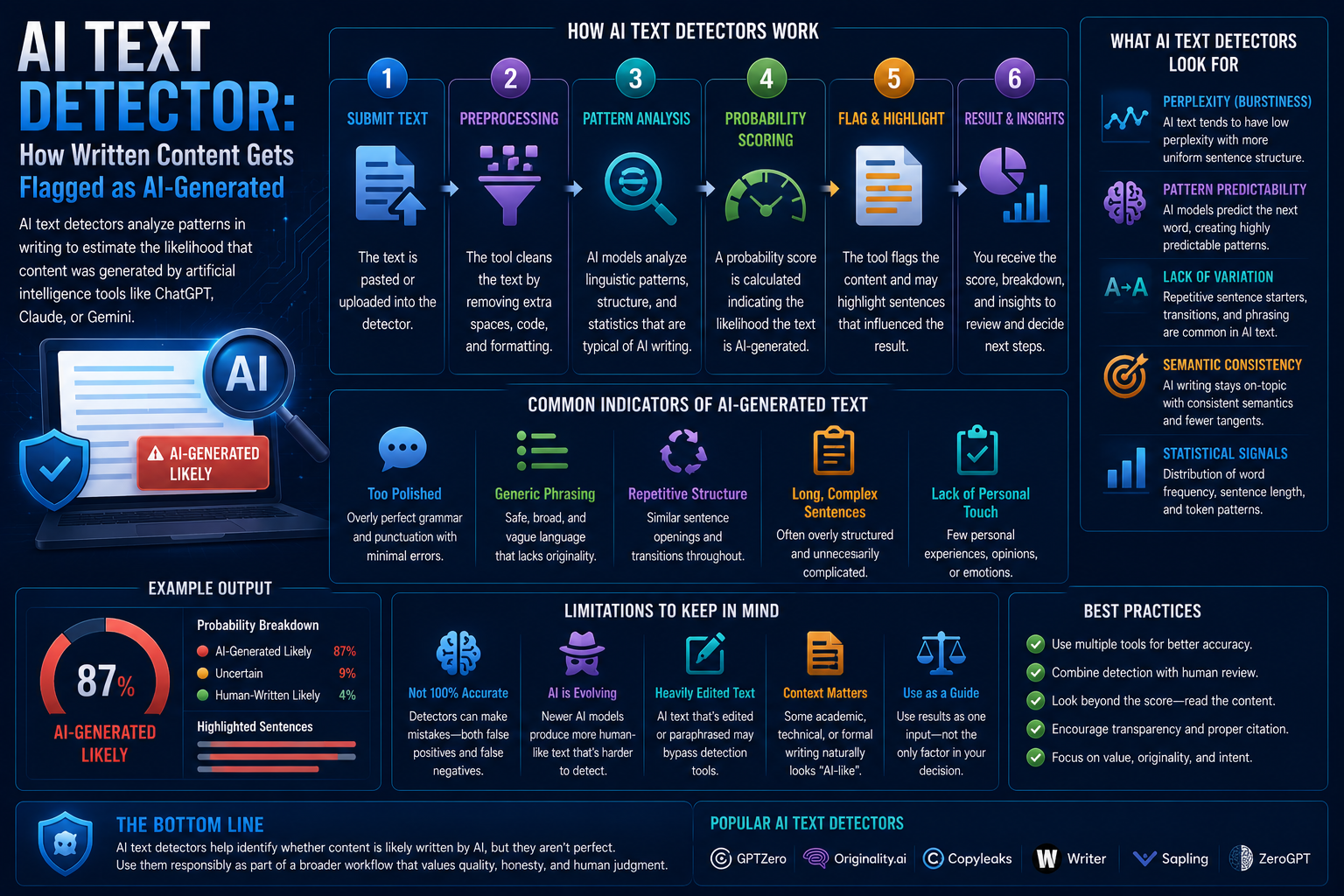
The AI text detector is a specialized software designed to examine the texts like essays, letters, articles, and reports and make an estimate if the content was produced using the language model or written by a human being. Although AI detectors include various media types like videos or pictures, text detection is one of the most developed and common branches of the technology due to the fact that large language models are the first kinds of generative AI to be widely used. This article will discuss the topic of AI text detectors in depth.
What Makes Text Detection Distinct
While image/video detection is mostly dependent on visual artifacts and metadata, AI text detection is solely dependent on the actual words used, their structure in sentences and statistical representation of ideas expressed. This means that text detection is not only the most evolved aspect of the field but also the one that may be considered the most challenging to achieve high accuracy in.
The Core Signals AI Text Detectors Look For
Perplexity
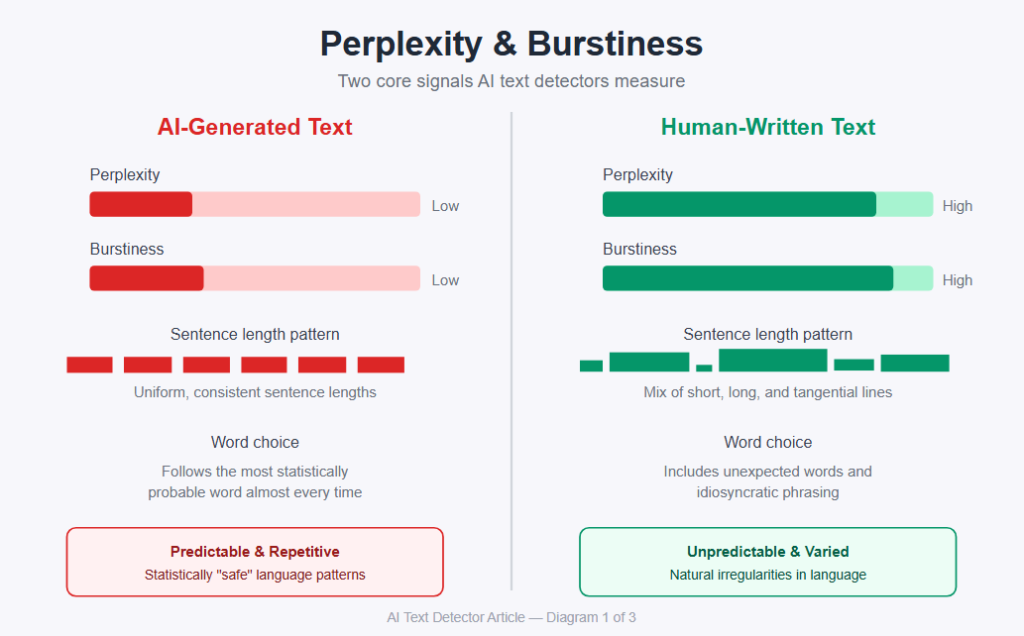
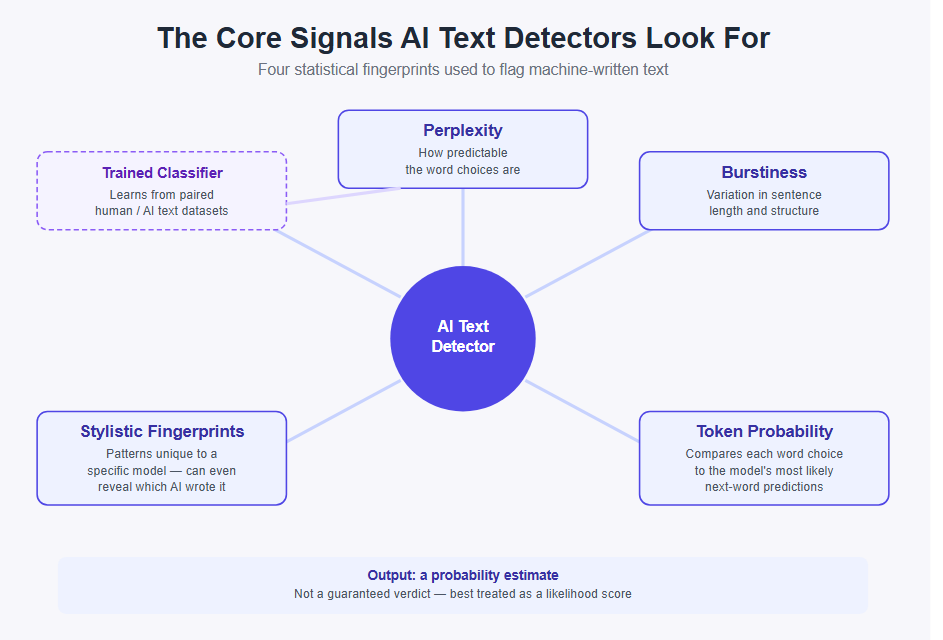
Perplexity refers to how predictable something is in terms of text for a language model. The output from AI models will generally have a lower perplexity, seeing that it is statistically probable that a certain word follows another. Human-written text will generally have more unexpected words, hence higher perplexity.
Key Points
- Determines predictability of text
- AI-generated text tends to have low perplexity
- Human-generated text often has unpredictability in terms of language usage
Burstiness
Burstiness refers to the variation in sentence length and structure in text. Human authors tend to use both short and long sentences in their texts, along with tangential ideas and changes in the structure of the text. AI-generated text has a tendency to be uniform.
Key Points
- Analyzes the difference in structure of sentences
- Writing by humans is usually more varied
- Text produced by AI is usually more consistent
Token Probability Distributions
Better detection software analyses the distribution of probabilities of each word choice compared to what the language model predicts at each stage of text generation. Text where almost all words match the most probable choices is more likely to be labeled as machine-generated.
Key Points
- Analyzes the probability for each word
- Measures the text against the language model’s probabilities
- Higher probabilities for words could mean AI detection
Stylistic Fingerprints
There are detectors that are designed specifically to detect certain patterns that a particular model usually generates, like certain writing styles, transitional words, or certain patterns that the model usually defaults to. With this, certain detectors can not only identify whether or not the text was generated by an AI but can even determine which AI model generated it.
Key Points
- Identifies writing style features that are unique to particular AI models
- Utilizes methods of model fingerprinting
- May be able to determine which AI model produced the writing
How AI Text Detectors Are Trained
Most classifiers are developed based on classifier models, which are trained on vast paired datasets of human and AI-generated text. The model is able to identify the difference between the two categories and then apply the learned differences to new texts. This is highly dependent on the quality and diversity of the training dataset used.
Where Text Detectors Struggle
False positives are quite frequent when using AI detectors in certain specific scenarios where the false positive issue is quite clear:
- Text produced by non-native English speakers may be less bursty and more structured, leading to false positives as it is detected as AI writing.
- Text generated by an AI, heavily edited and paraphrased with an aid such as QuillBot’s paraphrasing tool, may fail the detector despite being created using the AI initially.
- Short samples of text are more difficult to grade as there are fewer statistical indicators that can be relied on to detect AI writing, such as perplexity and burstiness.
- Language models have improved in recent years to create more natural language and vary the output.
Text Detection Accuracy in Context
Currently, there is no benchmark, accepted by all, which can be used to evaluate the performance of various providers of AI text detectors. Furthermore, the self-declared accuracy rate of text detectors can differ substantially and cannot be confirmed externally. Therefore, almost every piece of advice in this regard suggests that any individual detector’s score should be considered a probability assessment and not a definitive outcome especially in situations where there might be serious consequences involved.
Common AI Text Detector Tools
Originality.ai
Tailored mainly to publishers and content creators, focusing on batch processing, team reporting, and integration into the editing process.
GPTZero
It is one of the first text classifiers that was extensively used and gained popularity in academia, characterized by the use of perplexity and burstiness measures along with sentence scoring.
ZeroGPT
Text detector that is free and easy to use for fast individual testing purposes.
Scribbr
Academic writing oriented, with the focus on the provision of a free text checker designed especially for students when reviewing their essays.
Grammarly and QuillBot
Both integrate text detection technology into the overall writing assistant platform.
How Text Detectors Are Typically Used
1. Academic Integrity Review
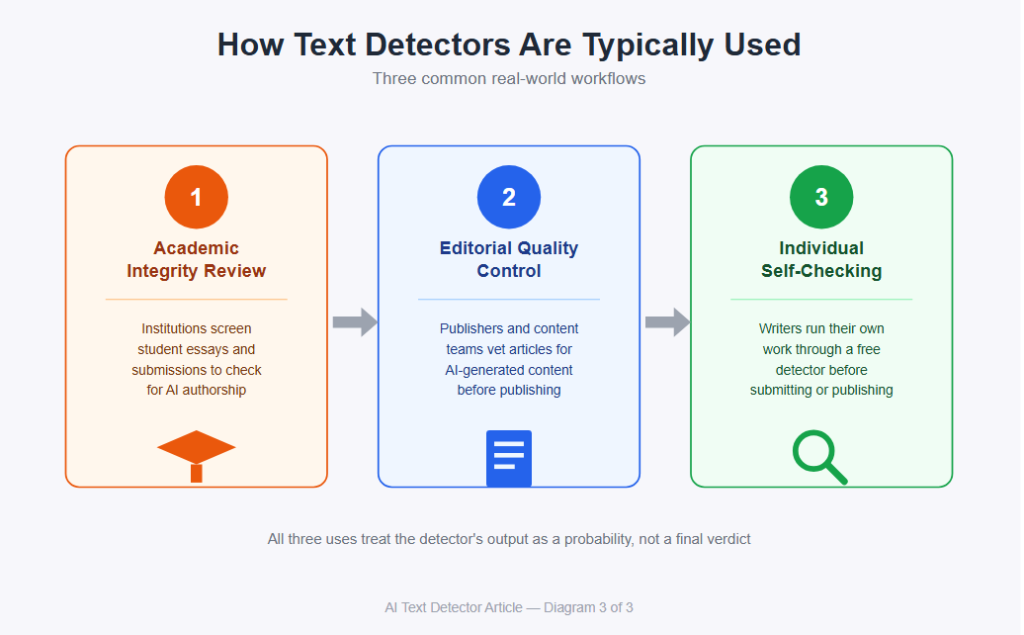
One of the factors that institutions consider as inputs during their assessment of AI-generated writing is the text detection software.
2. Editorial Quality Control
Publishing companies and content teams check for AI-generated content in the form of articles that have been submitted to them before being published.
3. Individual Self-Checking
The authors themselves often check their writing using a free detector before submission or publication just to be on the safe side.
Bottom Line
An AI text detector analyzes the statistical characteristics of the language used, including perplexity, burstiness, and token probability to assess the likelihood that the language model has generated the text. The technology is well-developed nowadays, but there is no AI detector at the moment which guarantees the results’ validity, so the possibility of a false positive exists especially for non-native speakers and highly-edited AI texts.