QuillBot AI Detector: What It Is and How It Compares

Introduction
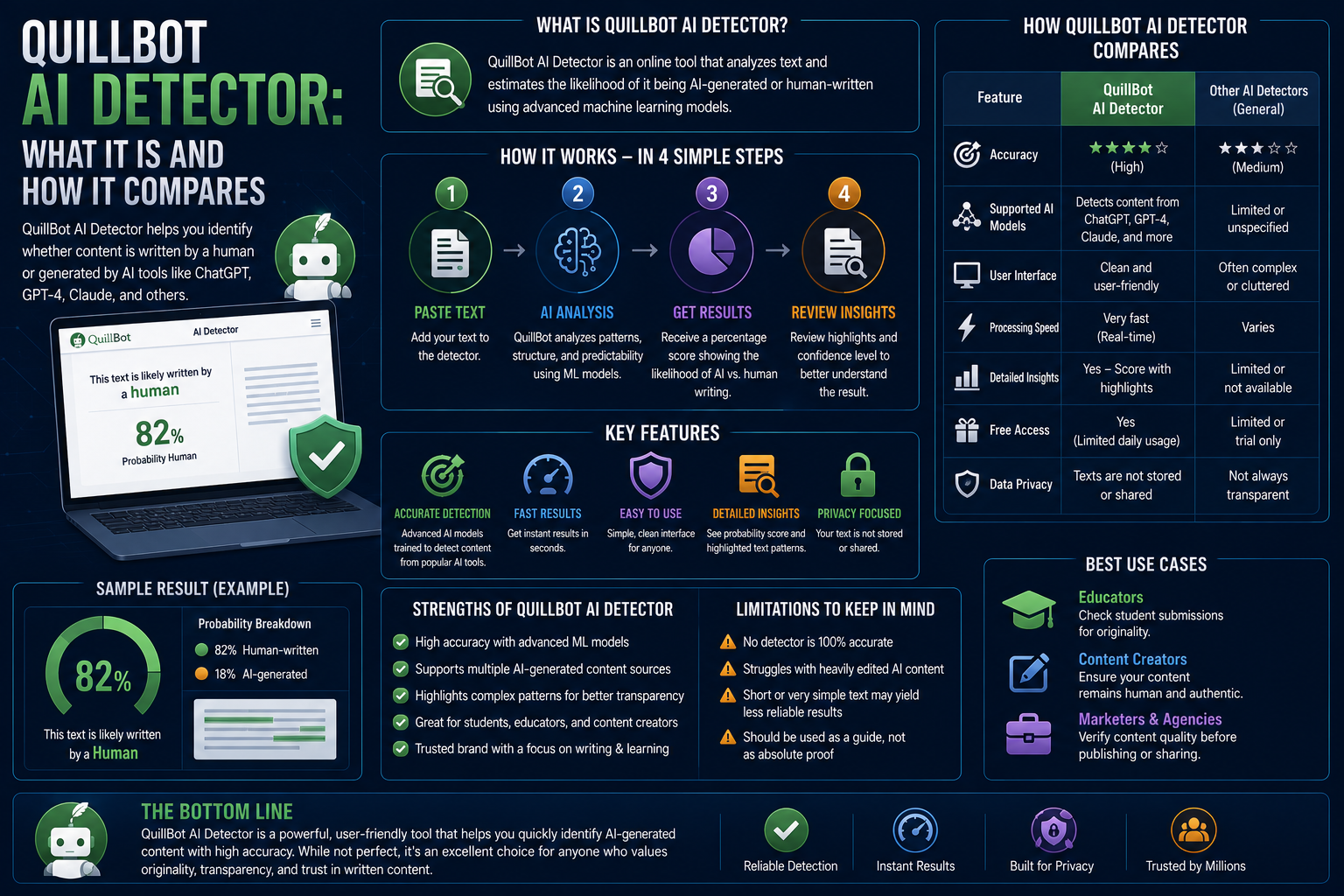
QuillBot AI Detector is a free program provided by QuillBot, which is one of the most popular companies developing paraphrasing and grammar check services, that assesses a particular piece of text and gives its estimate on the probability that it has been produced by some artificial intelligence. This article provides a thorough overview of the QuillBot AI Detector.
What the QuillBot AI Detector Is
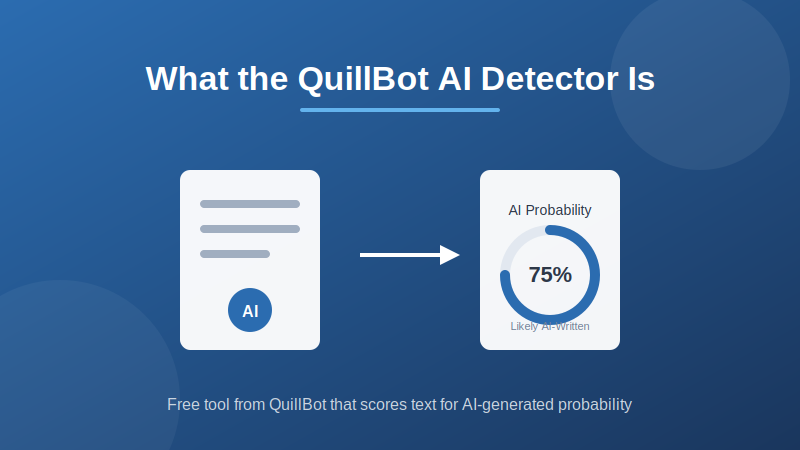
AI Detector offered by Quillbot is an online tool that takes the input of the pasted/uploaded text and gives a percentage figure of how AI generated the content is, as well as an analysis sentence or segment-wise.
It is available on the QuillBot website itself and does not need a paid subscription in order to access it, even though the overall suite of products from QuillBot, particularly its paraphrasing tool, comes with paid plans.
Interestingly, QuillBot is also positioned very differently in this context because Quillbot is one of the popular paraphrasing tools out there. This implies that the company that developed one of the most common ways of disguising the AI-generated content from detectors themselves developed the detector of it.
How the QuillBot AI Detector Works
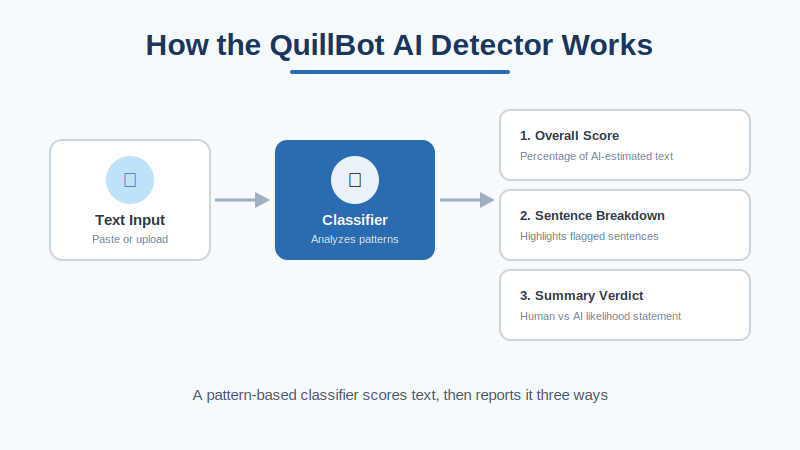
As with many of these applications, the Quillbot checker depends on a classifier that is able to differentiate between the patterns characteristic of human and machine-generated text.
This application then analyzes the uploaded text and provides:
1. An Overall Score
Percentage indicating the degree of AI writing estimated in the text.
2. A Sentence-Level Breakdown
Pointing out the sentences that made up the highest proportion of AI text.
3. A Summary Verdict
General statement about the likelihood of the text being written by humans or AI.
QuillBot’s Accuracy in Practice
Mixed feedback from users and independent reviews has been very common in the evaluation of QuillBot detector against paraphrased text, whether using QuillBot’s own tool or another one.
Similar to most detectors, slightly edited AI-generated texts tend to have lower scores compared to the actual output of a language model, which makes the effectiveness of such a detector against deliberately obfuscating AI-generated texts questionable.
No accuracy benchmarks based on independent verification have been released by QuillBot about the performance of its detector, which is a shortcoming shared by most similar products out there and not something unique to QuillBot.
Its results should be treated like those of any other detector – one of many pieces of information but not an ultimate solution.
How QuillBot AI Detector Compares to Other Tools
Against Turnitin and Similar Academic Tools
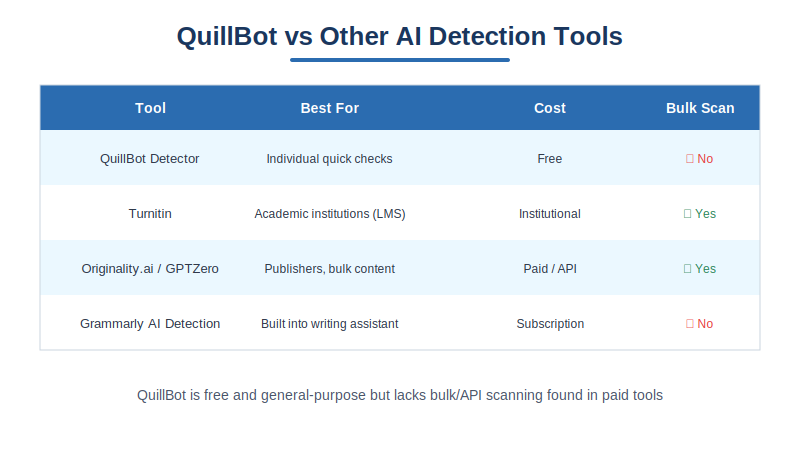
The academic oriented detection tools, like Turnitin, are usually built into the LMS of the institution and trained on patterns of academic writing, thus gaining an edge over other detectors in their domain of expertise.
Quillbot is a universal detector, which is free for everyone, hence it has its pros and cons.
Against Originality.ai and GPTZero
These tools are developed mainly for publishers, content creators, and educators who have to scan their content in bulk, usually with batch processing and API support.
The QuillBot detector, however, is designed more for individuals scanning a single text and lacks the extensive features available in the bulk scanning tools.
Against Grammarly’s AI Detection Feature
Grammarly has embedded the AI detection feature in its overall writing assistant and not offered it separately as a product.
On the other hand, Quillbot’s tool is an exclusive detector that some users might find easier to use for a once-off detection process.
Why QuillBot’s Detector Gets Searched Alongside Its Paraphraser
The curiosity of how the paraphrasing tool of QuillBot would be able to escape from detection using QuillBot’s own AI Detector constitutes a good part of the interest towards the AI Detector of QuillBot.
It is a trend that exists in the whole class because the very methods used by AI writing tools to make their texts seem more human, like varied sentence length and word choice, are exactly the things that detectors use to detect AI-generated texts.
Therefore, AI paraphrasing tools and detectors are often compared together although they are opposing products.
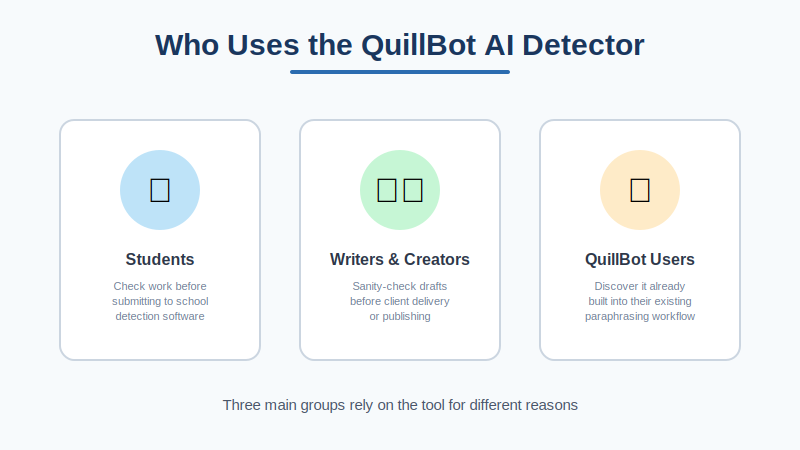
Who Uses the QuillBot AI Detector
Students
They employ this technology to assess whether or not they will receive a warning from the detection software used at their respective institutions or out of sheer interest in seeing how much influence artificial intelligence has over their writing styles.
Writers and Content Creators
A tool that can be used to sanity check one’s draft before presenting it to the client or publishing it, especially for freelancers who wish to avoid conflict regarding the usage of AI.
QuillBot’s Existing User Base
Because of the fact that the detector has been integrated into the same software which provides paraphrasing and grammatical tools from QuillBot, many people start to use it without realizing anything due to its presence in their workflow.
Limitations to Keep in Mind
Like any other AI detection service available today, QuillBot is unable to offer absolute accuracy, and it should be anticipated that there will be both false positives and false negatives, especially where the text in question has been altered, paraphrased, or produced by a non-native speaker of English.
It should not be overlooked in considering how much weight to give to QuillBot’s findings that it is both a provider of paraphrasing services and a provider of AI detection services.
Bottom Line
Quillbot AI Detector is an AI-powered tool that is free to use for general purposes but is not intended for bulk content checks due to its nature.
This tool operates on the same principle as the vast majority of competing detectors and has one major drawback, the low level of accuracy for paraphrased or extensively edited content by AI tools.
This tool is usually supplemented with other detectors for higher-stake usage scenarios like academic integrity decisions or bulk content audits.