AI Content Detector: How Publishers and Marketers Screen for AI-Generated Content

Introduction
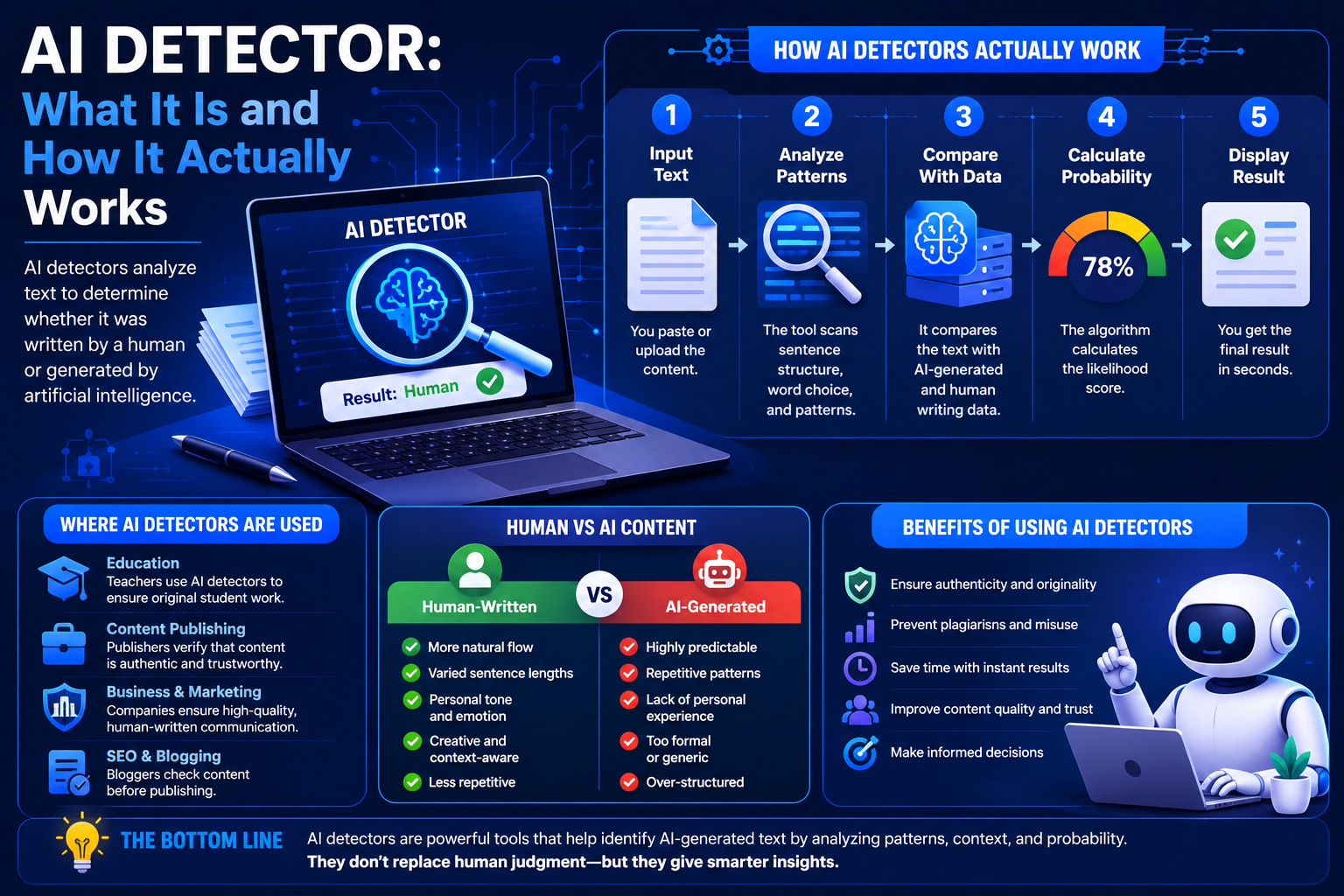
A content detector AI is a device that is used to determine whether content, mostly texts but now including images and videos as well, have been created through a generative AI algorithm or human effort. Though the term content detector AI is used synonymously with AI detector, it generally refers to a device used to check the content of an AI in marketing, publishing, and editorial scenarios. The main focus is not plagiarism here but quality checks.
What an AI Content Detector Does
An AI content detector is simply a tool which processes any submitted content and provides a score or a label on the probability of the content being created through an AI tool.
Such an application of the tool is usually made during the following parts of a content marketing process:
- Before publication to detect any content which has been created through the use of AI tools by any freelancers or agencies without mentioning it.
- During editing to identify areas which might require further human rewriting.
- While conducting a continuous audit of the content already existing on a website.
Why This Became Relevant to Content Teams
As generative AI has become increasingly common in content creation, there has been a need for content creators and marketers to implement standards for content that reflects their values, especially where clients, users, and platforms demand high-quality, human-edited content.
While search engines have emphasized that content quality takes precedence over methods of content creation, there are still concerns about the long-term treatment of unedited AI-generated content, and many businesses tend to be hesitant to generate large amounts of such content due to uncertainty and risks involved.
In addition, certain publishers work under more rigorous regulations in terms of content, especially in journalism, scholarly publishing, and regulated sectors.
How AI Content Detectors Score Content
The majority of tools of this kind use the same methods for analysis that are used in generic AI text detectors but adapted to the needs of analyzing longer texts.
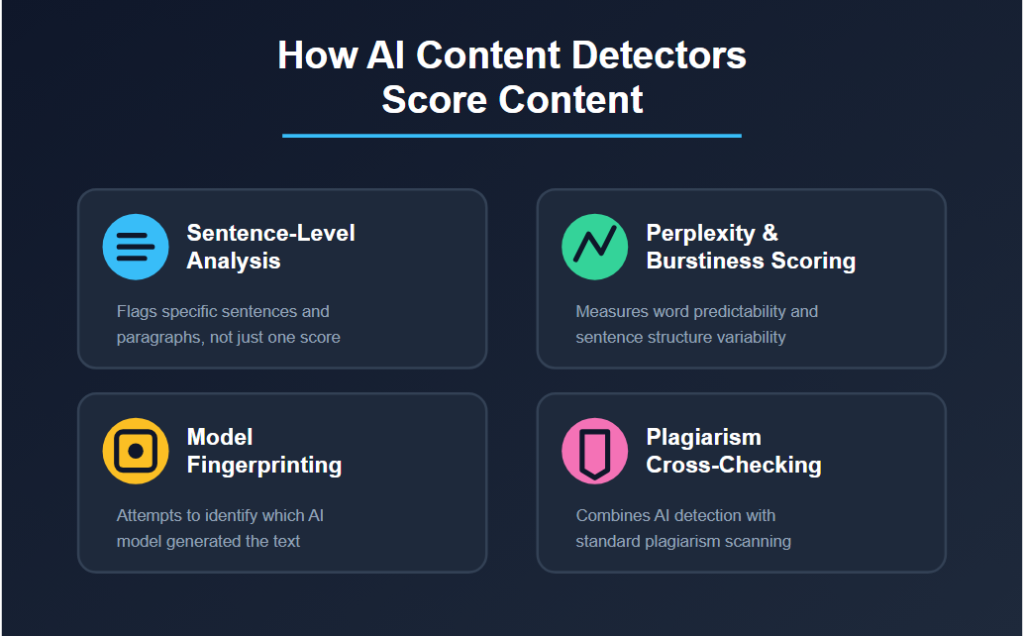
1. Sentence-Level Analysis
Sentences and paragraphs are individually analyzed, enabling the editors to learn which part of the text has been flagged instead of just obtaining one score for the whole text.
2. Perplexity and Burstiness Scoring
Evaluation of predictability of the usage of the words and variability of the sentence structures used in the text.
3. Model Fingerprinting
More sophisticated tools try to determine which particular model of AI was used in the generation of the particular text.
4. Plagiarism Cross-Checking
Most content-oriented detectors include AI check with standard plagiarism detection because both are included in one process which happens before the publication.
What Makes Content Detection Different From General Text Detection
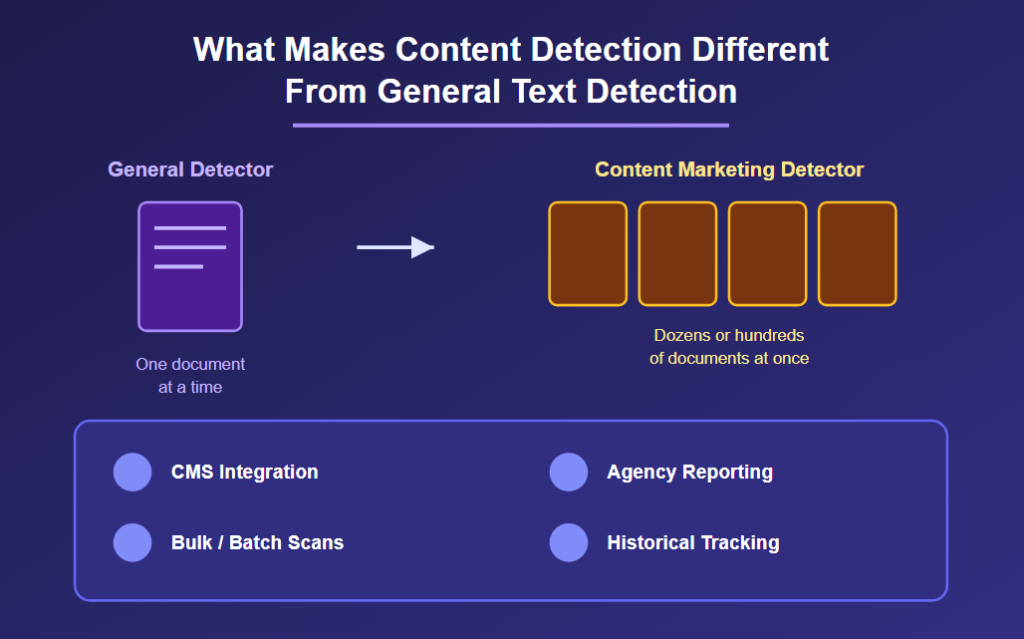
The AI detector oriented at checking any content in general is designed to analyze only one small-sized piece of content like an article or an e-mail.
Content detectors, oriented at marketing and publishing processes, have several additional features.
Bulk or Batch Scanning
Enabling team members to review several dozen or even hundreds of documents at once.
Integration with Content Management Systems
Documents can be reviewed either prior to, or while publishing them, not separately from this process.
Team and Agency-Level Reporting
Will help companies handling several freelance authors or outsourcing of the writing services.
Historical Tracking
Enabling website owners to track the evolution of their AI detection scores while scaling up the creation of content.
Limitations Specific to Content Marketing Use Cases
Like any other AI detector, content detectors are not immune to accuracy problems such as false positives and false negatives, and there is currently no content detector that provides conclusive results.
In relation to content marketing, this raises some distinct concerns, namely:
- Declining work from a valid freelancer because of a false positive can hurt the professional relationship needlessly.
- Highly edited AI-generated text, something that becomes more frequent with writers employing AI for outlines and first drafts, receives inconsistent scores and cannot be labeled easily either as “AI” or “human.”
- Scores received from detection tools will vary greatly even when using the same text on multiple detection tools, because each tool will have its own training data and scoring method.
In light of all this, professional content production teams prefer to utilize detector results as a trigger for further examination, as opposed to treating them as a cause for automatic rejection.
How Content Teams Typically Use These Tools
Pre-Publication Screening
Testing new articles with the help of a detector before publishing them, along with the plagiarism test, has become common practice.
Freelancer and Agency Oversight
Screening of incoming submissions from outside writers to verify if it matches the client’s or publishing house’s requirement for disclosures and standards of quality.
Content Audits
Evaluation of an extensive content library already in place, especially after purchasing a website or when dealing with inherited content backlog, to determine how many of those require rewriting by human writers.
Internal Quality Control
There are some teams who purposefully use artificial intelligence in their process, yet continue to use detection internally to recognize those pieces that seem too machine generated.
Choosing an AI Content Detector for a Content Team
There are certain aspects that become more relevant in content marketing than in a generic detection scenario.
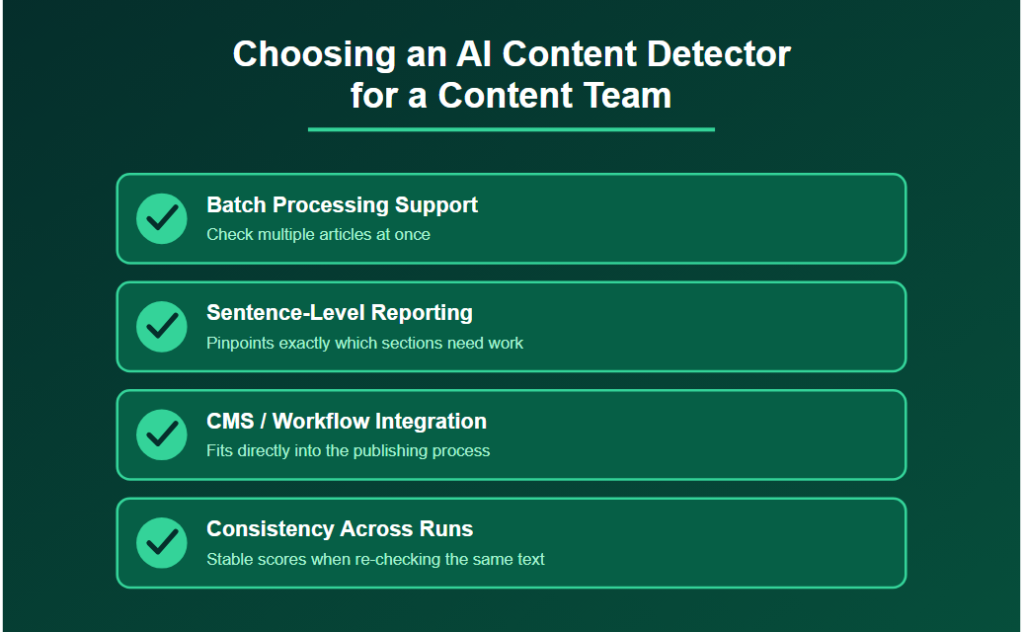
1. Batch Processing Support
This is due to the fact that content marketing involves checking multiple articles at once.
2. Sentence-Level Reporting
Therefore, it becomes easier for editors to understand exactly what sections of the article require improvement rather than work on the whole article based on the final score.
3. CMS or Workflow Integration
Integration tools which integrate directly within the publishing process lessen the difficulty of performing manual checks.
4. Consistency Across Runs
Because there is often inconsistency in scores when the same content is checked again using detectors, it would be better to have a tool whose scoring is more consistent.
Bottom Line
While an AI content detector is designed to fulfill a more specific role than an AI detector in general, its use involves the process of checking written content prior to publication for publishers, marketers, and content creators.
It uses the same AI detection technologies as an AI detector but has some additional features which make it suitable for dealing with bulk content and incorporating into editorial processes.
Its output can be used as the basis for further examination by humans as always with an AI detector.