AI Detector: What It Is and How It Actually Works

Introduction
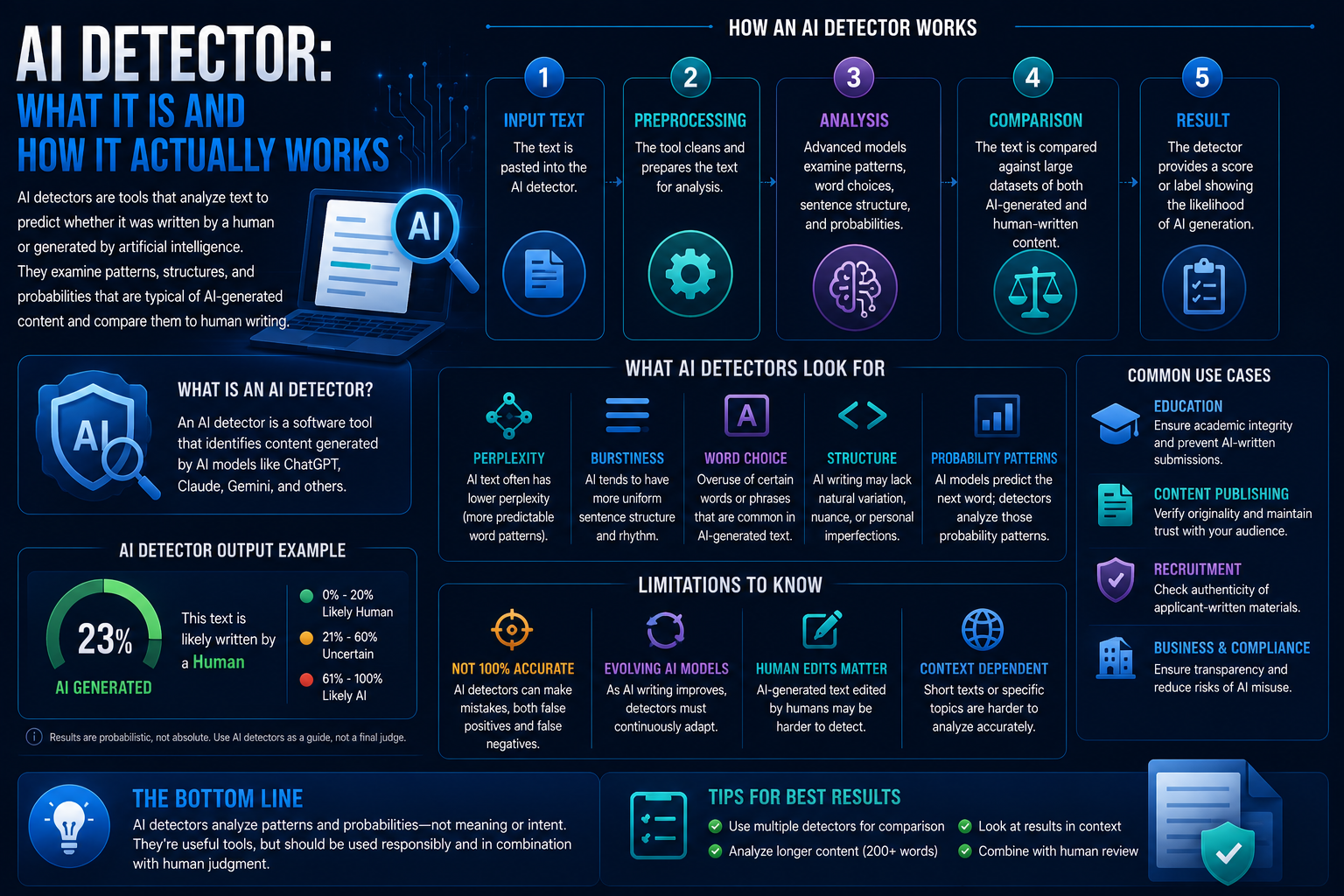
An AI detector is the name that is thrown around a lot on the internet despite being, in fact, a rather narrowly defined tool which means software capable of analyzing some kind of content, text, an image or a video, and determining the likelihood that the content was created using AI and not a human being. This paper will discuss in detail what AI detectors are, what their weaknesses are and how they are actually applied in real life.
What an AI Detector Is
The AI detector is the software that is either made available on the web as an application or browser extension or is used as an API service. It takes a submission from the user and makes an evaluation, which is usually presented in the form of a percentage or a statement such as “likely AI-written” or “likely human-written.”
The main idea behind these tools is the same for almost all of them: to bridge the growing gap due to the advancement of the generative AI systems that now can produce texts, images, audio, and videos indistinguishable from human creation.
In addition, detecting technologies have been around for many years in some shape or form but mainly as plagiarism detection solutions. Large language models and image generation tools via diffusion provided the category with its second chance.
How AI Detectors Work
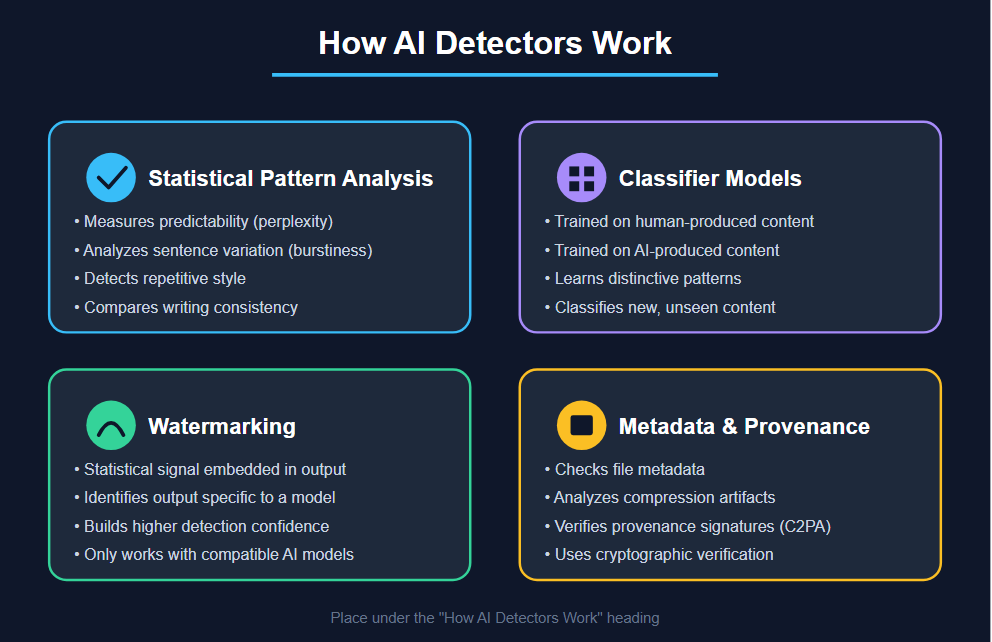
Many AI detectors use one or a combination of the following methods:
Statistical Pattern Analysis
This type of detector analyzes features like perplexity (the predictability of words) and burstiness (variation in length and structure). The output from AI has less variation and is more consistent compared to that written by humans.
Key Characteristics
- Measures predictability of words
- Analyzes variations in sentences
- Detects repetitions in writing style
- Compares writing consistency
Classifier Models
Machine learning algorithms are taught using large volumes of known human-produced and known AI-produced content. The algorithm is able to detect distinctive patterns and then classify the new unseen content accordingly.
How Classifier Models Work
- Train using human-produced content
- Train using AI-produced content
- Learn distinctive patterns
- Classify new content
Watermarking
Some AI companies have integrated statistical indicators directly into the output generated by their models. The ability of such a detector to detect this signal is sufficient for it to determine with reasonable certainty that the content is produced by this particular model, provided, of course, that the model has used the watermarking technique.
Benefits of Watermarking
- Identifies output specific to model used
- Builds higher confidence
- Functions only with AI models that are compatible
Metadata and Provenance Checks
In image/video files, some detectors analyze the metadata, compression traces, or digital signature-based signals (for example, C2PA) rather than the visual contents.
What Is Checked
- Metadata
- Artifacts of compression
- Signatures of provenance
- Crypto verification
Why AI Detectors Are Not Fully Reliable
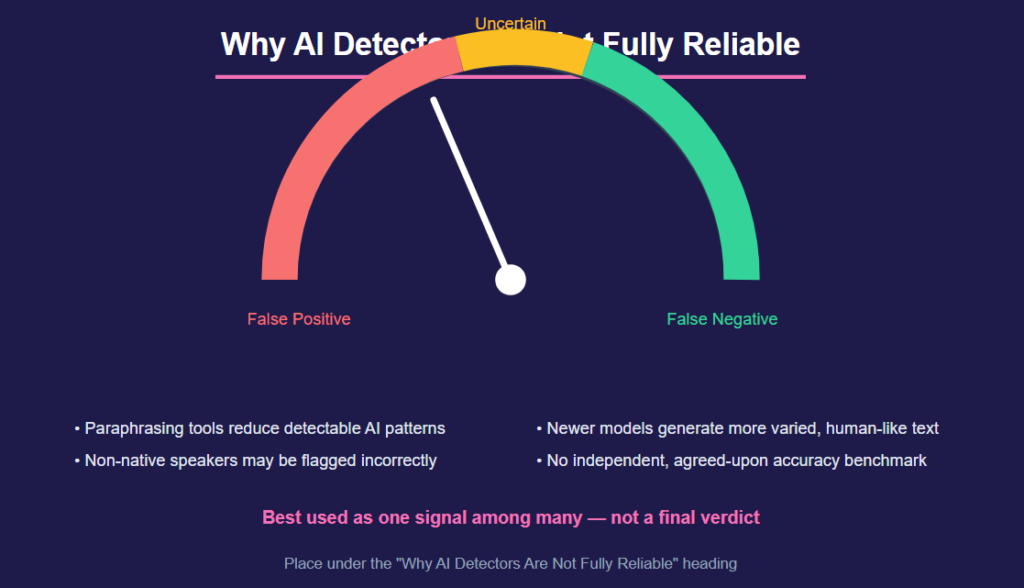
It is almost always the case that there is a high number of false positive and false negative results when it comes to detection of AI by means of such tools.
There are a number of reasons why this is so:
- Tools that paraphrase and make light edits can drastically reduce the AI patterns detected in the content without altering its meaning.
- The non-native speakers tend to write less bursty and more structured texts, which may be mistakenly interpreted by the detectors as being AI-written.
- The newer language models are deliberately designed to generate more varied content, thus reducing the statistical difference used by the detectors to identify AI patterns.
- There is no benchmark test of detector accuracy provided independently and agreed upon by all the users of such software.
This is why most of the detector providers use the probabilistic approach to labeling the content and warn against using one score alone for making decisions, especially when dealing with students or hiring candidates.
Common Categories of AI Detector
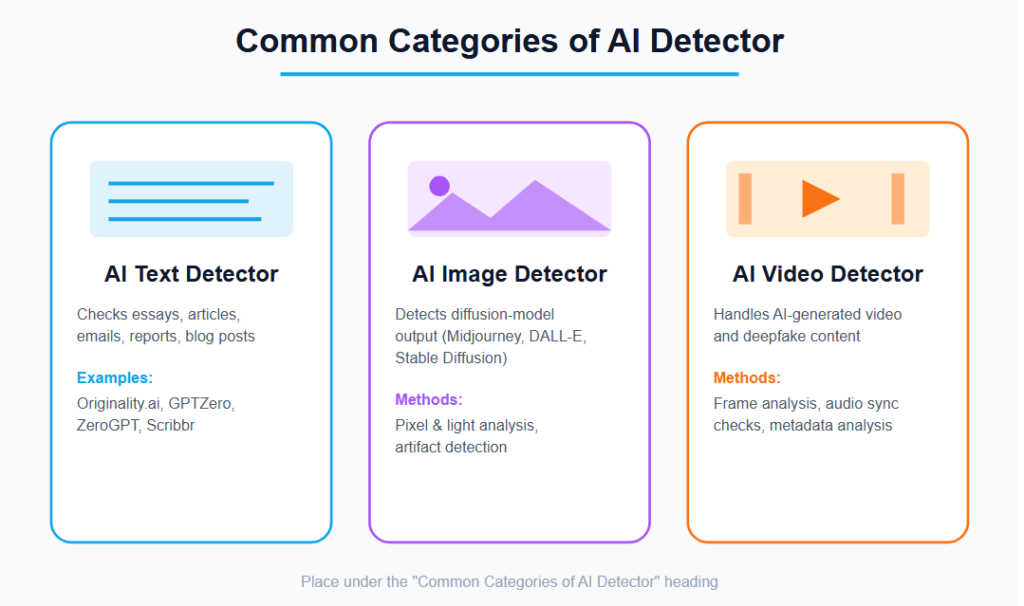
AI Text Detector
The commonly used variety of software, developed to check essays, papers, letters, and any written text. The examples of such are Originality.ai, GPTZero, ZeroGPT, and Scribbr’s checker, as well as built-in detection capabilities of various programs including Grammarly and Quillbot.
Common Uses
- Essays
- Articles
- Emails
- Reports
- Blog posts
AI Image Detector
Designed to recognize material generated by diffusion models like Midjourney, DALL-E, or Stable Diffusion. Generally, these detect visual features of images like pixel-level artifacts, inconsistent lighting, and other visual cues as opposed to using text-based cues employed for textual content detection.
Detection Methods
- Pixel analysis
- Light analysis
- Artifact detection
- Pattern Recognition
AI Video Detector
A more recent and less developed type of software, created to handle the emergence of video generated by artificial intelligence or deepfake technology. This type of software typically includes both frame-based analysis and audio-visual synchronization checks.
Common Detection Techniques
- Frame analysis
- Audio synchronization test
- Metadata analysis
- Deepfake test
Who Uses AI Detectors and Why
Educators
It is used to determine if the assignments that have been turned in were done by the student or by any other program such as ChatGPT, mainly as one source among others and not the only means of assessing academic integrity.
Publishers and Content Platforms
Useful for enforcing editorial guidelines or platform policies regarding restrictions or disclosure requirements for AI-created content, especially for media organizations and academic journals.
Employers and Recruiters
Used to check writing samples submitted by candidates, cover letters, or take-home assignments for signs of AI-created content.
SEO Teams and Marketers
Used to verify outsourced or AI-aided content prior to publication, typically as part of a larger process of content quality assurance and not merely as a pass or fail system.
How to Choose an AI Detector
With the number of tools out there, a few considerations are worth keeping in mind before using one.
1. Accuracy and Independent Testing
Ensure that you are choosing an algorithm tested by independent sources rather than simply based on what the vendor claims in their marketing materials.
2. Content Type Supported
Make sure that the algorithm has been created to work with the specific content you want to check, because algorithms that check text, images, and videos differ in their technology.
3. False Positive Rate
A detector with a low number of false positives will be more effective in high-risk situations like universities than a detector that maximizes the number of AI content detections.
4. Transparency of Scoring
Tools that explain why parts of a text have been flagged as such are easier to use than those that give you just a score.
5. Integration Needs
In case your team needs to audit texts at scale, an API and browser extension may be more important than a website.
Limitations to Keep in Mind
There is no detector that exists currently which can be absolutely sure of its predictions, and taking an individual detector’s prediction as absolute proof is not recommended at all.
This is particularly because the tools that have been mentioned on either side of the equation, the generators and the detectors, are continuously undergoing changes and advancements, and each advancement in either tool affects the performance of the other negatively.
Bottom Line
AI detectors are a probability tool, not a definite one. This tool works in such a way that it looks at some sort of statistics, visual, or provenance-based indicators present in a certain piece of content and calculates how probable it is for that content to be produced by AI, but there is still room for errors.
When organizations use AI detectors, they usually achieve better results if they treat the output from that detector as one of many data pieces.