GRC Automation: Reducing the Manual Burden of Risk and Compliance

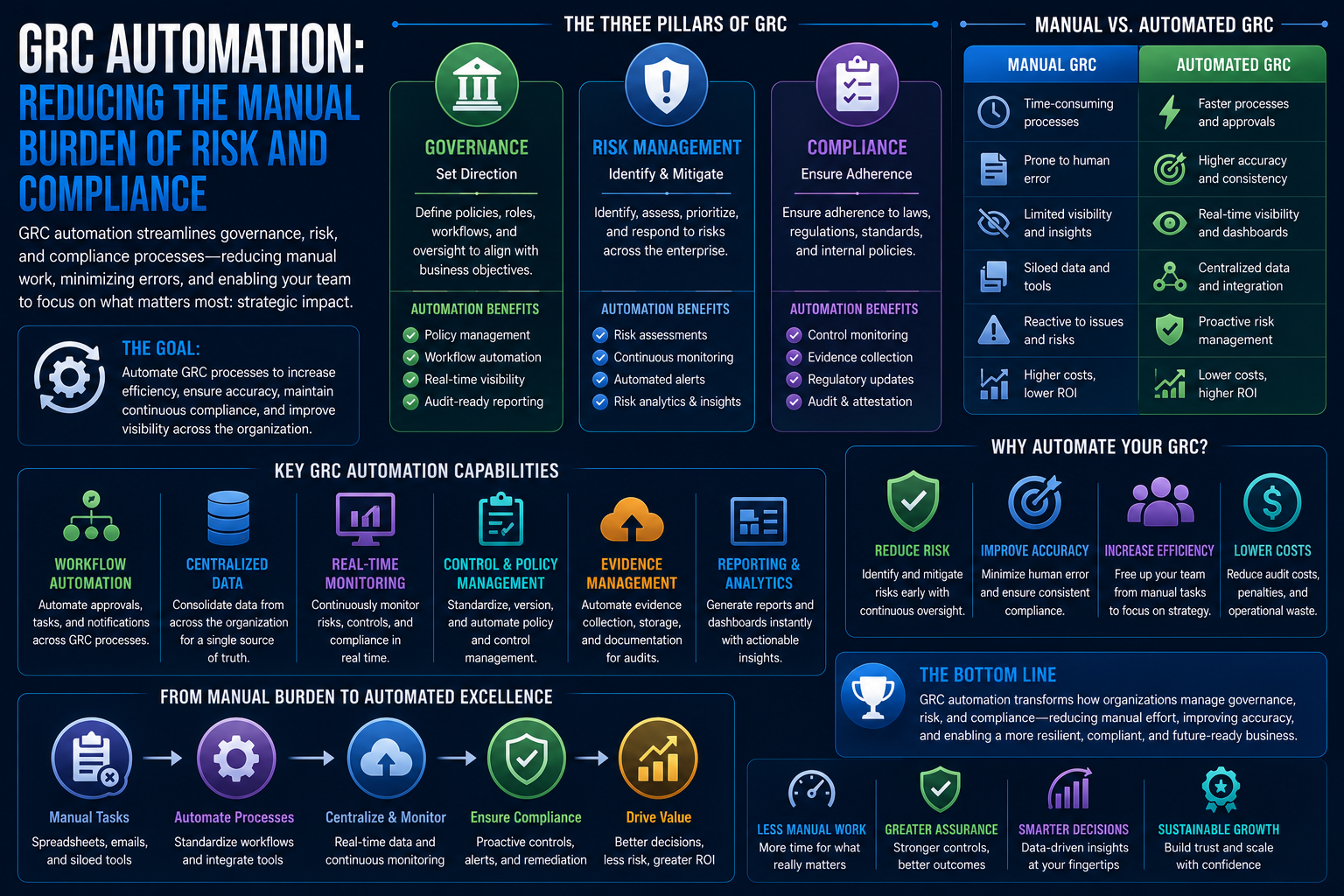
The term GRC automation can be defined as the process of implementing software solutions for performing activities in governance, risk, and compliance which earlier used to require substantial manual intervention by compliance and risk professionals. This is exactly what gets automated in this process, and where humans are needed.
Why GRC Automation Has Grown
As regulations proliferated, data privacy laws, security certifications that have become more frequently needed by customers, industry regulations, the burden of manually keeping up with multiple standards has significantly increased.
Gathering evidence, control monitoring, and preparations for an audit have become too time-consuming and laborious to be managed through manual processes alone, which led to rapid adoption of GRC automation tools, especially for fast-growing technology companies trying to get their SOC 2 certification quickly.
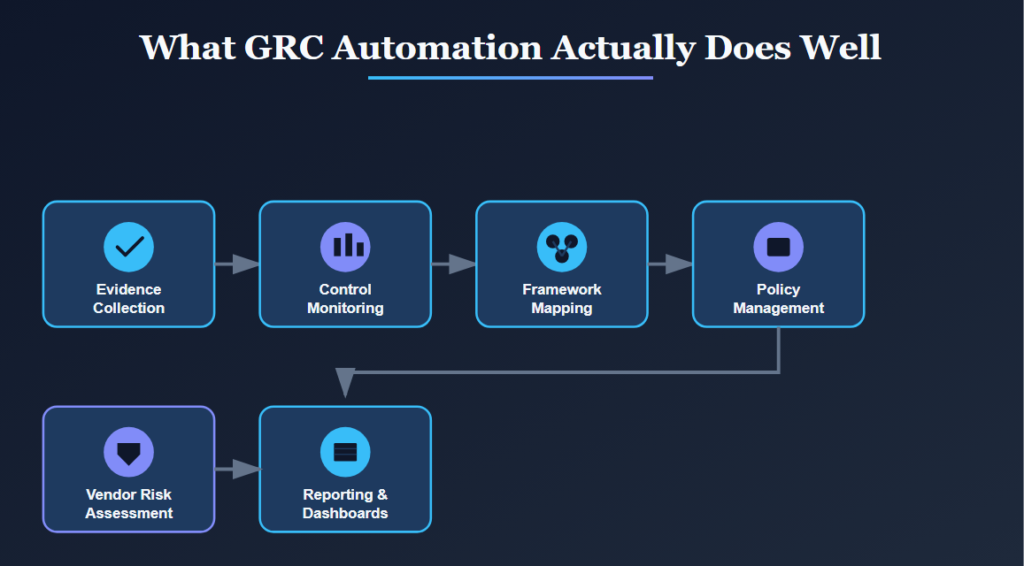
What GRC Automation Actually Does Well
Continuous Evidence Collection
Unlike the manual method of collecting screen captures and log files before audits, automated solutions link themselves directly to the cloud environment, ID providers, and other systems to gather data on whether or not controls work properly. This makes audit preparation a more continuous effort rather than an occasional struggle.
Control Monitoring
Automated monitoring is able to discover any instances of configuration drift or control problems within minutes, an unauthorized alteration to a security setting, or the existence of an inappropriate access permission.
Framework Mapping
Most automation systems have in-built maps to show how the same control addresses the different requirements in various standards such as SOC 2, ISO 27001, HIPAA, and GDPR, rather than having to manually do cross-mapping of controls.
Policy Management Workflows
Automate review process, approval process, and policy acknowledgements of employees to ensure policies are up-to-date without a manual version history and reminders process.
Vendor Risk Assessment
Third-party risk management tools automate some aspects of the third-party risk assessment, sending and tracking vendor security questionnaires, vendors who did not complete their reviews, and tracking of vendor certifications.
Reporting and Dashboards
Automatic generation of current compliance status reports for management and auditors, without the need to create the report manually from scratch every time.
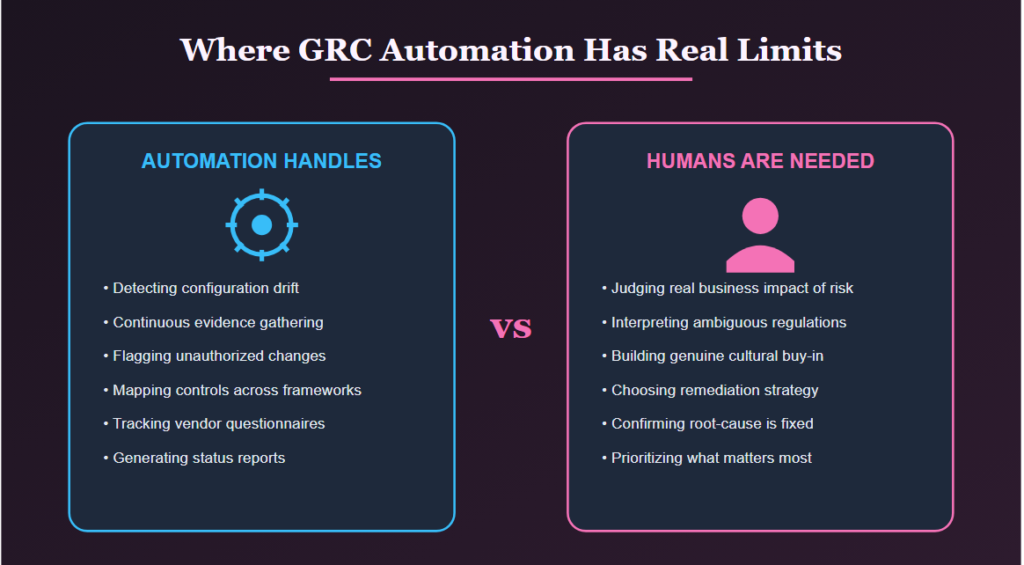
Where GRC Automation Has Real Limits
Judgment-Heavy Risk Assessment
Automation can detect anomalies, but the determination of the potential business effect of a particular risk and its probability and the way to handle it requires human judgment.
Interpreting Ambiguous Regulatory Requirements
It is well known that regulations are subjective and that it takes an expert to interpret how that regulation works in the context of an organization.
Genuine Process and Cultural Adoption
Automation will be able to check for whether or not the control is configured correctly, but not if the organization’s culture actually embraces the intention behind the regulation, which is more important than merely following the regulation itself.
Handling Audit Findings and Remediation Strategy
Even though automation can help detect the problem with the control quickly, determining the appropriate course of action and assessing whether it solves the root cause of the problem requires human input.
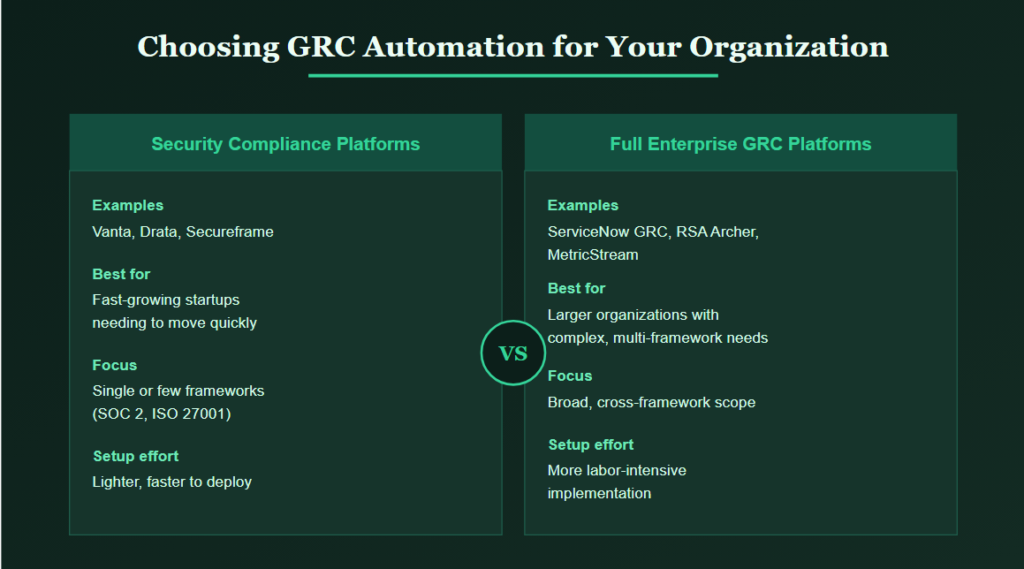
Choosing GRC Automation for Your Organization
There are major differences between automation tools.
Security Compliance Automation Platforms
Automation platforms for security compliance (Vanta, Drata, Secureframe) concentrate on certain frameworks (SOC 2, ISO 27001, etc.) and work well for growing startups that are required to act fast.
Full Enterprise GRC Platforms
GRC platforms for enterprises (ServiceNow GRC, RSA Archer, MetricStream) provide a wider scope of automation services in more complicated multi-framework projects, though the implementation is more labor-intensive.
It comes down to whether you have one framework or many, how automatable are your particular compliance requirements (as the technical cloud-based controls are much easier to automate than process-driven ones), and what resources you can afford to spend on a more advanced system or not.
Common Mistakes with GRC Automation
- In case automation obviates the need for compliance ownership completely, as opposed to lowering the manual burden associated with
- Opting for a solution that does not provide for the relevant frameworks applicable to your company
- Under-configuration of integrations that create blind spots for the automated gathering of data until an audit brings the issue up
- Considering automated monitoring notifications as an option as opposed to following them up immediately
Bottom Line
Automating GRC substantially lowers the workload of collecting evidence, monitoring, and reporting, although its ideal application is as a tool which helps human decision-making concerning risk prioritization and remediation approach rather than as a substitute for people skilled in compliance and risk management.