Lead Generation: The Complete Guide

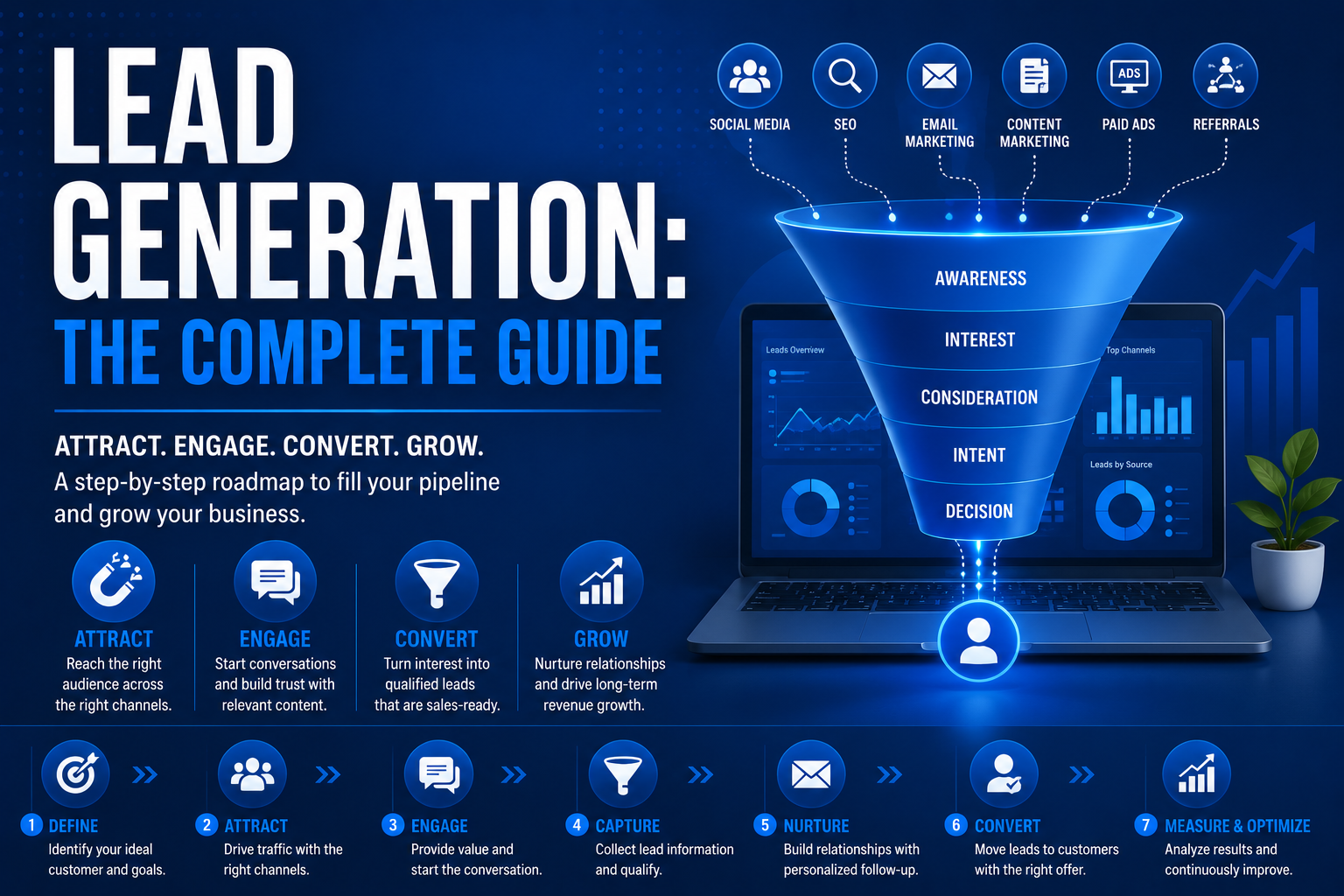
Every company, regardless of its sector, operates using the same fundamental principle: there is always a need for a consistent influx of interested individuals for whatever is being sold. This is called lead generation, which is the practice of generating leads or attracting interested prospects.
What Lead Generation Actually Means
Lead is nothing but an individual or organization that has demonstrated an interest in the product or service offered by you through filling a form, downloading an asset, asking for a quote, etc.
All the efforts made for creating and capturing interest are referred to as lead generation.
There is a scale when it comes to leads; there can be different types of leads and each of them will have a different purpose. The person who downloads a guide is entirely different from the one who asks for a demo.
Identifying where the lead stands on the spectrum is as crucial as generating the lead itself.
Inbound vs. Outbound Lead Generation
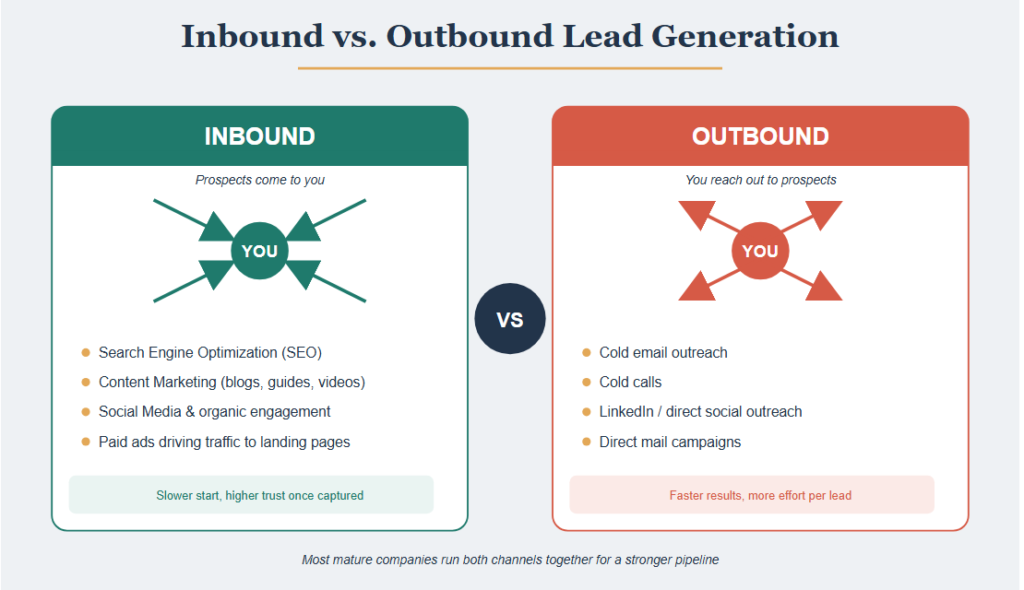
Inbound Lead Generation
Inbound lead generation brings prospects to you via content marketing, search engine optimization, social media marketing, or paid advertising that drives people to your landing pages or forms.
The process is slow initially, but you end up with leads who are aware of your company and have shown interest.
Outbound Lead Generation
Lead generation by outbound method is more direct; cold email, cold calls, LinkedIn outreach, direct mail.
The process generates quicker and more predictable results, but more labor-intensive and lower response rates will be experienced due to the prospect not having any prior interest.
Combining Both Approaches
Most developed companies operate both at the same time:
- Inbound generates an accumulation effect of pipeline at lower costs.
- Outbound compensates weaknesses and connects to certain target companies that inbound marketing would not be able to reach.
The Main Channels
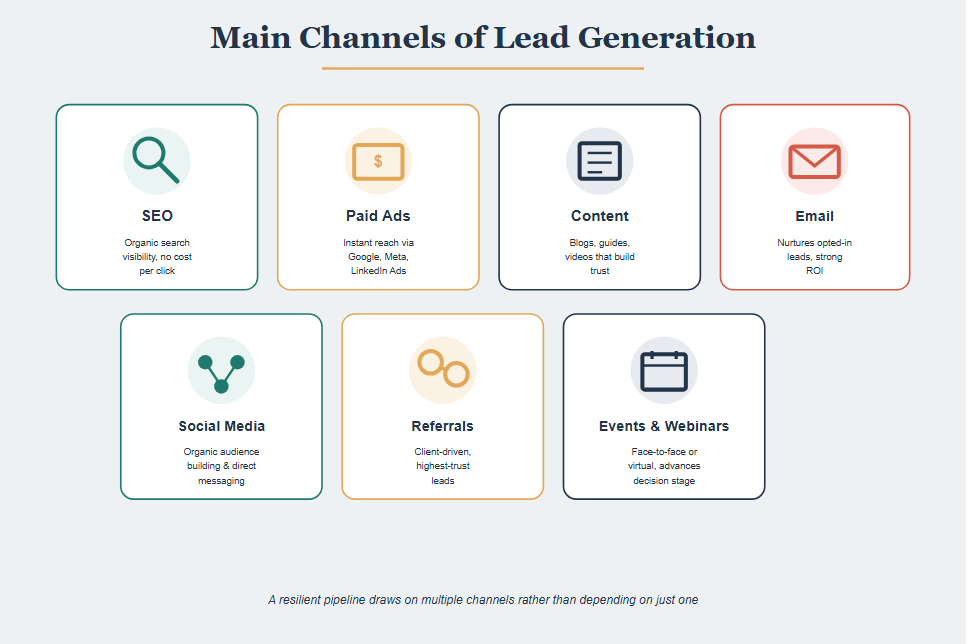
Search Engine Optimization (SEO)
Being ranked for organic search queries that your potential clients might have made already is one of the most sustainable lead generation sources you can get, which doesn’t cost anything per click after content ranking is achieved.
Paid Advertising
Google Ads, Facebook/Instagram Ads, and LinkedIn Ads can help you acquire leads instantly but require continuous payment for lead generation.
Content Marketing
Blogs, guides, videos, and tools that solve a client’s problem are great ways to establish trust and attract organic traffic.
Email Marketing
Email marketing, which involves nurturing your leads (or even previous clients), is one of the most ROI-oriented methods, because you contact people who have opted into your list.
Social Media
Posting and interaction organically create an audience and build up trust that can then be turned into leads through direct messaging, bio links, or gated content.
Referrals
When you have clients refer your business to others, this usually results in the most converting leads, because they bring the trust that comes from knowing your product.
Events and Webinars
Face-to-face or virtual events allow potential clients to analyze your offering before engaging in the sales conversation, thus creating leads who have advanced further in their decision process.
The Lead Generation Funnel
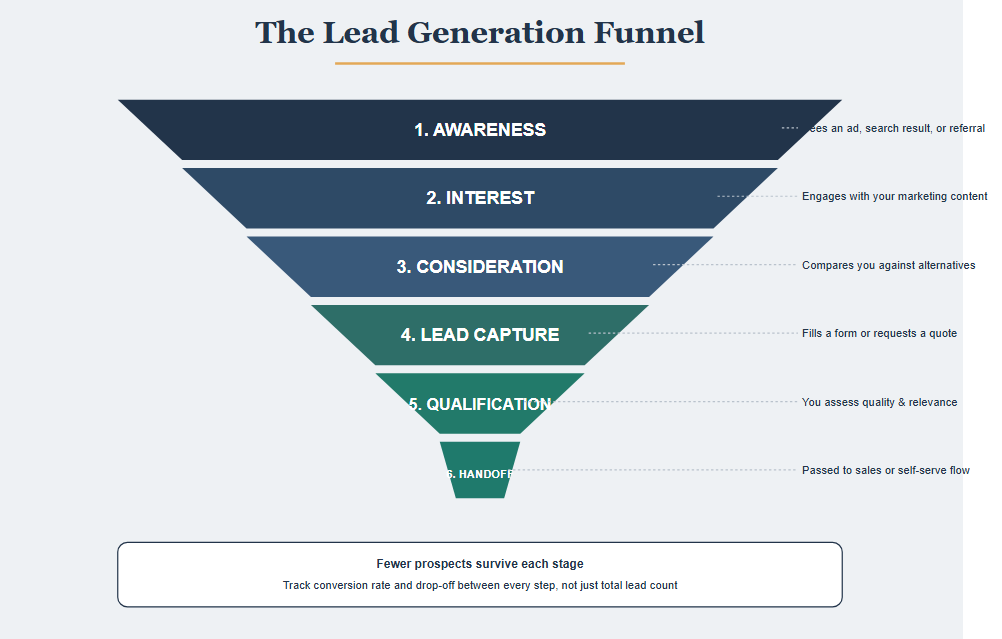
The majority of lead generation efforts adhere to a simple funnel model:
1. Awareness
The lead becomes aware of you by means of an advertisement, a search result, or by someone referring to you.
2. Interest
The lead interacts with your marketing materials, indicating interest in your products/services.
3. Consideration
The lead evaluates you versus other available options and conducts their own research.
4. Lead Capture
The lead acts on something, completing a form or asking for a quote and thus entering your system.
5. Qualification
It is up to you to assess the quality and relevance of the lead.
6. Handoff
Nurtured leads are then passed to the sales team (or a purchasing process for self-serve products).
Lead Magnets and Offers
Lead magnet refers to the value proposition that you provide to someone in exchange for their contact details, which may be in the form of a free guide, a free consultation, or a tool/calculator.
The most effective lead magnets provide a solution to a very specific problem connected to the product sold.
Measuring Lead Generation Performance
The meaningful measures include those that move past counting leads:
- Cost per lead, by channel
- Conversion rate from leads to customers, because not all leads have the same quality through various channels
- Cost per acquired customer, the measure that determines profitability of the channel
- Time to convert, particularly applicable for B2B and high consideration purchase scenarios
Common Mistakes
- Pursuing lead volume while neglecting the quality of the lead or its conversion
- Dependent on one method only, rendering the company at risk in case anything changes in terms of that channel’s price or performance
- Not having any follow-up mechanism, causing leads to get cold before sales even gets to them
- Neglecting current customers as a potential source of leads since referral is often the cheapest and most effective channel around
Bottom Line
Lead generation is not an individual strategy; it is a process consisting of the appropriate channels for your company, effective qualification, and quick, constant follow-up.
Companies that develop their own multichannel system and take quality as well as quantity into account will have a much stronger lead generation pipeline than businesses focusing on one particular strategy.