Local Citations for SEO: What They Are and How to Build Them

Local citations should be an important part of any SEO strategy when you have a business that caters to people within a certain geographic location. They may not be sexy, but they are essential for rankings within the Local Pack and ruling over local searches.
What Are Local Citations?
A local citation refers to any mention of your company’s Name, Address, and Phone Number (NAP) information on the Internet. These mentions can take place in different types of online directories.
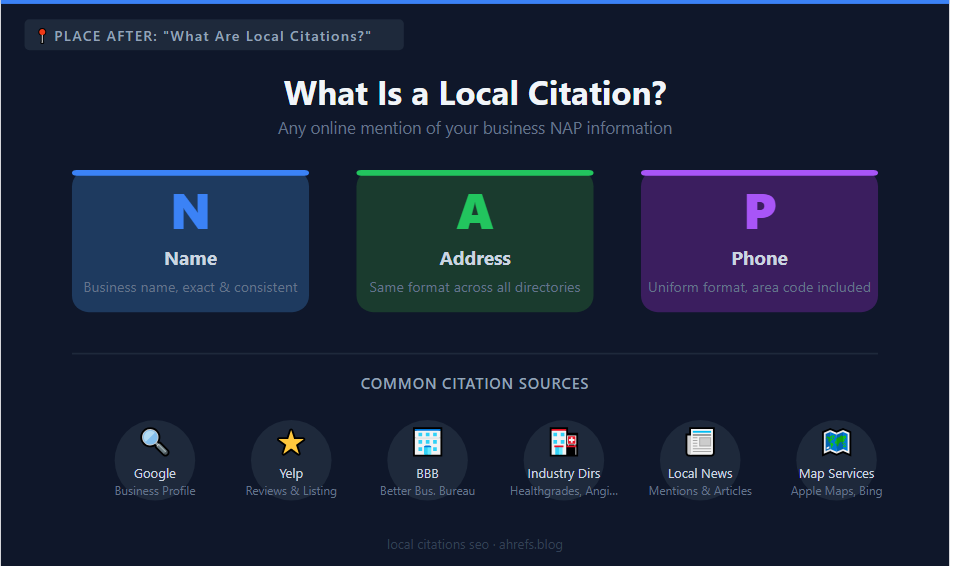
Examples of Citations
- Google My Business Listing
- Yelp listing
- Listing on the Better Business Bureau Directory
- Entry on a specialized industry directory (for instance, a dentist listed on Healthgrades, while a contractor is on Angi)
- Being mentioned in a local news article
How important are citations to local SEO? Google uses citations to make sure that your business is real and that its location data and information about it are accurate. When Google is sure about your business, you get higher visibility in local searches.
Types of Local Citations
Structured Citations
Formalized citations can be found in business directories with structured fields for the name, address, phone number, website, opening hours, and description. This is the most common citation type and also the one that matters the most.
Key Structured Citation Sources
- Google Business Profile (this one is the most critical citation of all)
- Apple Maps
- Bing Places
- Yelp
- Facebook Business
- Better Business Bureau
- Yellow Pages
- Foursquare/Mapbox (used by numerous apps)
Unstructured Citations
Unstructured citations refer to references of your business in natural text within a local blog entry, a newspaper report, or a discussion forum that is not in a directory form.
Example: “I highly recommend [Business Name] on [Street], their contact number is [Phone].”
Unstructured citations hold less value than structured citations but nonetheless are taken into consideration by Google about your business.
Why Citation Consistency Is Critical
This is where businesses unwittingly sabotage their local rankings – NAP inconsistency!
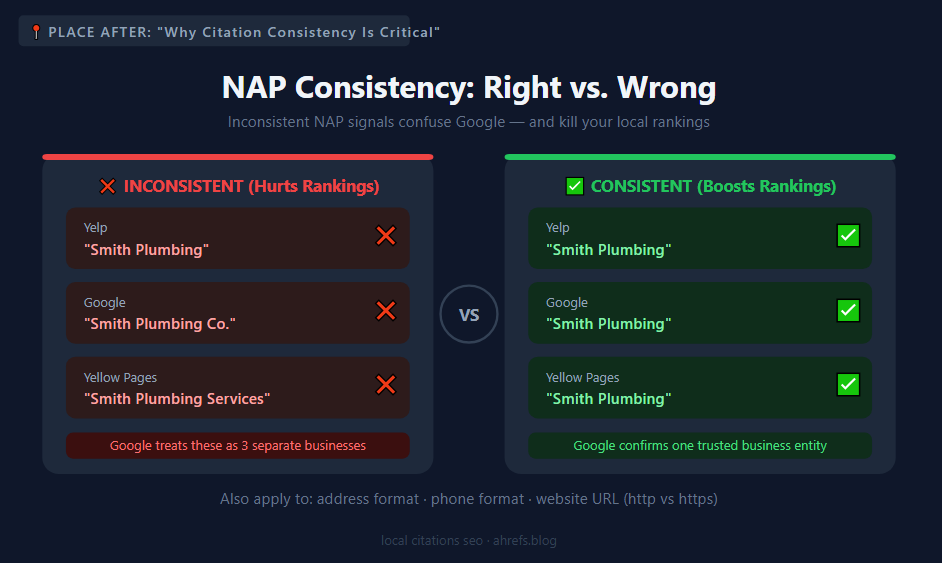
Your business appears as:
- “Smith Plumbing” at Yelp
- “Smith Plumbing Co.” at Google
- “Smith Plumbing Services” at Yellow Pages
In essence, Google considers this to be three separate entities. And this could ruin your local rankings since Google cannot conclusively consider all these NAPs to represent one entity.
Consistency Must Extend To
- Company name: The same exact company name in all locations (including abbreviations)
- Address: Same format, same abbreviations (St. vs Street, Ave. vs Avenue)
- Phone number: Same format (with or without area code, with or without hyphens/dots)
- Website URL: Same URL including whether http or https; www or non-www
How Citations Affect Local Rankings
The Google local algorithm ranking takes into consideration mainly three things:
- Relevance: Relevance between your business and the search query
- Distance: Distance from you to the person searching for something near him/her
- Prominence: Prominence of your business
Citations are mainly linked to Prominence. If a business can attain consistency and completeness in its citations, this means that it has high prominence. Conversely, a business lacking consistency in its citations means the contrary.
There is substantial research on the relationship between citation number and Local Pack Rankings. Businesses ranked among the top 3 slots of the Local Pack tend to have more citations than businesses not in the pack.
How to Build Local Citations
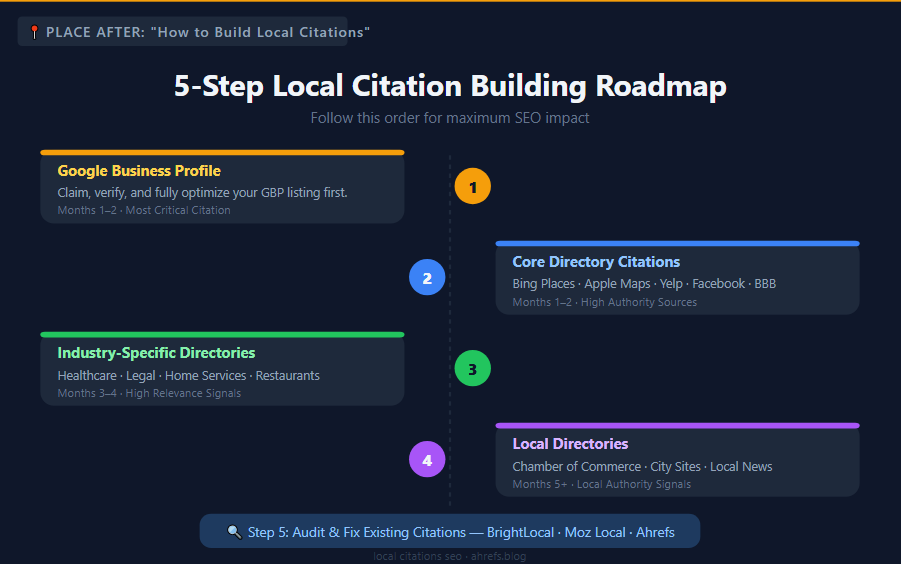
Step 1: Claim and Optimize Google Business Profile
Your Google Business Profile is the key citation, and without this, your profile will not be included in the Local Pack.
GBP Optimization Checklist
- Fill out all information on this platform, such as the company’s name, category, description, services offered, operating hours, and attributes.
- Upload high-quality images for both interior/exterior shots, employees, and products/services.
- Pick the most appropriate and precise primary category.
- Put your website URL in your profile.
- Answer all reviews, both positive and negative.
- Post updates through the posts option.
Step 2: Build Core Directory Citations
After your Google Business Profile, you can move on to other directories, the top general directories being the authority citations.
Priority 1 (Essential)
- Bing Places for Business
- Apple Maps via Apple Maps Connect
- Yelp for Business
- Facebook Business Page
- Better Business Bureau
Priority 2 (Important)
- Yellow Pages (yp.com)
- Foursquare
- Mapquest
- Manta
- Superpages
Step 3: Build Industry-Specific Citations
Following the core directories, create citations on citation sites which are specifically suited for your industry. Such citation sites offer very relevant signals.
Examples by Industry
Healthcare:
- Healthgrades
- Zocdoc
- WebMD
- Vitals
Legal:
- Avvo
- FindLaw
- Justia
- Martindale
Home Services:
- Angi
- HomeAdvisor
- Houzz
- Thumbtack
Restaurants:
- TripAdvisor
- OpenTable
- Zomato
Automotive:
- CarGurus
- Edmunds
- AutoTrader
Step 4: Build Local Citations
Create citations on relevant websites based on location:
- Your local Chamber of Commerce
- Local business organizations
- City or municipality websites
- Local news media
- Local events websites
Step 5: Audit and Fix Existing Citations
Before creating new citations, address any inconsistencies in existing citations.
Tools for Citation Audits
- Ahrefs Site Explorer: See who is linking to you (some backlinks will be citations)
- BrightLocal Citation Tracker: Search for and manage citations in bulk
- Moz Local: Track citations and inconsistencies
Whenever you come across an inaccurate citation, reach out to the directory to make the necessary correction, or utilize the tools provided by the directory for business owners.
Citation Velocity: How Fast to Build
Do not acquire citations rapidly, because getting a hundred citations within a day would look very artificial.
A Natural Citation Building Pace
- Months 1-2 – Core directories and GBP optimization
- Months 3-4 – Niche-specific directories
- Months 5+ – Local directories
Citations vs. Backlinks: What’s the Difference?
Backlinks refer to the hyperlinks on other websites linking to your website. Citations do not necessarily contain links.
An example of a citation that is also a backlink would be a Yelp listing which contains a link to your website. An example of a citation without a backlink would be mentioning your address in a forum.
For Local SEO, Both Matter
- A citation denotes a legitimate and prominent business to Google
- Local citations from local directories denote authority and relevancy
An ideal process for building citations should lead to the creation of backlinks locally. As you reach out to local directories and organizations, make sure you include your website.
Tracking and Maintaining Your Citations
Citation building is a continuous activity that is never complete. The reasons for this include businesses moving, changing their phone numbers, re-branding, and expanding.
Systems for Ongoing Citation Management
- Use citation management tools (BrightLocal, Yext, or Semrush Listing Management) to make changes in all citations at once from a single dashboard
- Set up an audit of your top 10-15 citation sources every quarter
- Monitor Google Business Profile regularly; suggested edits made by users can alter your listing without you even knowing about it
Conclusion
Local citations are the backbone of local SEO – not exactly the glamorous side of it, but without them, your local SEO efforts will be hamstrung from the start.
Start with optimizing Google Business Profile, and then gradually expand into other key directory citations, industry-specific listings, and local directories. Address discrepancies, rather than just creating more listings. And keep everything accurate as your business changes.
The brands ranking at the top of Google’s Local Pack have already done their homework in this area. So that is what you are shooting for.