IT Sales Lead Generation: How Tech Companies Fill Their Pipeline

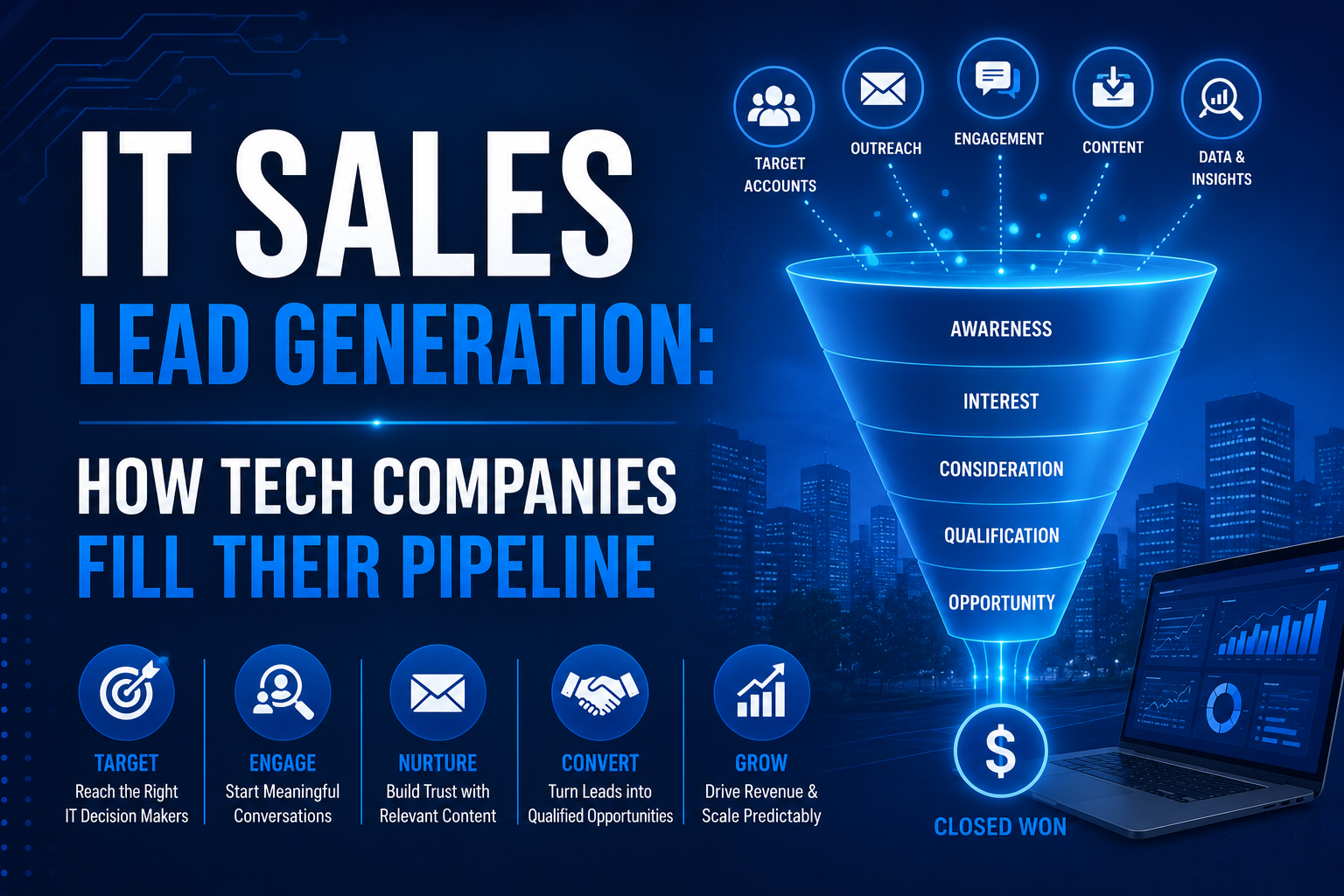
Selling IT products and services, managed services, software, cyber security, cloud services, involves a much longer and more technical sales process compared to other B2B verticals. Prospects will have done their homework before they even speak with you, committees will be large, and cycles can be lengthy. It means that “lead generation” has to change.
Why IT Sales Lead Generation Needs a Different Approach
IT buys are not typically impulsive. The prospect of assessing an alternative MSP service or cybersecurity solution is vetting vendors, researching, and often bringing IT, finance, and legal into the equation before any deal is sealed.
This means the traditional lead generation approaches suited to the impulse purchase of consumer goods will usually fall flat. Instead, the key lies in establishing credibility upfront and sustaining visibility throughout the extended consideration period.
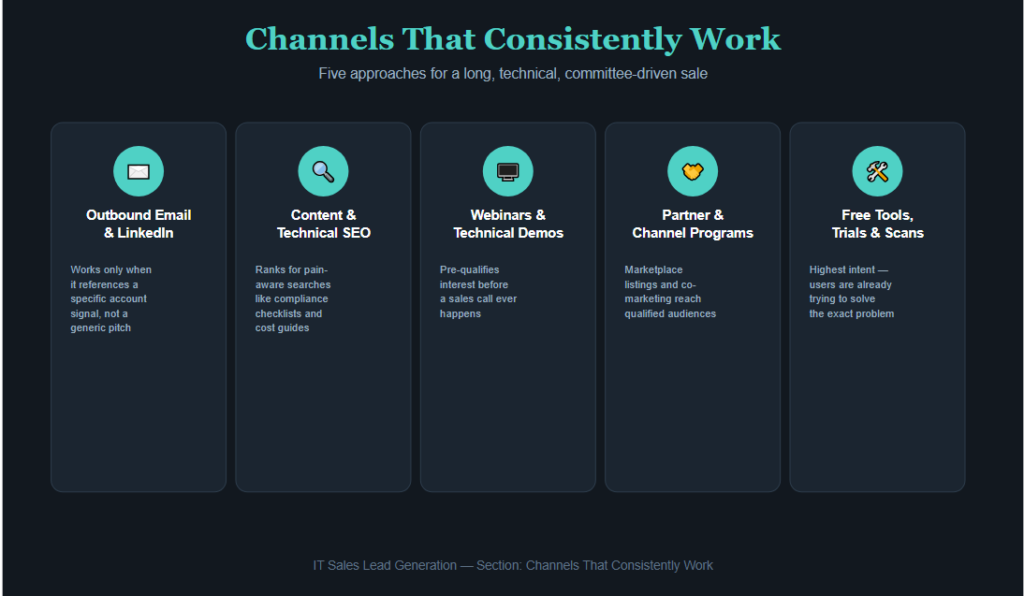
Channels That Consistently Work for IT Sales
Outbound Email and LinkedIn Outreach
Cold outreach in IT sales can work when done appropriately.
The gap between spam and a successful process is the relevance of mentioning either the technology stack, recently raised financing, a compliance issue that is being experienced by the potential client, or an issue within the specific industry.
E-mails asking for a “quick question” are never read; only those referring to something specific about the account get responses.
Content Marketing and Technical SEO
IT buyers search on their pain before searching on vendors, “how to lower cloud expenses,” “SOC 2 compliance checklist,” “best RMM software for MSPs.”
Being found for these bottom-of-the-funnel, pain-aware keywords positions your brand with IT buyers who are assessing potential solutions, for a small fraction of what it costs to advertise on Google.
Webinars and Technical Demos
Buyers need convincing before they will commit time for a sales presentation.
Webinars, particularly those that show how something solves a problem, lead to prospects that have already been pre-qualified for their interest and are farther down the road than usual prospects.
Partner and Channel Programs
The vast majority of IT lead gen opportunities, particularly for managed service providers and infrastructure solutions providers, are actually partner leads that don’t involve any traditional marketing.
Listing on your partner’s marketplaces and co-marketing campaigns with complementary vendors (such as a security application paired with a cloud vendor, for example) gives you access to a qualified audience.
Free Tools, Trials, and Assessments
Free network security scanning, cloud cost analysis and trials for a limited period of time are much more effective than almost any kind of gated content, since you allow your prospects to verify value themselves before even talking to your salespeople.
It is one of the most intent-based sources of leads in IT sales; those people who use your free assessment tool are trying to solve the same issue you provide solutions for.
Qualifying Leads Before They Hit Sales
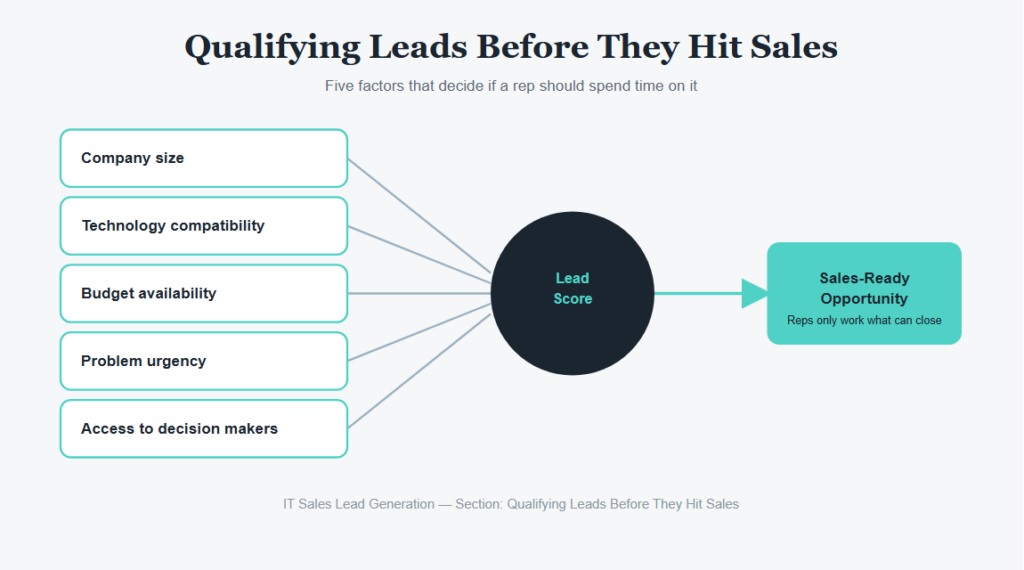
IT sales processes are costly to execute, and that is why qualifying leads is more important in IT than in other industries.
The fundamental scoring system can be based on:
- Size of the company
- Technology compatibility
- Budget availability
- Problem urgency
- Access to decision makers
That way, reps do not end up pursuing opportunities which were never meant to materialize into conversions.
In many instances, sales organizations within the IT field have an SDR role simply for qualifying leads that come in, because bad leads could cost a rep weeks of their time in the sales cycle.
Account-Based Marketing for Larger Deals
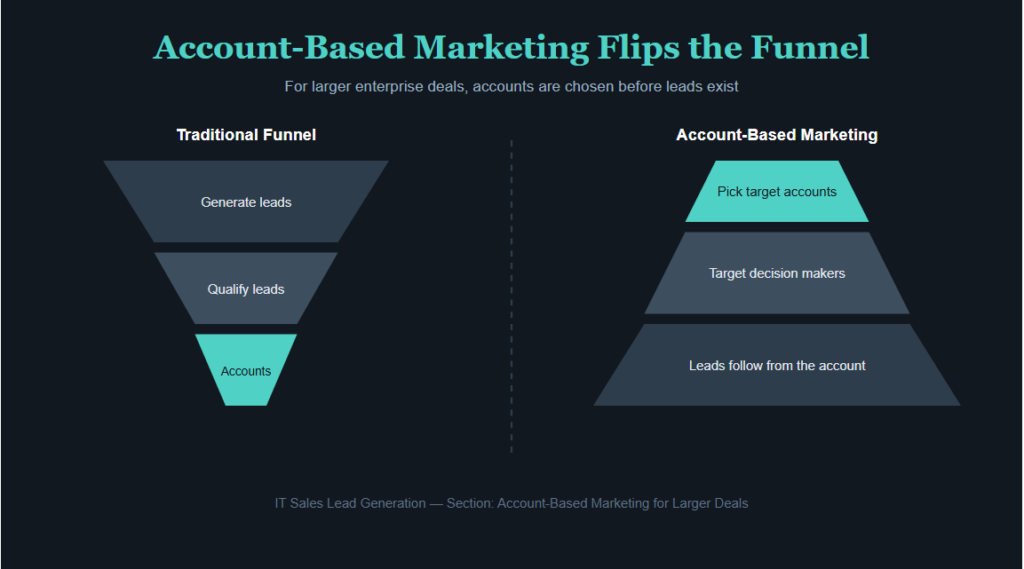
Where the sale of IT products is more expensive, such as enterprise infrastructure and large-scale managed service deals, wide-scale lead generation becomes less common in favor of account-based marketing.
The process includes:
- Developing a list of potential accounts initially
- Doing marketing campaigns that are targeted towards decision makers in these accounts
This turns the traditional lead generation funnel around, as opposed to generating leads and qualifying them to be accounts, accounts are chosen first before generating leads.
Measuring What Actually Matters
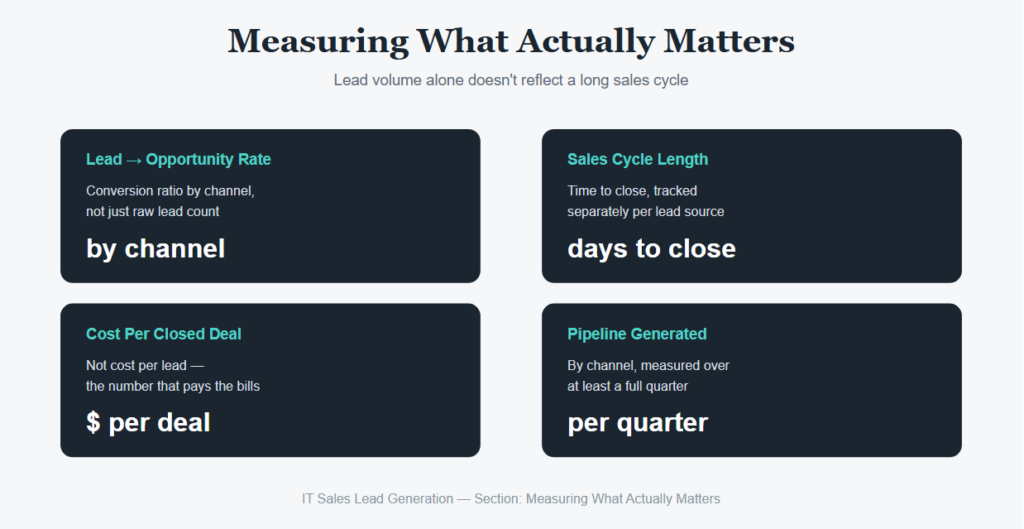
Since IT sales cycles are lengthy, lead volume alone does not reflect reality.
Other important measurements are:
- Conversion ratio of leads to opportunities via channel
- Length of sales cycle based on the lead generation channel
- Closing costs, rather than cost per lead
- Pipeline generated through channel for at least a quarter
Bottom Line
In IT sales lead generation, credibility is more important than quantity.
The firms that create consistent lead streams manage to merge the organic stream (content marketing, SEO, and free tools), which can capture buyers already doing their own research on the solution, with outbound streams, and they give themselves enough time to analyze the results.