What Is Project Scope Management? A Plain-English Guide

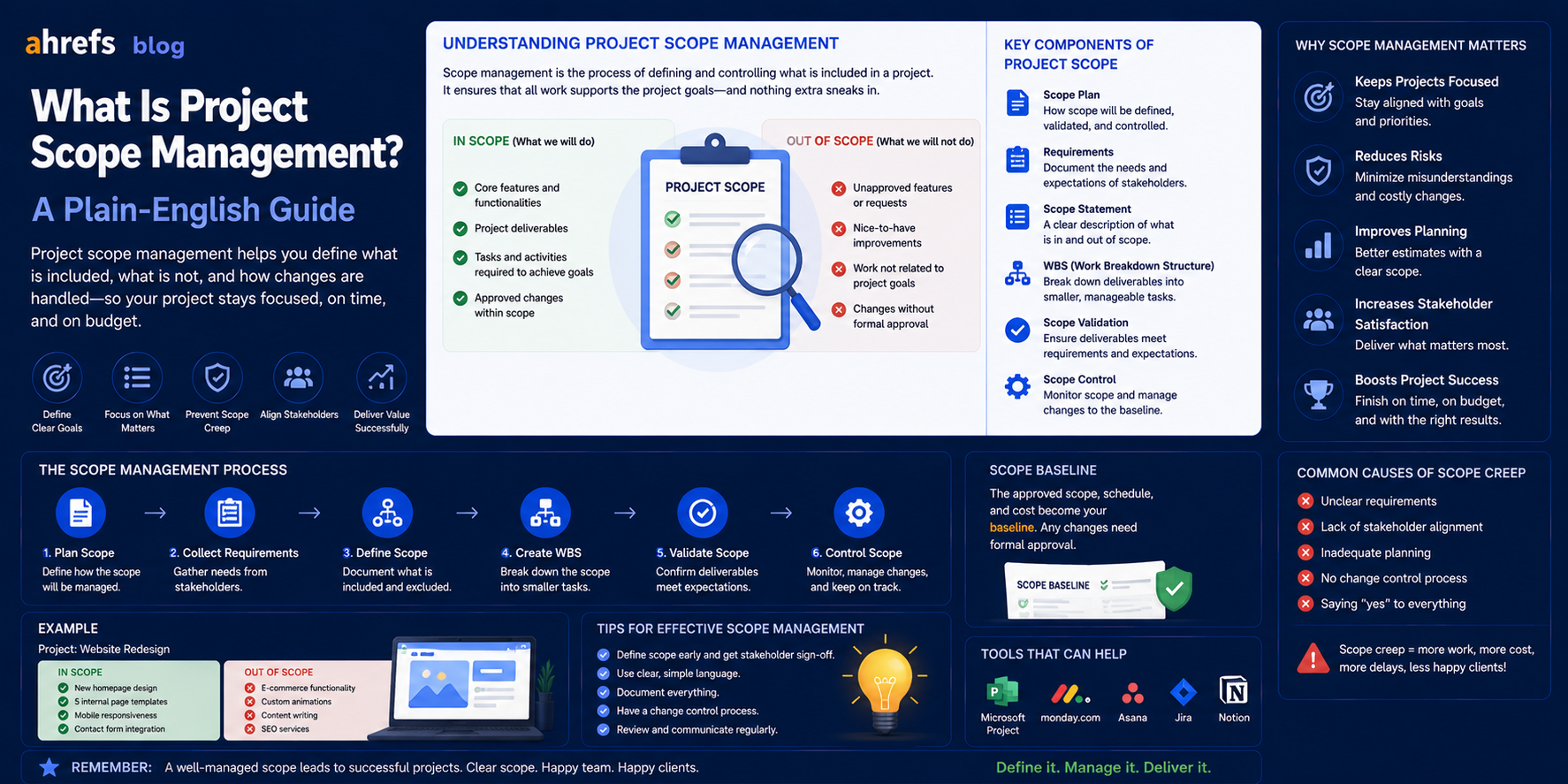
“Scope creep,” and not poor execution, inadequate budgets, nor technological failure, is the main reason why projects overrun. The scope of projects increases because the scope itself was never clearly identified in order to protect it. The scope of project management is how you avoid that. Here is an overview.
Table of Contents
- What Is Project Scope?
- What Is Project Scope Management?
- The 6 Processes of Scope Management
- Scope Creep: What It Is and How to Avoid It
- Scope Management in Various Methodologies
- Tools for Scope Management
- Conclusions
What Is Project Scope?
Scope of project is about the project boundaries, which include and exclude.
Well scoped project provides answers to such questions as:
- Which deliverables should be produced by the project?
- What work will be needed for their production?
- What is definitely out of scope of this project?
- What quality requirements should be met?
Scope is not an objective itself (“to launch the new website”), it is a particular list of deliverables and work needed to be done.
What Is Project Scope Management?
The scope management process of a project is defined as the process group utilized in defining, documenting, controlling, and officially agreeing on the scope of a particular project. Scope management is one of the ten knowledge areas within the PMI PMBOK framework.
This is not about being inflexible; it is about making sure that everyone, including the project team, client, and all the stakeholders, is clear about the scope of the project and what it does and doesn’t include.
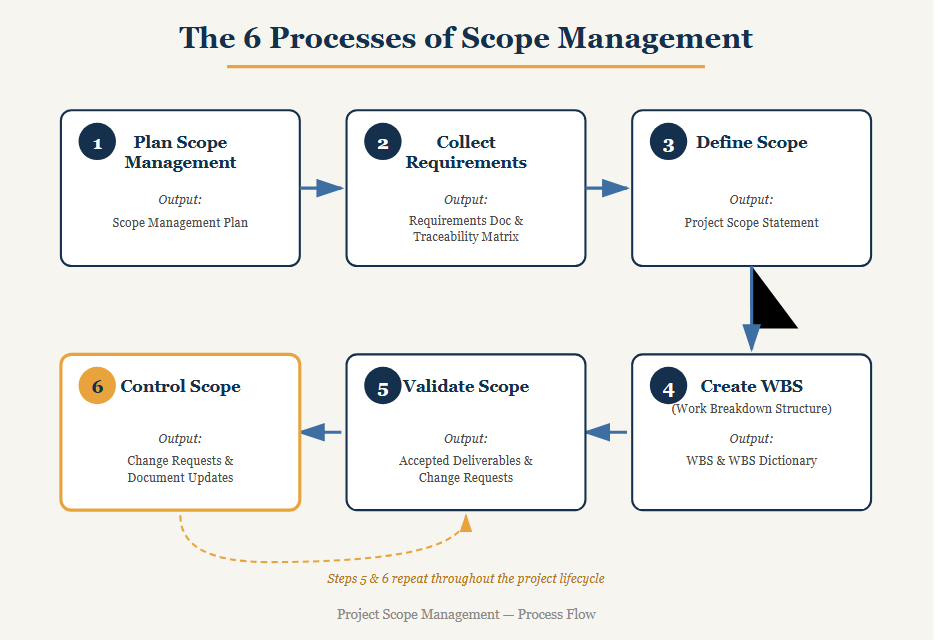
The 6 Processes of Scope Management
1. Plan Scope Management
State your methodology in defining scope, validating scope and controlling scope for this particular project.
Output:
- Scope Management Plan
2. Collect Requirements
Obtain thorough stakeholder requirements by conducting interviews, workshops, surveys or documentation reviews. Requirements are the basis of scope; vague requirements lead directly to scope issues down the line.
Output:
- Requirements Documentation
- Requirements Traceability Matrix
3. Define Scope
Take the requirements and turn them into a Project Scope Statement, which is a detailed written specification of the project, what it will deliver, any assumptions or limitations, and things that it won’t cover.
Output:
- Project Scope Statement
4. Create WBS (Work Breakdown Structure)
Break down the project scope into manageable units of work. The WBS does not show timing or sequencing; it shows all the work that needs to get done. Each deliverable in the scope statement must be shown on the WBS.
Output:
- Work Breakdown Structure
- WBS Dictionary
5. Validate Scope
The official process of validating the deliverables phase-by-phase, as opposed to just once at the end. This way, it avoids the shock effect when delivering the finished product.
Output:
- Accepted deliverables
- Change requests
6. Control Scope
Project Management involves overseeing all changes to the set scope during the whole process of the project. Any change in the scope must be dealt with using an Integrated Change Control process and not an informal discussion of “can you just do this?”.
Output:
- Change requests
- Updates to project documents
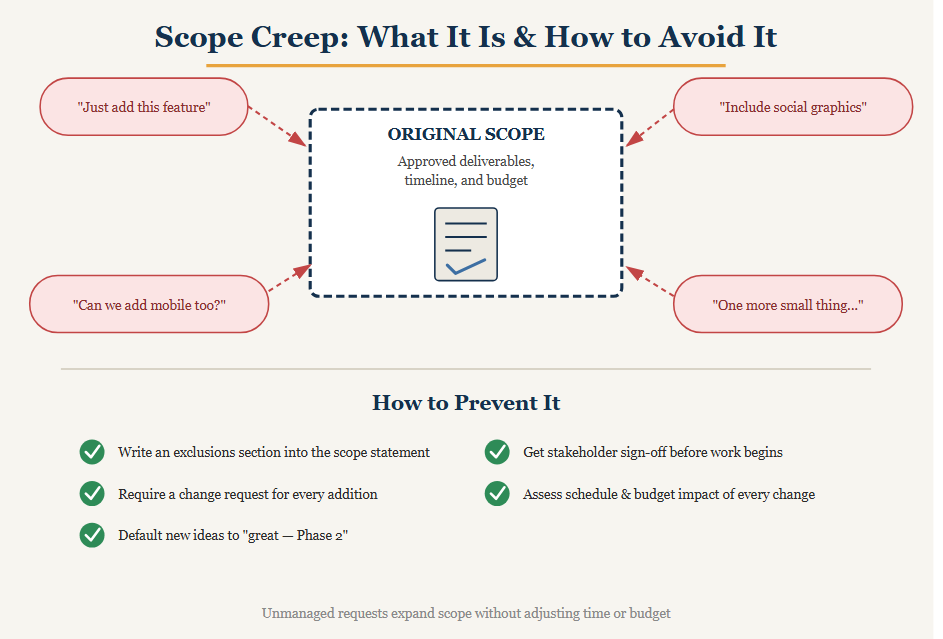
Scope Creep: What It Is and How to Prevent It
Scope Creep is an increase in the scope of a project without adjusting the schedule or budget of that project. It is the process of “just add this feature”, “can we include the mobile version as well” and “this includes social media graphics”.
How to Prevent It
- Create a scope statement including an exclusions section prior to starting work.
- Utilize a change request process whereby every scope inclusion is followed by an assessment of impact on schedule and budget.
- Turn “that’s a great idea but for Phase 2” into an automatic response.
- Obtain stakeholder approval for the scope statement prior to doing any work.
Scope Management in Different Methodologies
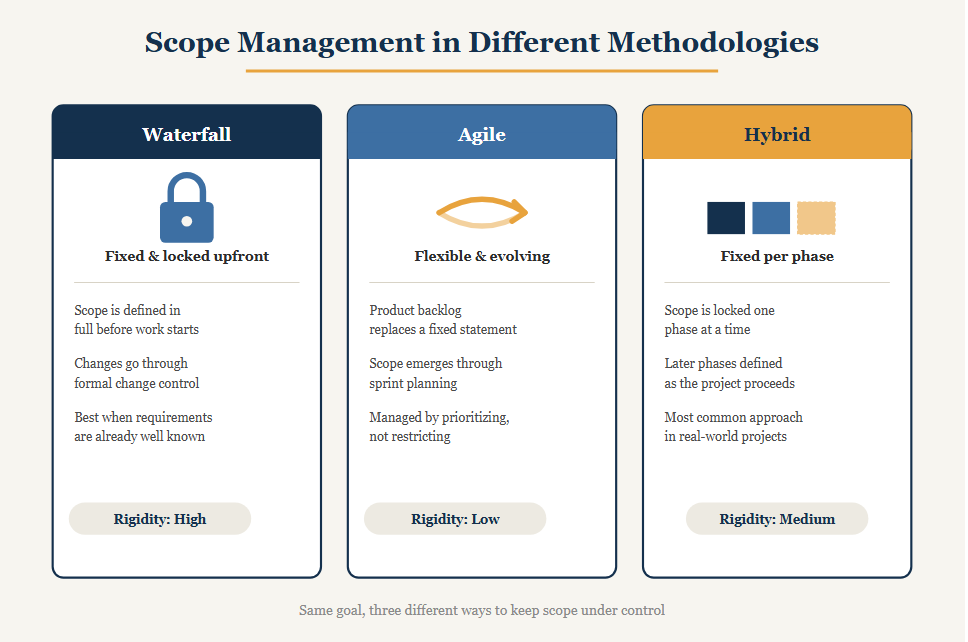
Waterfall / Traditional PM
The scope is well-defined at the outset and kept under tight control. Any changes are handled formally. Effective if the requirements are well-known before starting the project.
Agile
The scope is intentionally kept flexible. The product backlog substitutes for a scope statement and scope emerges via the sprint planning process. Scope management is done by prioritization and not restriction.
Hybrid Approaches
Most projects in real life define the scope by project phases, fixed scope in each phase, but the later phases are known as the project proceeds.
Tools That Support Scope Management
Scope Statement Templates
Structured documentation that includes deliverables, exclusions, assumptions, and acceptance criteria.
WBS Software
Use of Lucidchart, MindMeister or a WBS tool to visualize decomposition.
Change Request Logs
A basic tracking mechanism (even in Excel) that records all the changes in scope requested and impact assessment.
Requirements Management Tools
Jira, Confluence, or custom software for risk management if the project is complex and involves lots of people.
Final Thoughts
Scope management isn’t as much about writing reports as making sure everyone’s aligned. The scope statement, WBS, and change management procedures are all means to make sure that everyone understands what’s being built and that any changes in the build are intentional and not accidental results of numerous informal requests. Define the scope, get it approved, and control changes officially.